Poetry Inside Out In My Newcomers Classroom
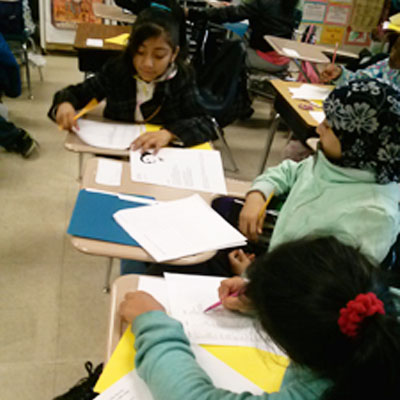
For my Newcomer students, Poetry Inside Out was intimidating, challenging, and risky. And yet it was a challenge that they were not afraid to take on. If you can walk from El Salvador or Honduras to the United States, translating a poem or learning a language is nothing. As we all witnessed, the risk that one takes when reading an unfamiliar language, translating it, and creating a new poem builds a wealth of knowledge and a deeper understanding of language.
I first introduced Poetry Inside Out to a small group of eight 8th graders–four from my Newcomer program and four who were proficient English speakers. While reciting the poems was fun, the discussions were minimal and the translation process seemed very formulaic: find the word; translate the word; write the new word. Was I doing something wrong? Then I realized what needed to be done. The process in general was a challenge, but we had to challenge each other, asking questions like “Why do you think that?” or else just plain disagreeing. These were teenagers; they needed conflict.
Once testing week came around I had smaller classes and the experiment began. What if we went from Japanese to English to Spanish? Students used Google Translate and searched for images on their phones in order to identify the synonyms they wanted to use for their double translations. Students spoke in their native languages to develop a deeper understanding. Students with a deeper knowledge of English helped those with less. At times they were vexed. “No this makes no sense in Spanish,” Kevin cried one day. I realized that their previous exposure to poetry was minimal. They struggled to understand that a poet might skew the rules of sense and grammar in order to communicate meaning.
I decided that all my students needed to have this experience and, I asked myself, what better time than the end of the year? While introducing the poem to the group, I initially focused on the process of translation. Some students seemed bewildered. They couldn’t quite grasp how to use the Translator’s Glossary, which gives definitions and possible synonyms for each word, and were more comfortable using Google Translate on their phones. One thing did resonate with the whole class: the joy of reading poetry in another language. The Ethiopian students read Spanish, Salvadorans read Vietnamese, and everyone gave German (my favorite) a try. Participation was growing through the roof.
Students were excited, and it wasn’t until watching a video of my class doing a translation that I realized Jefferson wasn’t off topic when talking to Kevin; he was expressing his excitement for the language we were translating that day. There was something about Poetry Inside Out that went beyond the uncreative, thoughtless, point-and-say curriculum that programs like mine have unfortunately adopted.
Excitement drives me forward and keeps me thinking about my theoretical questions. I began with some doubts because of my students’ language limitations, disrupted educations, and their general placement in schools as “others.” But what I did next surprised me: I dove in, I tried, I failed sometimes, but mostly I succeeded. Poetry Inside Out made me reflect on what I wanted my classroom to be: a place for students to learn and love language. Building basic English is important, but it has to be connected to something meaningful. Poetry Inside Out made me feel like we were doing just that.
Help us raise the funds we need to keep Poetry Inside Out in Oakland classrooms next school year! Your donation of any amount gives students the chance to experience the program.