CAT Book Club: Who Is Madame Nielsen?
Have you started reading The Endless Summer(opens in a new tab) yet?
Remember, we’re hosting the book’s author, Madame Nielsen, at Green Apple Books on the Park this Thursday, where she’ll be in conversation with Scott Esposito. If you haven’t started the book yet, don’t worry—you’ll be able to get a copy at Thursday’s event!
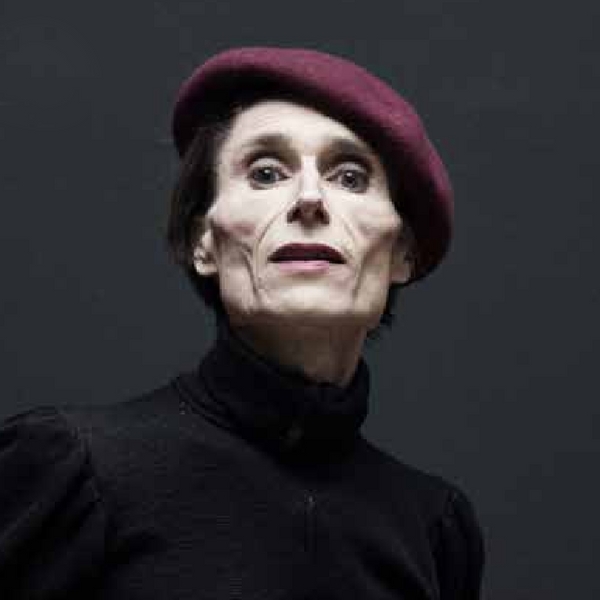
In the meantime, take a moment to get to know Madame Nielsen and her work. She is a novelist, poet, actor, and musician, as well as one of Denmark’s most daring artist.
Madame Nielsen was born Claus Beck-Nielsen in 1963. In 2001, Claus Beck-Nielsen declared himself dead and became a man without an identity. Still, people continued to refer to the man as Claus Beck-Nielsen, so nearly a decade after “dying” he decided to hold a funeral for Claus Beck-Nielsen.
In 2010, the nameless man and Sophie Calle learned that they both had ideas involving self-burial, so the two artists met to discuss their funerals!(opens in a new tab) In 2011, an effigy of Claus Beck-Nielsen was buried.
Some of the nameless man’s most striking lines from his conversation with Calle:
“I would prefer my funeral not to be unique.”
“[The ideas is] to see if it would be possible to live a human life also beyond national identities and personal identities…so it’s a very utopian thing.”
“Even though [Claus Beck-Nielsen] was declared dead, he keeps haunting my work.”

Read this insightful interview(opens in a new tab) Madame Nielsen gave during the summer of 2017. She raises several interesting issues regarding identity, art and literature, and language.
An excerpt on identity and influence:
I want to think of the human being as a potential, and instead of becoming “the one I really am” or that one I want to be, I’ll try to live as many different aspects of these potentials I have. I will stay Madame Nielsen as long as she’s producing things I’m interested in. My writing—The Endless Summer, The Invasion, and The Supreme Being—has changed completely for me with this identity change and these three recent novels are very different from the things I wrote before. I’ve always loved the French writers—Flaubert, Proust, Rimbaud, Stendhal, Claude Simon, Patrick Modiano, Marguerite Duras, Koltés, and Celine—so I think they influenced me from the way I conceive the sentence to questions of love and memory. My body is getting older, so I have more and more past to host in. I became more reflective and more Proustian in a sense.
And on inhabiting a space between genres and languages:
The ideal would be to be a world citizen able to speak all languages. I can’t separate the dimensions of my work, so I can’t say that I’m a novelist, or a poet; I’m not even an artist, I’m just someone who does all sorts of things. In general I write in Danish, but in my poetry, I like also to open the space for many languages. I also wrote a novel that is a mix of German and Danish, it’s a linguistic hybrid.
Linguistic hybrid? We would love to read a translation of that book!!
We’ll see you Thursday at 7:30 pm Green Apple Books on the Park.