Two Stories of Jinpa: An Interview with Pema Tseden
I was first introduced to Pema Tseden’s short stories as a student in Lhasa almost a decade ago. Reading his novella Grong khyer gyi ‘tsho ba [City life] in my modern literature class I couldn’t help thinking it read like a film script. Last year we had a conversation about his award-winning film Jinpa, and his collaboration with the Tibetan writer Tsering Norbu. Jinpa premiered at the 2018 Venice Film Festival and was awarded the Orizzonti Award for Best Screenplay.
—Riga Shakya
Riga Shakya: Some readers might be aware that a number of your films have been adapted from your own short stories. Jinpa is a little different in that the script was adapted from two short stories: “I Killed a Sheep” (Zhuang si le yi zhi yang), one of your own stories, and “The Killer” (Sha shou) written by Tsering Norbu. Could you speak a little about the process of adaptation and the relationship between the stories and the film?
Pema Tseden: I read Tsering Norbu’s short story “The Killer,” thought it could be adapted into a film, and began to adapt it. During the process, I realized the story was a little short and lacked the necessary depth. I thought of my own short story “I Killed a Sheep,” and decided to knead together the two stories to complete the script. The two pieces work well together. They both tell stories that happened on the road and reflect Buddhist concepts such as charity, liberation of animals, and redemption.
RS: Tsering Norbu is a well-known Tibetan writer. Were you familiar with his work beforehand and what input did he have during your collaboration?
PT: We have known each since very early on and we both have a good understanding of each other’s works. As for our collaboration, I first had to obtain his consent, and only then began to adapt. Tsering Norbu didn’t play a large role during the process. Occasionally, I would discuss some details with him, including the specific location of some of the settings in the story and their spellings in Tibetan.
RS: Reading both stories, I found the similarities in subject, narrative, and character remarkable. Both your stories are about long-distance truckers driving through a frontier landscape. Many films of the Tibetan new wave can arguably be characterised as road films. Why do you think you were both compelled to this subject?
PT: As writers, both of us have written many different kinds of works, but this particular kind of story just seems to develop on the road, and as you mention, there are similarities in structure and so on. With regards to the adaptation, I just selected two short stories that could complement each other and put them together organically. There was no coincidence.
RS: Portrayals of the Tibetan plateau in magical realist Sinophone literature and cinema have drawn the ire of some critics, for example Zhang Yang’s adaptation of the Tibetan writer Tashi Dawa, the 2016 film Soul on a String (Pi sheng shang de hun). What are your thoughts on magical realism?
PT: I don’t think there is a need to redefine magic realism (for the Tibetan context). What we term magical realist literature must bear the marks of a certain region’s historical culture or folk customs, so there are naturally distinctions between the Latin American magical realism literature and the Tibetan context. The historical culture or folk customs of these regions themselves contain things that may be full of magic in the eyes of outsiders, but to the indigenous they might not be magical at all.
RS: A recurrent motif in both your work is the double. For the Western reader, we might trace the trope to Dostoevsky’s The Double. The concept of the doppelgänger continues to be popular in contemporary world literature. In the film, one notable change you make is to have both the characters called Jinpa.
PT: In the film, the character Jinpa has multiple aspects to him, including that of the double. Some viewers have understood him as a dream. I think what he represents is open, and each member of the audience can have their own interpretation. In order to strengthen this feeling of ambiguity, we not only gave the two protagonists in the film the same name but also emphasized this through composition and other methods.
RS: Many of your protagonists are men of few words, who are struggling with issues such as impotency or depression amidst huge social and economic transition on the Tibetan plateau. We might say this is indicative of the tensions between traditional notions of masculinity and modernity. Jinpa is very typical of one of your protagonists, and the actor who plays him—also named Jinpa—is somebody you worked with in your recent film Balloon (2019). Can you talk about the idea of masculinity in your work?
PT: The men in my films actually show different personalities or character traits because of their own personalities, different time periods and regions. I follow these basic principles to shape each different character, so that they have a different so-called Tibetan masculinity.
RS: In a recent discussion, several young Tibetan writers bemoaned the lack of innovation in contemporary Tibetan literature. Your early films had a very distinctive naturalistic, almost documentary style, but from Tharlo (2016) onward I notice you are experimenting more aesthetically. Jinpa was a collaboration with Wong Kar Wai, whose films are known for their sensuous aesthetics. Would you share your thoughts on aesthetic style?
PT: As a professional director, I usually have several projects running at once. Generally, I prepare two or three scripts at the same time. I shoot the first project I can get investment for, so there is no continuity and regularity in creation. I will look for different forms of expression according to different themes. For example, “I Killed a Sheep” is a rather abstract story, and it is impossible to shoot it in a very realistic way.
Read Tsering Norbu’s “The Killer” translated by Riga Shakya.
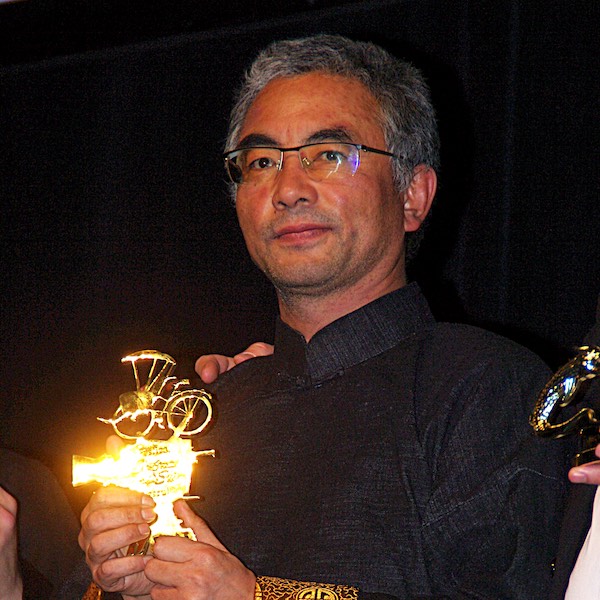
Image of Pema Tseden by Christophe Delorme, Creative Commons License.
Riga Shakya translates contemporary and classical Tibetan literature. He is a PhD candidate in late Imperial Chinese and Tibetan history at the Department of East Asian Languages and Cultures (EALAC) at Columbia University, where he is finishing a dissertation on the role of Tibetan life writing and poetry in Qing imperial expansion into Inner Asia in the 18th century.
Pema Tseden was born in 1969 in Amdo, in the Tibetan region of Qinghai Province. He is widely recognized as the leading filmmaker of a newly emerging Tibetan cinema and the first director in China to film his movies entirely in the Tibetan language. Tseden has published more than fifty short stories and novels both in Tibetan and Chinese. His work has won numerous awards including the Drangchar (sbrang char) Tibetan Literature Prize and has been translated into English, French, and German. Since beginning his film career in 2002, Tseden has created a highly acclaimed body of work. Tseden is Chairman of the Directors Association of China; he is also a member of the Filmmakers and Literary Societies of China.