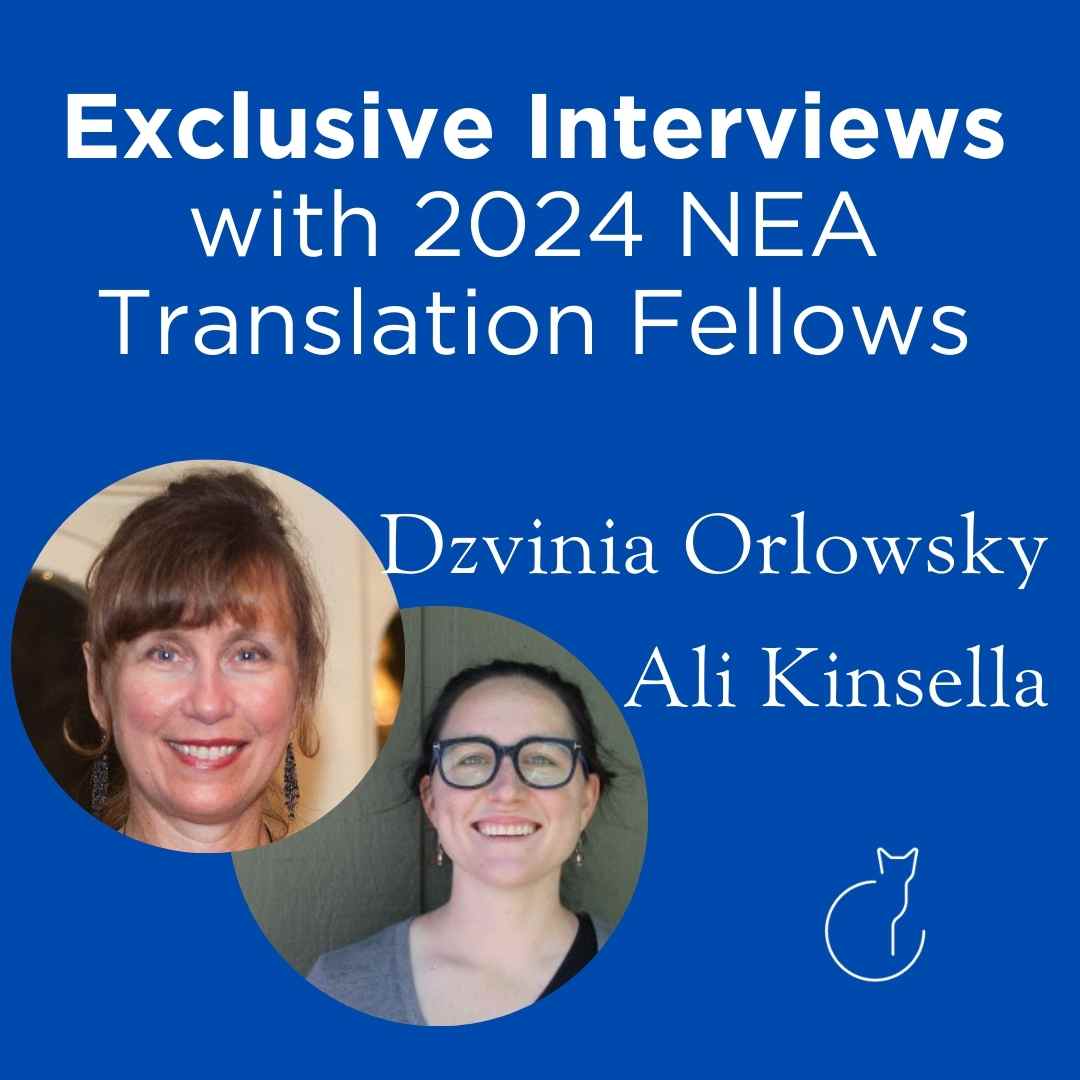
Exclusive Interviews with the NEA Translation Fellows: Ali Kinsella & Dzvinia Orlowsky
Tell us a little about your project. What drew you to the work you’re currently translating—themes, style, the author’s insight?
ALI KINSELLA:
Not long after we finished working on Natalka Bilotserkivets’s poetry for Eccentric Days of Hope and Sorrow, we started trying out other Ukrainian poets, firstly for a folio of Mom Egg Review called MER Vox: Ukrainian Voices(opens in a new tab). That came out in December of 2021, so when Russia escalated the war with its full-scale invasion only two months later, Dzvinia and I knew that we needed to keep up our “fight” on the cultural front, and Halyna seemed like the obvious place to start.
Interestingly, the poems that will comprise Lost in Living have never been published in Ukrainian. Kruk’s last collection came out in 2017; when we first reached out to her, she sent me a file with over a hundred poems she had written since then but not yet published. The war in Ukraine has been going on since 2014, so in that sense they are all war poems, even if they are not all post-2022. Several of the more recent ones have been “published” on social media, as the urgency of the situation leads many Ukrainian writers, including Kruk, to ignore traditional publishing routes, at least for now. For this reason, the shape of the collection has been evolving.
DZVINIA ORLOWSKY:
In March 2022, Grace Mahoney, editor for the Lost Horse Press Contemporary Ukrainian Poetry Series, invited Ali and me to co-translate a second volume for the series. Encouraged by our progress on Halyna’s work, our goal was to complete a book-length project either based on an existing unpublished manuscript or as a “selected” collection. Halyna sent us a significant number of more recent, unpublished poems, many composed during “war-time peace”—before Russia’s devastating invasion on February 24, 2022.
The poems of Lost in Living encompass all facets of life: childhood, love, aging, faith or failing faith. They highlight the crucial role of poetry not only in times of peace (though I hesitate to use that word), but also emphasize its return to fundamental purposes during war—bearing witness, preserving memories of events and the deceased, and attesting to resilience.
How did you begin your foray into the translation community? What authors and translators (or personal relations!) inspired your early interests in global literature?
ALI KINSELLA:
I began translating somewhat accidentally after I had learned Ukrainian pretty well as a Peace Corps volunteer in Western Ukraine. I was living in New York and a friend asked me to edit an essay he had translated. At that point, I realized I was much more interested in doing the translation myself than the editing—true to this day, as I am forever starting projects and rarely following them all the way through to completion!
As a younger reader, I was enamored of South American writers and especially magical realism. I studied Spanish in high school and college, so I think somewhere in the back of my mind there was an idea or a hope that I could become proficient enough to be able to translate myself. But for a very long time reading them in the original was beyond me. Weirdly the grammar-translation approach didn’t endow me with the flexibility needed to truly master a language or the confidence to approach authentic sources without knowing every single word.
DZVINIA ORLOWSKY:
As an undergrad, my first poetry translation workshop left me with a slim portfolio. Fluent in a hybrid Ukrainian influenced by Polish, I felt lost and intimidated because no one knew what Ukrainian meant. There was a common assumption that I was trying to translate Russian. This misunderstanding, combined with the poems by Ukrainian poets I had encountered while growing up—mostly learned on Saturdays during weekend Ukrainian School—revealed that they were often anthems for national sentiment or conveyed a longing to find one’s way home. From my maternal grandmother, I inherited a profound sense of “otherness,” of displacement and exile. But this “otherness” was also very abstract and, for the most part, intangible to me. As a young student of translation, I felt I was merely voicing in a simplistic way rather than authentically expressing anything.
At Oberlin College, I formed lifelong connections with Franz Wright and Bruce Weigl, deepening my appreciation for lyrically intense poetry. Wright’s translations of Rilke and René Char were pivotal, emphasizing the intricate relationship between language and external phenomena. Weigl’s focus on “ordinary people in extraordinary situations” in war poems reshaped my perspective regarding war-time poetry. It removed the stigma that this poetry best served history through narrative poems about heroes and heroic actions.
Stuart Friebert, my creative writing professor and first mentor, played a crucial role in my grasping language’s nuances and its profound impact on expressing inner thoughts. Inspired by him, I ventured into translating from the Ukrainian, Natalka Bilotserkivets’s poetry, eventually gaining recognition in various publications. This experience marked the beginning of my greater involvement as a translator.
What excites you about translation—as a concept, a community, and an ever-evolving practice?
ALI KINSELLA:
For me translation is like a game. I love having to solve the puzzle of each sentence, and then also consider the puzzle of the story or the book and make them all fit together. Unfortunately, until I started working with Dzvinia, translation was kind of a lonely place for me, one without much community. I think that is beginning to change now. Perhaps this is due to an internal shift in the Ukrainian translation community, but I think it is motivated at least in part by the growing interest in the culture. Before I think we all kind of felt like we had to scrape by and get what we could where we could. Not that it was competitive—perhaps even less so—but there was no unified front we could rally behind. But I’d be lying if I said I were in it for the community. Ultimately what drives me is the satisfaction of really getting something, be it a word, sentence, a concept. I think this is probably true for all translators.
DZVINIA ORLOWSKY:
Translation challenges us to reimagine the boundaries of our more familiar communities as well as artistic expression—at best, navigating the delicate balance between fidelity and creative interpretation. More recently, however, I’ve been reconsidering not only what I translate or co-translate but also how I translate, embracing the possibility of transformation and granting existence to unique linguistic expressions in the target language. Why not transfer the perplexing punctuation or nuanced elements that make the original text compelling to the target language? What if, in our pursuit of clarity, we miss an opportunity to broaden our perceptions and invite transformative experience?
French philosopher and writer, Maurice Blanchot argues the necessity for such open-mindedness beautifully: “The poet only exists after the poem. Inspiration is not the granting of a secret or of words to someone existing; it is the granting of existence to someone who does not yet exist.” (Source: No Siege is Absolute, Versions of René Char, Franz Wright)
Are there any books or authors in translation that you would like to share?
ALI KINSELLA:
Ah, and here is where I reveal my proclivity for prose. I think a good place to start in Ukrainian literature is:
- Fieldwork in Ukrainian Sex by Oksana Zabuzhko, translated from the Ukrainian by Halyna Hryn.
- The Moskoviad by Yuri Andrukhovych, translated from the Ukrainian by Vitaly Chernetsky.
- Perverzion by Yuri Andrukhovych, translated from the Ukrainian by Michael Naydan.
- Depeche Mode by Serhiy Zhadan, translated from the Ukrainian by Myroslav Shkandrij.
- Mondegreen by Volodymyr Rafeyenko, translated from the Ukrainian by Mark Andryczyk.
- Translations from other languages I’ve loved in the past few years include:
- A True Novel by Minae Mizumura, translated from the Japanese by Julie Winters Carpenter.
- The Piano Teacher by Elfride Jelinek, translated from the German by Joachim Neugroschel.
- The Story of My Teeth by Valeria Luiselli, translated from the Spanish by Christina MacSweeney.
- The Child by Kjersti A. Skomsvold, translated from the Swedish by Martin Aitken.
- Grey Bees by Andrey Kurkov, Ukrainian but translated from the Russian by Boris Dralyuk.
- Drive Your Plow Over the Bones of the Dead by Olga Tokarczuk, translated from the Polish by Antonia Lloyd-Jones.
- Breasts and Eggs by Meiko Kawakami, translated from the Japanese by Sam Bett and David Boyd.
- The Makioka Sisters by Junichiro Tanizaki, translated from the Japanese by Edward G. Seidensticker.
- Magda Szabó, translated from the Hungarian by Len Rix, especially The Door.
- Elena Ferante, translated from the Italian by Ann Goldstein.
DZVINIA ORLOWSKY:
That’s a tough question! So many to choose from. However, in addition to those authors previously mentioned, favorite authors/books in translation would have to include:
- A world rich in anniversaries, Jean Follain, translated from the French by Mary Feeney and William Matthews.
- Extracting the Stone of Madness, Poems 1962 to 1972, Alejandra Pizarnik, translated from the Spanish by Yvette Siegert.
- Salt, Wislawa Szymborska, translated from the Polish by Stanislaw Baranczak and Clare Cavanagh.
- The Silence Afterwards, Rolf Jacobsen, translated from the Norwegian by Roger Greenwald.
- Call Yourself Alive? Nina Cassian, translated from the Romanian by Michael Impey and Brian Swann.
- Look Back, Look Ahead, Srecko Kosovel, translated from the Slovenian by Barbara Siegel Carlson.
- What We Live For, What We Die For, Serhiy Zhadan, translated from the Ukrainian by Virlana Tkacz and Wanda Phipps.
- The Voices of Babyn Yar, Marianna Kiyanovska, translated from the Ukrainian by Oksana Maksymchuk and Max Rosochinsky.
- Words for War: New Writing from Ukraine, various authors and translators, translated from the Ukrainian, editors, Oksana Maksymchuk and Max Rosochinsky.
- The Slow Horizon That Breathes, Dimitra Kotoula, translated from the Greek by Maria Nazos.
Giovanna Lomanto is a poet and essayist with a tendency to play the same song on repeat until she has memorized every last note. She received her BA in English at U.C. Berkeley and finished her MFA at NYU, during which time she published two poetry collections and two mixed media chapbooks.