My Negritude is… What Exactly?
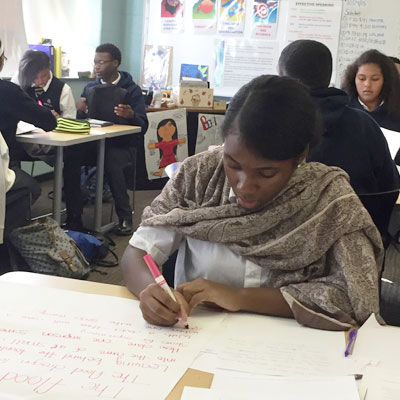
“My negritude is not a stone / nor a deafness flung against the clamor of the day,” reads one translation of Martinique poet Aimé Césaire’s famous Cahier d’un retour au pays natal (or Return to My Native Land). The 7th graders at Cook-Wissahickon Elementary School in North Philadelphia had already translated an excerpt from the poem when Poetry Inside Out’s Mark Hauber and Marty Rutherford visited their classroom last week. The two were in Philadelphia on a follow-up visit with teachers who were part of a Poetry Inside Out workshop during the Philadelphia Writing Project’s Invitational Summer Institute in July.
Hauber and Rutherford scheduled their trip to be able to spend two days visiting area schools where students were being introduced to Poetry Inside Out. Now, on the second day of classroom visits, the Cook-Wissahickon students were reciting their translations to the class. Like most of the schools where Poetry Inside Out teaches, the student body there is diverse: 50% white, 35% African-American, 11% “Other” or multiracial, 3% Latino, and 1 % Asian. Poetry Inside Out’s poems from more than 25 languages reflect and tap into this cultural and linguistic diversity.
Between readings, however, students seemed unsure of the context or significance of the poem—essential for any translator, who owes fidelity not only to the words themselves but also to the poet’s intent. What did this poem mean? Almost everyone in the class had translated the repeated phrase “ma négritude” as “my negritude,” but what was “negritude”?
While the word itself is somewhat obscure in the United States, it speaks to issues that are especially relevant today. Aimé Césaire himself defined negritude as, “The simple recognition of the fact that one is black, the acceptance of this fact and of our destiny as blacks, of our history and culture”. Though Césaire grew up on the French-colonized island in the Caribbean and wrote the poem during the 1930s, his ideas have crossed seas and influenced nearly a century of subsequent movements.
The class circled back to the author bio included on the poem page and focused on a single word: “movement.” Most students didn’t know that it could refer to a group of people organizing toward a political, social, or artistic end. Armed with that critical piece of information, the students were ready to revisit the poem.
And then it clicked. Digging deeper into the poet’s biography and the meaning of that one word, students began making connections between negritude and the Black Lives Matter Movement, between negritude and the Civil Rights Movement. Suddenly the poem held more weight and was related to their own lives and experiences. As the students continued to read their translations, one girl belted hers out with preacher-like emphasis. Another revised her translation to read “my blackness.” For these 12 and 13-year olds, it was no longer about Césaire’s negritude, blackness, or identity, but their own.
Here’s the poem:
Cahier d’un retour au pays natal (fragment)
ma négritude n’est pas une pierre, sa surdité ruée
contre la clameur du jour
ma négritude n’est pas une taie d’eau morte sur
l’oeil mort de la terre
ma négritude n’est ni une tour ni une cathédrale
elle plonge dans la chair rouge du sol
elle plonge dans la chair ardente du ciel
elle troue l’accablement opaque de sa droite
patience.
Return to My Native Land (fragment)
My negritude is not a stone, its deafness hurled against
the clamor of the day
my negritude is not a leukoma of dead liquid over the earth’s
dead eye
my negritude is neither tower nor cathedral
it takes root in the red flesh of the soil
it takes root in the ardent flesh of the sky
it breaks through opaque prostration with its upright patience
(translation by Clayton Eshleman and Annette Smith)