Sonic magic: An interview with poet-translator Sarabjeet Garcha
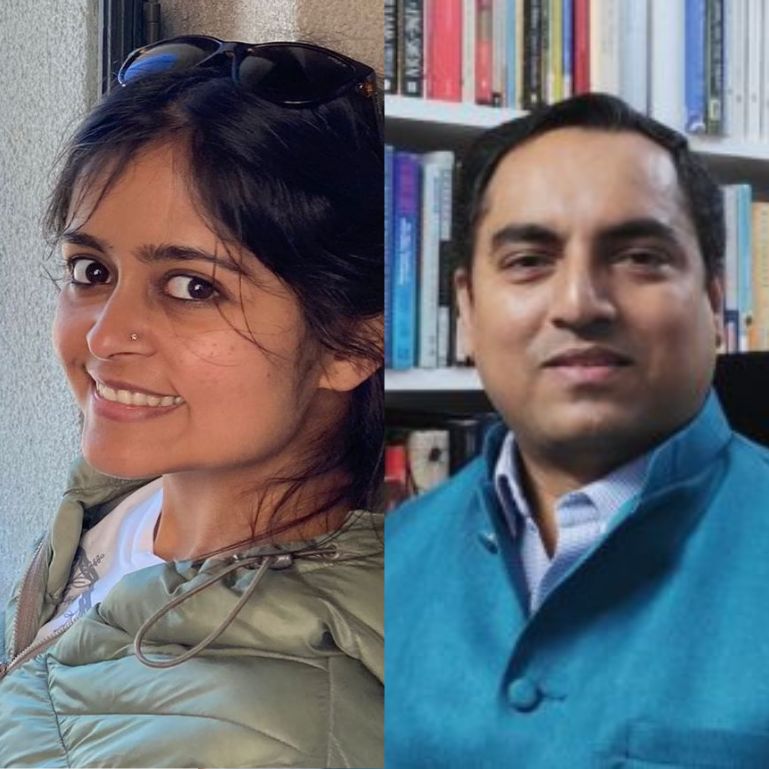
CAT Public Fellow Radhika Prasad talks with poet and translator Sarabjeet Garcha about how reading and translating other languages influences his poetry in English.
Sarabjeet Garcha is a translator who translates from Punjabi, Hindi, and Marathi into English, and from English into Hindi. He also writes his own poetry in English. Earlier this week, Two Lines published Garcha’s translations of three Hindi poems by Mangalesh Dabral. Dabral, a poet who was himself a translator, read and approved many of Garcha’s translations of his work. When I interviewed him, Garcha spoke of the ways in which indigeneity enters his English poetry via his reading and translation of other languages, sweetening it like water by an earthen pot.
—Radhika Prasad, 2022-23 Public Fellow
Radhika Prasad: How do you choose what to translate?
Sarabjeet Garcha: I translate what I’m obsessed with. Such obsession, however, doesn’t become apparent right away. It works its way into your soul slowly, but once it grips you, there is no escape. Earlier, I used to think that it’s some kind of urgent intoxication, hard to shake off, but over time I realised that it’s a leisurely awakening that comes about in its own spacetime. This awakening leads to a certain satiety that can be experienced within that space and that time only. I translate what I believe adds to my satiety.
RP: As a multilingual poet who translates from Punjabi, Hindi, and Marathi, your translations are shaped by a rich linguistic landscape. Do these languages ever seep into each other? How does multilingualism shape the poetic landscape of your mind?
SG: Why just languages? Even everything that language can’t convey is game for percolation. Because of the sonic magic of words, plainspeak in one language can become breathtakingly poetic in another, and vice versa. Experience is a standalone phenomenon, but being humans, we weld it with language. Yet, no single language is adequate enough to express every subtle experience with absolute fidelity. Some bit of transmission loss is unavoidable. Poets are committed to minimising this loss. Writing poems is like shooting Zeno’s arrow—coming to terms with the fact that the distance between the bow and the target will keep getting halved but never become zero.
The osmotic receptibility of each language is different. For instance, over the last few decades, quite a bit of English syntax has silently seeped into Punjabi, much to the chagrin of classicists. Assimilation is not a bad thing, but a language with a compromised core ceases to enchant. It’s the job of poets to not only preserve the core but also enrich it.
I find Marathi to be a closer acoustic cousin of Punjabi than Hindi. Marathi and Hindi share the same script, Devanagari, but they are very different syntactically. Gurmukhi, the Punjabi script, descended from the Lahnda script. Translating between Indian languages is easier because their DNA is similar.
English is the most stylish of hosts, capable of accommodating cousin and stranger alike.
RP: As someone who translates poetry both from and into English, do you find that there is a difference in working in these two directions?
SG: There is. English is equipped with several literary devices, which can be put to great use. It is immensely malleable, even if not perfect. In English, poets passionate about specificity have a vast corpus as well as precise technical vocabulary at their disposal. Achieving brevity in Hindi requires a lot of work, whereas English is innately conducive to concision. Enjambment doesn’t work the same way in Indian languages as it does in English. Poets writing in Indian languages do not use the white space in the same way as those writing in English do. If we are bent on sticking to the line breaks of the original, we might not always get the best version of the poem in English. The reverse is equally true.
RP: When you translate poetry, what aspects are you most compelled to retain? Is it the form, the imagery, the atmosphere, the voice, or something else?
SG: First and foremost, I feel compelled to retain the original thought that gave birth to the poem. That also encompasses the imagery and the atmosphere. Translation is the best means to arrive at a poem’s provenance, and once you’re there, you can work your own way out. If the poem demands that its form be different in the target language, then there is no reason to hold on to its form in the original.
Voice is a slippery beast to handle. When translating, I imagine the poet writing in the target language. When I ask myself whether the poet would use a particular word if they were writing in, say, English, I usually get the answer. This exercise abets word choice.
RP: You both translate and write poetry. How does your own writing of poetry shape your translations? Do you locate your own voice in the pieces you choose to translate, or does translation help you expand your poetic voice? How do the two practices nourish each other?
SG: Yes, I do locate my own voice in what I choose to translate, but I never let it muffle the voice of the original. I try to limit my presence as that of a one-man chorus, subtle yet unmistakable. My own poems carry a patina of indigenousness because I translate poetry. But this deposition happens unconsciously. After all, water from an earthen pot will not taste the same as water from a steel vessel.
I was born and raised in Maharashtra, but I grew up speaking Punjabi at home. I hobnobbed with the spiritually inclined who were deeply invested in the Advaita philosophy. They influenced my Hindi. Language also influences thought, and when that happens, the poem can move away from its intended direction, sometimes producing interesting results. However, that can also become a trap. If you let only language control a poem, the poem will not flower fully. Being on a roof helps you fly a kite, but it’s important to know the roof you are standing on. Translation has helped me find a suitable roof.
RP: Who are some of your favorite translators, and what do you admire about their work?
SG: W.S. Merwin, Mangalesh Dabral, David Hinton, Robert Hass, Arthur Sze, Jane Hirschfield, Sam Hamill. I love the texture of their work. You can carry its silkiness into your dreams.
RP: Could you tell us about your experience of translating Mangalesh Dabral’s poetry?
SG: It was thoroughly enriching. He is the most humane of all the Hindi poets I’ve known, whether personally or through reading. He had read and approved dozens of his poems in my translation. Being an outstanding translator himself, he also gave several suggestions, which ultimately made the translations better. Even after his death, I have instinctually felt him agreeing or disagreeing with my versions of his work. The disagreement helps, in that the poems in question are honed until I get his approval in my mind.
Looking for more translation from Indian languages?
- Two Lines: two poems by Mangesh Narayanrao Kale, translated from Marathi by Sarabjeet Garcha
- Two Lines: “The Funeral” by Geet Chaturvedi, translated from Hindi by Anita Gopalan
- Two Lines: “Near and Around Shapes” by Kunwar Narain, translated from Hindi by Apurva Narain & John Vater
- Radhika Prasad reflects on Geetanjali Shree’s Tomb of Sand and the Story of the Hindi language
Radhika Prasad is a PhD candidate at the University of California Santa Cruz and was the 2022-23 Public Fellow at the Center for the Art of Translation.