World

The world has been ending for months.
Mundo
Guada dice:
—He decidido irme.
De repente ya no está la voz chillona de la tele, y la luz tenue de la tarde se rompe. Sólo queda explotar. Miro la pared: sé que habla de irse de mí.
Mundo
Guada dice:
—He decidido irme.
De repente ya no está la voz chillona de la tele, y la luz tenue de la tarde se rompe. Sólo queda explotar. Miro la pared: sé que habla de irse de mí.
Desde la calle nos llega el agudo pitar de una sirena de policía o de ambulancia. El ajetreo dentro del café se detiene, esperando una señal que nos ratifique el miedo. Miramos hacia afuera: el sol, las hojas tiernas de los árboles, la rutina distante de quienes pasan al otro lado de la ventana. Parece un día normal, no vemos ninguna patrulla. El ulular se aleja entre las movilidades conducidas por extraños, entre calles que no vemos y desaparece.
Dentro mío, el vacío adquiere un cuerpo y se solidifica.
Hace meses que afuera el mundo se ha ido terminando. Caminas y si miras a los rostros ya no reconoces a nadie. Es mejor no confiar. La política lo invade todo; conversas con alguien, con cualquiera, y a los diez minutos ya está diciendo que si el presidente, que si los indios, que esta tierra es nuestra y no nos avasallarán. Cada quien tiene razones para odiar. Las palabras se extraen de prisa desde el vientre, como cuchillos. Los amigos se van transformando, asumen posiciones. Yo pienso de una manera que no es la de ellos, ellos de una forma que no es la mía. Después de discutir unas cuantas veces, nos despedimos con la sonrisa forzada y a la semana siguiente, cuando nos encontramos, ya no tenemos nada para decirnos.
¿Quién de nosotros es el que se aleja?
La otra noche, en una exposición, estaba charlando con un amigo y nos reíamos. Había mucha gente conocida, y en eso se acerca la esposa de ese amigo, llega por detrás de él hasta sus hombros y lo abraza. Él desarma delicado el abrazo y me presenta, pero ella se queda estática, me mira acercarme para darle un beso en la mejilla, retira el rostro, se da la vuelta y se va. Una espalda alejándose de lo que queda de mí. Él intenta continuar la charla, pero yo lo miro y lo desconozco, quién es este que sonríe en mi frente, y me alejo entre los desconocidos que me empujan; avergonzada, como si todos me hubieran escupido en la cara.…
World
Guada says, “I’ve decided I’m leaving.”
Suddenly the shrill voice on TV is gone, and the dim evening light is broken. All that’s left to do is explode. I look at the wall: I know she means she’s leaving me.
From the street comes the sharp wail of a police car or an ambulance. The bustle in the café stops, as we wait for a sign to confirm our fear. We look out: the sun, the tender leaves on the trees, the distant routine of people passing by on the other side of the glass. It seems like a normal day, no cop cars in sight. The howl moves away among the vehicles driven by strangers, among streets we can’t see, and vanishes.
Inside me, the void takes on a body and solidifies.
The world has been ending for months. If you take a walk and look at people’s faces, you can’t recognize anyone. It’s better not to trust. Politics invades everything: you chat with someone, anyone, and ten minutes later they’re already saying but the president, but the indigenous, but this land is ours, they can’t push us around. Everyone has reasons to hate. Words are extracted quickly from the guts, like knives. Friends change, take sides. I don’t think like them and they don’t think like me. After a few arguments, we part ways with forced smiles, and the next week, when we run into each other, we have nothing to say anymore.
Which of us is moving away?
The other night, at an exhibition, I was talking and joking with a friend. There were lots of people I knew, and at one point the friend’s wife approached from behind and laced her arms around him. He gently untangled from her hug and introduced me, but she just stood there, static, watched me move closer to greet her with a kiss on the cheek, pulled back, turned around, and left. A back moving away from what was left of me. He tried to keep the conversation going, but I looked at him as if he were a stranger, who is this guy smiling in my face, and I moved away among the shoving strangers; ashamed, as if all of them had spit at me.
Guada says she’s leaving and the explosion starts inside me in slow motion. I never told her about the snub. I never will. I try to lose myself in the pale yellow wall I’m facing, but invariably I glance for the tenth time at the TV, beside and above us. The news bulletin is over. In my head, though, plays the same tireless image.
As I search for the words to answer her, I can’t help but repeat the incident to myself.
She was an older woman in a hurry, maybe sixty years old, and she spoke in a thin voice, as if her exhaustion had accumulated there. The camera focuses on her from behind, trailing her urgency. The lady walks down the street in flip-flops, quickly, her hair short, dyed blond. You can see she’s downtown. Her pants are pale and light, the hem stops above her ankles, and she’s wearing a blue sleeveless blouse. When she waves her arms, because she’s almost always clutching at her head as she walks, but sometimes she also raises her arms and waves them as if trying to be seen from afar, then you can see that her arms are fat, and the skin is somehow loose and uneven, a faded but still-warm cloth, as I imagine it, and soft.
The lady rushes down the middle of the road, the camera never shows her face, shaking her arms and shouting, later I remember her voice when she shouts Let go of her! Let go of her! Help, they’re hitting her! Let go of her, they’re hitting her!
She never stops yelling, the camera follows close behind but never catches up, and she herself covers the camera, but behind or actually ahead of her we can make out what looks like a disturbance, a mob, six or eight guys, all young, two of them large, plus two girls. The men grab a woman in a dress, they grip her with incredible violence, Let go of her! She tries to free herself, tries rushing ahead, struggles to shake them off, but they’ve got her captive by the arms, in suspense, and the girls circle her constantly. We can hear the insults from a distance, the rough voices rising from the viscera, floating over it all.
Let go of her, oh God, help! Help her let go of her they’re hitting her they’re hitting her!
The city breaks a little more every day. A few weeks ago, flyers appeared, stuck to the walls around the square, a list, titled
Civil Death for Traitors
followed by the names of people I know. We drive along the street with the windows up. The air conditioning is shot, but we don’t open the windows, unless the road is clear and we can accelerate; but if we pause at the light, if we need to stop at some corner, we roll up the windows without saying a word to each other. Guada, sweaty, closing hers.
The woman, who has been dragged and yanked to the center of the mob, is being kicked along by the girls, from what little we can see it looks like she’s doubled over from a kick to the belly, and to the left a young man from the group of six or eight approaches and yanks her by the hair.
Let go of her they’re hitting her! the older lady screams from behind, but she can’t stop them, and in the footage we sense that the cameraman hurries up to overtake her and capture the whole scene of harassment.
The mob advances, almost jogging, taking the woman with it: They’re hitting her they’re hitting her! Long arms skyward.
Curious onlookers gather, but no one stops the mob of six or eight, which fends off anyone who tries to intervene, then we see two of them threatening people with bats.
They’re hitting her they’re hitting her!
That’s when a motorcycle veers in from the camera side, two police motorcycles, three, with two cops per motorcycle, they get off and run over, they’re armed.
Oh God help! the lady continues, now behind the police, who run toward the mob, and the six or eight men stop.
At some point the camera moves past the shouting lady and we see the precarious, fragmented aftermath: the woman, now we see the dark and bloodied face, the open mouth, the dirty dress, barefoot. A policeman puts his arm around her waist, tries to lead her away from the scene, but she trips on her own feet and starts to fall:
Help oh God!
The cop catches her and lifts her up again, carries her in his arms, exhausted, and as he carries her the woman’s skinny arm dangles to one side.
Then we see the news anchor. She displays a serious face, an expression of concern. Our sponsors. Nothing bad happens to shampoo or bank credits or beer.
The lady’s screams echo in my head.
The world is ending, I tell myself, it would be reasonable to explode. If only something would shatter into a thousand pieces inside my chest, a hundred thousand, if only the expanding wave would infect this body. The disfigured look on my face, when the blast of energy detonates against my cheeks from the inside, against my lips and eyeballs, an explosion so ferocious that nothing is left, not even blood, absolutely nothing, just unrecognizable dust, floating in the air like any other dust mote pierced by the dry light of the sun.
“So?” Guada wants to know.
I’m stuck in time. Everything is stuck: it’s six pm, but the morning is still happening. I look around us: just a few people at other tables, a couple chatting. And then the voice again, Let go of her oh God!, still sounding.
I meet the eyes of an older man who’s brought his grandson for an ice cream, we hold each other’s gaze for a few seconds and I imagine his story, a respectable gentleman, probably retired from some company like my dad, is he for or against, would he say bad words? has he seen the shouting woman? and then we both look away.
“I’m talking to you,” Guada presses.
“I don’t know.”
“So you just don’t care, is that it?”
“No, I do care.”
Looking elsewhere, at the yellow wall, at my fingertips, not at her face, my eyes don’t meet hers. But Guada’s face is tilted toward me, she’s speaking. She takes up words again, says lots of words. My nails have grown.
From a distance, it must look like she’s picking a fight with me. People at the other tables must see us arguing. Two crazy women gesturing, saying things, challenging each other, right in front of us, the details of their twisted lives, the lives we don’t want to know about. These women, who do they think they are, it was a sunny afternoon and now this: in a café, in broad daylight, how vulgar.
Just a moment ago I also raised my voice at her, I didn’t mean to. I’d suddenly felt such rage. I felt like digging nothing but razors out of my guts and tossing them into her face, merciless. “Don’t yell at me,” she said, and I backed down.
Now I look at our fights from a greater distance. We start out in a small circle, tiny really: a complaint about some look, some reaction or lack thereof, and we start turning in circles. As we keep speaking, we trace the circle again and again, pulling more and more troubles into our rotation, some incident from yesterday, a condescending remark that went unpaid, and we gradually expand the wheel and the speed of that wheel. Then we awaken a centripetal force that intensifies all by itself and draws more and more things into the center, and then, shouting, we smash headlong into all the muchness wheeling ruthlessly between us, surrounding us, besieging us until one of us is spit back out and suddenly everything stops.
It’s getting dark. Guada hates this time of day.
In a few years, I’ll have that lady’s arms, that woman’s tired voice. Five years, ten, what does it matter. Isn’t time just an illusion? Death hounds me too, moves closer too, and in its territory, time, the time that remains, is an opportunity, the very last one.
What will the future hold, what will it look like.
I wish I didn’t have to say anything else. I close my eyes: again the lady screaming and running behind the mob, Let go of her!, in my head.
“But are you okay with this?”
There’s nothing to protest. How many times did I myself imagine the end, like a blurry line coming closer and closer, sometimes even with tenderness?
I look up and there are Guada’s angry eyes. My silences enrage her, she thinks silence means contempt.
We startle if we hear a man yelling in the street. Lots of men pass by, roughhousing, their voices harsh outside our house, and we peer out alarmed to see what’s going on. At night, when we can’t sleep, we study the road from the window, and the gate looks too fragile, too old to resist the battering of those enormous young men.
Who are they really?
“So you’ve made up your mind, then?” I ask her to buy some time. I know she has; that’s Guada, sometimes she spends weeks turning something around in her head, dropping clues, little by little. Sometimes even when we’re in bed she’ll suddenly say something like “My mom said I should get a better job,” or “I was thinking maybe we could move to another city.” And our bodies break away from each other and I never know what to say.
The waitress approaches with the remote control in hand, aims for the TV, and starts flicking through the other channels. Face engrossed, mouth half-open.
“You’re not going to put soccer on, are you?” Guada demands.
“No, no. Don’t worry.”
“Why don’t you just leave it where it was,” she says, brittle, and the waitress, Laura says the plastic rectangle on her chest, lowers her eyes and returns to the local channel. Shame nests everywhere.
Propaganda.
“I’ve made up my mind. I thought you’d agree that this isn’t working anymore.”
“Yes,” I tell her. It’s almost time for the hourly news. I’m sure it’ll replay the lady shouting, the mob, the guy grabbing the woman by the hair, shaking her by the head. We’ll glimpse the kicks to her belly from this angle of the screen.
“I think it’s for the best.”
It’s the end of the world.
“I don’t know, Guada, I don’t know what’s for the best.”
“For me, leaving is for the best. Just look at how you treat me, you don’t talk to me. You don’t ask me to stay. I’ve had enough. You have nothing to give me.”
She slips a ring around, rotates it around her forefinger as if it were us and she were about to take it off.
“Yeah, maybe so,” I say.
I feel like crying, I do cry, but it’s not over her and it’s not over us. It’s not because she’s decided to leave. It’s for the best, leaving, but I won’t be going anywhere.
“When did you decide?”
“I’ve been thinking about it for days.” She takes a deep breath and asks, “Do you love me?”
I don’t have anything to say. Not even to deny. The bloodied face, the dangling arm. I feel like my body is fading away. I review the names on the list pasted all over the walls of the square, Civil Death, it says. Everything’s frozen in place and I really don’t want to watch the hourly news.
Let go of her! but they’ll keep beating.
We never would have had children, and we would have always lived alone. The time for love is over, Guada. The houses will get covered in flags, heads will get covered in flags, the same colors over and over in people’s mouths. The night isn’t ours anymore, I can’t hold your hand. Our hands dangling down. The same mob reproduced and repeated across the poor neighborhoods of the city.
One day you’ll be in some square and you’ll get mugged, your bike stolen. The mute trees. The world doesn’t exist anymore.
Minuscule dust motes hover in the sun’s debris. Then I’ll leave the café and it will be night. I should have made sure not to leave you alone in the fear. Later I’ll stand beside our bed and it won’t be ours. They’re hitting her they’re hitting her!
Whose bed is this? I’ll ask inside myself, but I’ll lie down in it. If I get any sleep, I’ll dream of offices ablaze, of raging young men flinging papers into the street. If I lie awake, the silent cars will drive past with men in them and I’ll guard the gate, tiny.
From Los árboles. La Paz: Editorial El Cuervo, 2019.
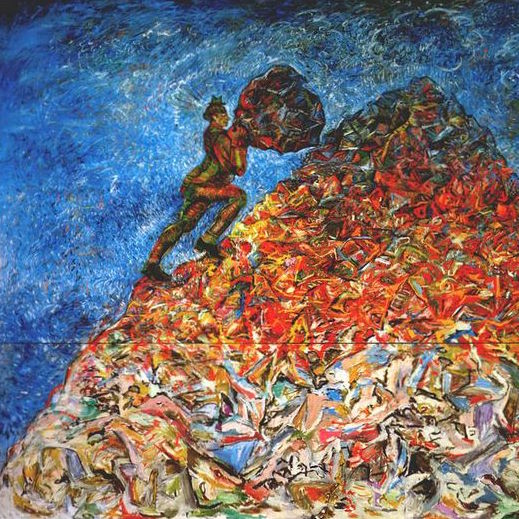
Image by Antonio Carrau.
Claudia Peña Claros (Bolivia, 1970) is a poet, fiction writer, and essayist. She has published the short story collections El evangelio según Paulina and Que mamá no nos vea; the poetry collections Inútil ardor and Con el cielo a mis espaldas; and the novel La furia del río. In 2016, she won Bolivia’s Franz Tamayo National Short Fiction Contest. One of her stories, “Verde,” was made into a film by director Rodrigo Bellot. (Photo credit: Vero Mendizábal)
Robin Myers is a poet and Spanish-to-English translator. Her translations include Copy by Dolores Dorantes (Wave Books), The Dream of Every Cell by Maricela Guerrero (Cardboard House Press), The Book of Explanations by Tedi López Mills (Deep Vellum Publishing), Another Life by Daniel Lipara (Eulalia Books), Cars on Fire by Mónica Ramón Ríos (Open Letter Books), and other works of poetry and prose. She lives in Mexico City. (Photo credit: Nuria Lagarde)