The Double Man

As soon as Sebastian stepped onto the damp earth, he knew that he was crossing the borders of the Duke’s territory, and a shudder ran through him.
As soon as Sebastian stepped onto the damp earth, he knew that he was crossing the borders of the Duke’s territory, and a shudder ran through him. There were neither walls nor soldiers; the sole indication that anything was different was the curtain of rain that divided the forest in two. From that point, the vegetation changed; the sky was grey and the animals, the few animals, seemed to have merged with the copper tones and decomposed forms of the trees. Sebastian moved forward through the overgrown, knotted roots. As he went, he turned to see his own shadow, hazy but identifiable: as reluctant to follow him as his soul, and so different from that other shadow, the one his body usually cast on the safe side of the forest. He needed to watch his shadow, because Magdalena had told him that in the place where he lost it he would find another sign.
The further he went, the more difficult it became for him to comprehend the reality his eyes presented to him. With each step his uneasiness grew. Finally, the last rays of light from a sickly sun disappeared, taking Sebastiin’s shadow with them.
It continued to grow dark. His eyes could not adapt to the half-light. He stood motionless, waiting for the signal, but nothing happened and the forest began to fill with noises: the flapping of birds’ wings, the crack of branches splitting violently, and the sound of something that, as it crept along, collided in Sebastian’s mind with the memory of the tragedy that had befallen a couple of villagers who had lost their way one night. But he did not want to think of the somnambulists. He wanted to find the caravan and finish his task once and for all.
Sebastian had the feeling that something was watching him. They were not the eyes of a wild boar nor those of a wolf; rather, it was as if a hostile gaze grew out from the forest itself, or from the darkness. As he turned halfway around, his feet knocked against something: the thing that had been creeping forward had stopped moving: it was large and to all appearances it was dead, since it did not even moan as it received the entire blade of Sebastian’s dagger. He had no idea what he had driven his weapon into; he was still on the defensive when the wind, disturbing the branches of the trees, opened a passage of opaque moonlight and allowed the situation to become clear. Sebastian could see, and he drew away immediately: he felt horrified at himself: he had uselessly stabbed through the body of a man who had been tortured. Could that be the signal? The corpse’s expression was enough to convince him: the caravan was near. But the trees were so dense that Sebastian was forced to stray from the path, and if he did find the caravan after several days, it was only by following the dead bodies that Odilon left behind. Now, while he looked at those bodies with repulsion, Madgalena’s words resonated inside him as if she were telling him, from the alchemical laboratory, how to identify the double man’s wagon, about the potion with which he could obtain his obedience, about the close night that the fire would interrupt. Sebastian hid behind a thicket to watch how those beings approached the man with one single eye: that afternoon he was prophesying the future: he shouted out his premonition that death was prowling around them.
Sebastian could no longer hear the voice of the seer: it had been diminishing in volume and was now no more than a murmur, barely perceptible to the man’s closest interlocutors; but Sebastian could still watch him, noting the emotion that he awakened in the others, who drew away upon hearing his words, frightened like birds at the setting of the sun.
Little by little the light of the bonfire brightened. Sebastian moved toward the wagons stealthily, the same way the darkness had fallen. He strove to banish from his mind the images of what could happen to him if he was trapped in Odilon’s hell. He could not allow himself even a single slip and, for that reason, before provoking panic and confusion by starting a fire, he wanted to make sure that the double man was in his wagon.
Far from the predictions that had inspired terror in dwarves and hunchbacks, the double man slept, covered to his necks with a blanket made of uncarded wool. Sebastian saw nothing strange: it looked as though two men with dark beards and similar features had lain down next to each other to sleep on the straw. It seemed as if each one of the heads crowned a different body.
As he lifted the blanket, Sebastian noticed that from an extremely wide waistcoat four arms emerged irregularly; he stared, entranced, when one of the heads fixed its gaze on him. Alarmed, and without thinking, he flung all the liquid that Magdalena had given him into the double man’s awakened face. The body jerked on the hay. Instinctively, the four hands moved up to the eyes that blinked with irritation. The abruptness with which the hands rose to the eyes pulled the second head from its sleep only to hear, without understanding what was happening, absurd orders from a man who did not even belong to the caravan. But the most disconcerting thing was that his other head promised to obey.
Sebastian left the wagon, certain that the double man would follow him like his own shadow. Outside, in the camp, there was disquiet. The fear provoked by the seer’s words was spreading, possessing even the men who had lost their gaze. Everyone wanted to take refuge underneath the seer’s wagon. The fear continued to spread through the caravan; it moved forward, carried on air it saturated with bad omens. It crossed the curtain of rain, the Duke’s woods, the walls and even people’s dreams. The fear had also reached the village. At that hour, everyone shook with terror, victims of a collective dream. Everyone dreamt of the woman without a skeleton. The image of that woman burning in her wagon was their common nightmare.
Even the dwarf, behind a folding screen in the Duke’s chambers, dreamt of the woman without a skeleton, of eunuchs that ran while Odilon attempted to put out the fire; one of the idiots howled among the flames and no one did anything for him. Everyone wandered from one side to the other except for the double man, who withdrew into the trees with Sebastian. The dwarf tried to recognize one of Odilon’s accomplices in this man, but all he could see of him was his back. Julia, on the other hand, did recognize him. Only she would be able to identify him in the middle of that agitated, confused dream. Only she knew that it was her son and that he was in trouble. Julia could intuit this, because the dream had shown her the pair of identical heads arguing, because she had been able to see, behind the hazy mantle of smoke from the fire, the scene in which Sebastian escaped with the double man.
The villagers arose well before sunrise. They knew, without needing to speak of it, that they had all dreamt the same thing, that their common dream was prophetic and that it forecast new misfortunes: animals with multiple heads would be born, their storehouses of wheat would catch fire, plagues and illnesses would come and soften their bones. They did not know exactly what would happen, but to dream of a woman without a skeleton was inevitably a bad omen.
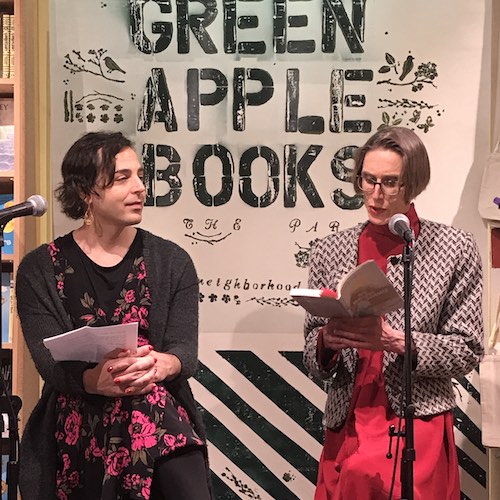
Beatriz Escalante was born in Mexico City in 1961. She has published books of short stories, novels, and a book on Spanish grammar for writers, and has edited collections of contemporary Mexican short fiction.
Jen Hofer is a poet, translator, bookmaker, and educator. Her translation of Mexican poet Myriam Moscon’as Negro Marfil/Ivory Black received the 2012 Harold Morton Landon Translation Award from the Academy of American Poets and the 2012 PEN Award for Poetry in Translation.