An exclusive conversation with About Uncle author Rebecca Gisler
Happy pub week to About Uncle, our latest Two Lines Press(opens in a new tab) title!
This slim volume by Rebecca Gisler, translated from French by Jordan Stump, centers around an unnamed young woman finds herself moving to a small town at the seaside to care for her uncle. He’s a disabled war veteran with questionable habits, prone to drinking, gorging, and hoarding—not to mention the occasional excursion down into the plumbing, where he might disappear for days at a time. When the world starts to shut down, Uncle and his niece become closer than ever. She knows his every move—every bathroom break he takes, every pill he swallows—and finds herself relying more and more on this strange man, her only company in a shrinking world. But then Uncle’s health takes a turn for the worse: He’s sent to a hospital that cares for cats, dogs, and Uncles, and any way for her to make sense of this eerie new reality, and her place within it, falls apart.
Poet-novelist Rebecca Gisler’s debut novel, set against our increasingly disjointed world, welcomes readers into a home of shut-ins as cozy as it is claustrophobic. Gisler’s bright, winding prose, masterfully translated from French by Jordan Stump, offers a rare witness to the complex ways in which we order our lives, for better or worse, inside and out.
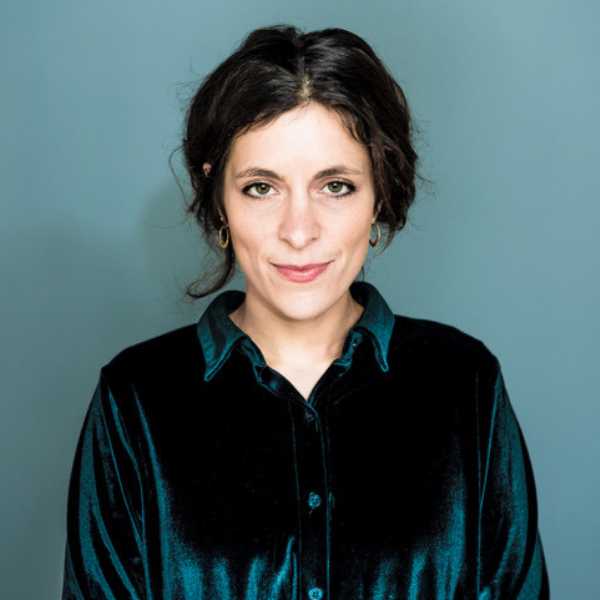
Rebecca Gisler, born in Zurich in 1991, is a graduate of the Swiss Literature Institute and of the Master’s degree in Création littéraire at the University of Paris 8. She writes in German and French and translates her texts from one language into another. She has published poetry and prose in numerous magazines and anthologies. She is the co-organizer of the series Teppich in the House of Literature Zürich. In 2020 Rebecca Gisler won the 28th Open Mike literature competition.
Here, we’re including an exclusive conversation between Two Lines Press and Rebecca herself. Don’t worry—there are no spoilers! We hope this scintillating conversation excites and electrifies Uncle and all his intrigue.
Two Lines Press: About Uncle is set in a small French village in Brittany. Why did you choose to set the novel there, and what meaning does it have for the main characters?
Rebecca Gisler: The story takes place in a small isolated hamlet by the sea, in a seaside resort, deserted in winter and full of tourists in summer. It’s a place that exists and which I know very well. There’s a certain magic and power in the atmosphere: the winds, the bay, the rocks, the animals. But it’s also a place that presents a reality, which can be found in many places as soon as you get away from the big cities: people repressed by society, living away from it all. Then there’s this little white house with blue shutters, eaten away by the iodine air and surrounded by a large hedge, a house in which the uncle has lived alone since the death of his parents. The house is a place full of memories, which the uncle keeps as if in a box. The niece and nephew have been coming to the house for vacations for years, and suddenly they’ve moved in. The three characters, who find themselves living together in this house, plunge into a kind of family narrative, sometimes fantasized.
TLP: The niece, her brother, and their uncle all live in close quarters in their small house, the novel has very long sentences that give a claustrophobic and isolated feel to its narration, and there are many oblique, but not specific, references to the world shutting down. Would you consider About Uncle to be a pandemic novel, or is the idleness of the narrator and characters a symptom of our contemporary world?
RG: I must confess that I wrote a large part of the book during the pandemic. But I wouldn’t call it a pandemic novel. However, I do think that there is an atmosphere in the book, which may resemble those atmospheres we have experienced, such as not being able to travel or the increased presence of animals and plants. The effect of a world shutting down leaves plenty of room for inventing other worlds. I think that the idleness of the characters can be seen as a symptom of our contemporary world, like many people who are lost on the margins of society because they don’t fit into predefined roles. Maybe we could say that this in between, this grey zone, is a symptom of our contemporary world.
TLP: The uncle’s niece and nephew both work for a pet supply site, translating product descriptions. Later, the uncle goes to see an uncle specialist in a hospital that also treats yaks, guinea pigs, cats, and dogs. Can you talk about the significance of animals in this novel?
RG: Animals are very important in the novel – just as important as human beings. I’m of the opinion that, by observing ourselves, we can spot very animalistic behaviors and gestures. The narrator observes her uncle as if she were observing an animal – his eating habits, his routines, and so on. In general, I think the boundary between child/adult and animal/human is very blurry, which presents an important point in the story and in the relationship between the characters.
However, I have to say that some of the big themes of the novel – animality, metamorphosis, childhood – were in no way presupposed when I wrote this text. They were given to me, I would even say offered to me by my subject of study. What I mean is that the fantastical aspect or the importance of animals in the text came while writing, from the meticulous, and therefore dreamy, observation of reality. By observing everyday gestures in detail, they will for sure transform themselves.
TLP: The narrator references Kafka’s short story “The Cares of a Family Man.” Can you talk about the novel’s relationship to that story? What other works were you reading when you wrote About Uncle?
RG: This magnificent short story has several links to the novel. First of all, the Odradek is a foreign body which the family worries about, not only because it has no use, but also because it doesn’t wear out, because it doesn’t age. It seems to be stuck in an intermediate phase, between a thing and a living being, its metamorphosis not yet complete. I use this to try and define more terrifying knick-knacks, like the gadgets on sale at the supermarket, whose usefulness isn’t clear either.
Kafka has and always had an influence on my writing. To name a few others, I was reading Monique Wittig, Otessa Moshfegh, but also Georges Perec, or Marc Graciano, a contemporary French author who inspired me for the language. An other important book I was reading, was a book written by Jean Henri Fabre called Souvenirs entomologiques, which contains over a thousand pages of descriptions of the lives of insects, described in a very poetic way. Eugène Savitzkaya, a contemporary Belgian poet and writer, also greatly inspired me and features at the very beginning of the book. For me, his writing is some of the most moving I’ve ever discovered, and he has a very beautiful way of writing novels that seem more like giant poems.
TLP: You are a poet, and this is your debut novel. What drew you to telling this story in the novel form? How did your background in poetry inform About Uncle?
RG: I sometimes write poetry but I don’t consider myself as a poet. I read a lot of poetry. When I started to write, I wrote in German. Then I moved to Paris, where I started to write in French and to read a lot of poetry (Rimbaud, Desrosiers, Savitzkaya, Michaux, …).
The transition (from German) to French, which is my mother tongue, and more a family and oral language contributed a great deal to the way this novel is written. In the beginning, I felt much less comfortable writing in French compared to German, and this experimental language attempt gave rise to a character that reflected its own instability: the uncle. French poetry and the French language, perhaps because I use it more naively, has helped me to free myself from the narrative with which I associated German. It has allowed me to play with language as material, to make of it a truly subjective experience, sometimes raw, sometimes incorrect, and which carries with it a large number of influences. To put it simply, this text comes first and foremost from an encounter with language. I would say that my writing really takes place somewhere in between those two languages.
Before joining Two Lines Press, Karen Gu worked in publicity at Graywolf Press. While in graduate school, she worked for The Believer and the National Book Foundation. She is a fiction writer and Kundiman fellow.