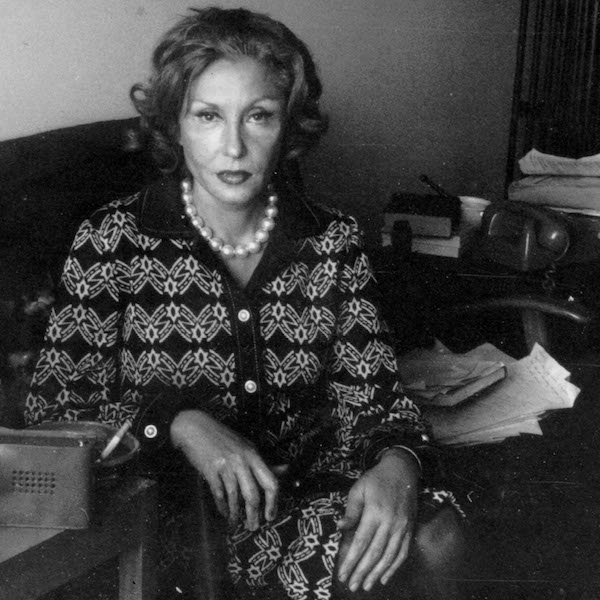
The Genius of Clarice Lispector
Hotel Rex | San Francisco, CA
We collaborated with Litquake to celebrate that rare literary genius that was Clarice Lispector.
Blending the stream of conscious lyricism of Virginia Woolf with the dark, existential themes of Franz Kafka, Lispector’s novels have experienced a recent renaissance with four new translations, published last year to wide acclaim. Here, we paired two of Lispector’s translators with two acclaimed writers for a deep exploration of the infamous life and dazzling work of one of the 20th century’s great innovators.
Panelists: Idra Novey, Hector Tobar, Micheline Aharonian Marcom, and Katrina Dodson. Moderated by Two Lines Editor CJ Evans.
Clarice Lispector was born in 1920 to a Jewish family in western Ukraine. As a result of the anti-Semitic violence they endured, the family fled to Brazil in 1922, and Clarice Lispector grew up in Recife. Following the death of her mother when Clarice was nine, she moved to Rio de Janeiro with her father and two sisters, and she went on to study law. With her husband, who worked for the foreign service, she lived in Italy, Switzerland, England, and the United States, until they separated and she returned to Rio in 1959; she died there in 1977. Since her death, Clarice Lispector has earned universal recognition as Brazil’s greatest modern writer.
Idra Novey is a novelist, poet, and translator. Her new book of poems, Soon & Wholly, is out this September. Her most recent novel, Take What You Need, was a New York Times Notable Book of 2023, a finalist for the Joyce Carol Oates Prize, and longlisted for the Dublin Literary Prize. She has translated various Brazilian and Chilean authors and is the co-translator with Ahmad Nadalizadeh of Iranian poet Garous Abdolmalekian’s Lean Against This Late Hour, a finalist for the PEN America Poetry in Translation Prize in 2021. Her fiction and poetry have been translated into a dozen languages and she’s written for The New York Times, The Atlantic, The Washington Post, and The Guardian. She teaches creative writing at Princeton University.
Hector Tobar is the author of three books, including the novel The Barbarian Nurseries published by Farrar, Straus and Giroux and named a New York Times Notable Book. For two decades he’s worked for the Los Angeles Times: as a city reporter, national and foreign correspondent (on assignments from from East Los Angeles to Iraq), and was part of the reporting team that won a Pulitzer Prize for coverage of the 1992 L.A. riots. He is also the author of Translation Nation: Defining a New American Identity in the Spanish-Speaking United States and The Tattooed Soldier, a novel, which was a finalist for the PEN USA West award for fiction.
Micheline Aharonian Marcom has published five novels, including a trilogy of books about the Armenian genocide and its aftermath in the 20th century. She has received fellowships and awards from the Lannan Foundation, the Whiting Foundation, and the US Artists’ Foundation. Her first novel, Three Apples Fell from Heaven, was a New York Times Notable Book and Runner-Up for the PEN/Hemingway Award for First Fiction. Her second novel, The Daydreaming Boy, won the PEN/USA Award for Fiction.
Katrina Dodson is the translator of The Complete Stories, by Clarice Lispector (New Directions, 2015), winner of the PEN Translation Prize and other awards. Her translation of Mário de Andrade’s 1928 Brazilian modernist classic, Macunaíma: The Hero With No Character was published by New Directions in 2023. Her writing has appeared in The Believer, McSweeney’s, The Paris Review, and elsewhere. Dodson holds a PhD in Comparative Literature from the University of California, Berkeley and is an affiliated scholar of the Brazil LAB at Princeton University. A San Francisco native, she now lives in Brooklyn and teaches translation at Columbia University.
CJ Evans is the author of A Penance (New Issues Press) and The Category of Outcast and received the Amy Lowell Poetry Traveling Scholarship and a Poetry Society of America Chapbook Fellowship.