Sea Now: An interview with translator Anne Thompson Melo
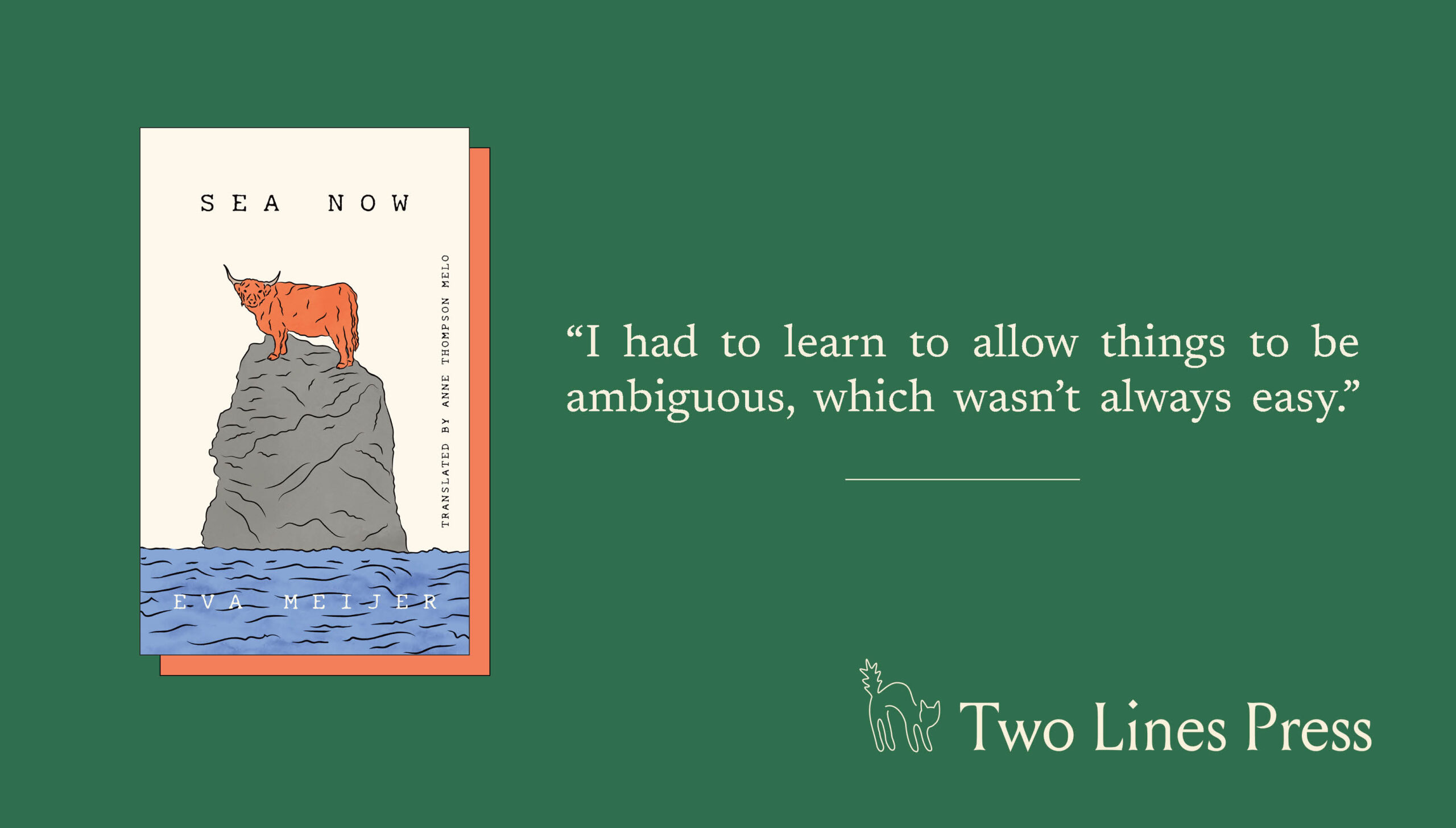
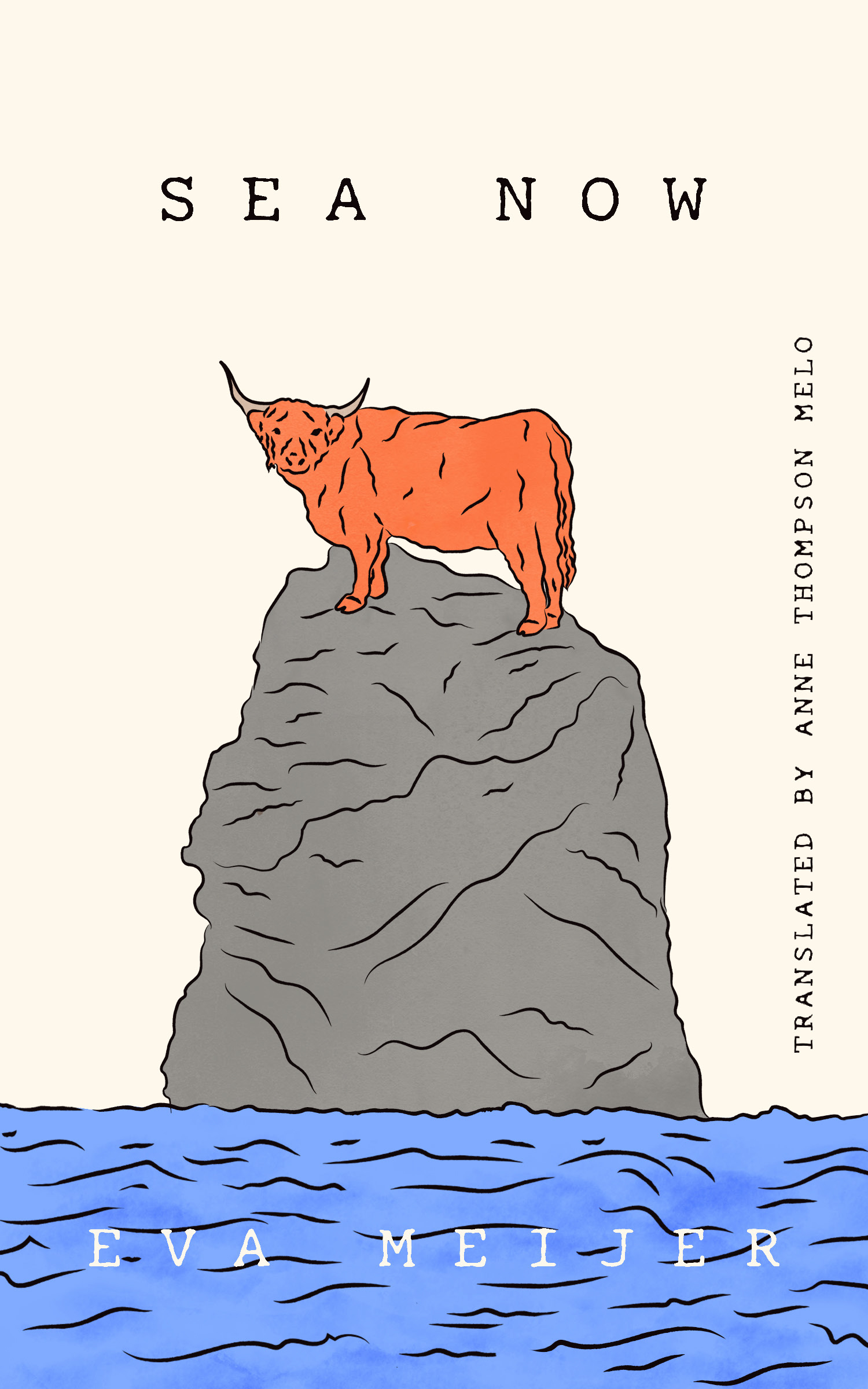
Set in a flooded Netherlands, Eva Meijer’s Sea Now(opens in a new tab) follows three women who choose to stay behind as the ocean consumes their cities and memories. Traveling by boat in search of loved ones, they encounter a transformed landscape reclaimed by kelp forests, seabirds, and whales. Weaving philosophy with rich nature and poetic writing, the book offers a deep look at grief, resilience, and coexistence.
In this interview, Anne Thompson Melo, the 2024 winner of Two Lines Press’s and Peirene Press’s Stevns Translation Prize(opens in a new tab), shares her creative practice—from translating brochures for a German car manufacturer to her first literary translation work—and reflects on her process translating the novel from the Dutch.
Don’t miss the live event! Tuesday, August 18th, at 6:00 PM PDT, author Eva Meijer and translator Anne Thompson Melo will discuss Sea Now live in conversation with the San Francisco Public Library’s Program Manager Gregory Hom at the Koret Auditorium (SFPL Main Library).
What was your path to becoming a translator?
My Dad was a German teacher, so I grew up surrounded by language books. And I ended up studying German and Dutch at university. I did the odd translation during my time at uni but my first proper job was working on a short-term technical translation project. I worked for various agencies after that and eventually got a job with a German car manufacturer, working for their Promotional Communications department. That was the golden age of my commercial translation career, when it felt like a proper profession, taken seriously, paid well. Sadly, it didn’t last. Incremental changes – outsourcing, machine translation, post-editing, and ultimately AI – chipped away at both income and creative output and, like many translators, I found it wasn’t a viable (or fun) profession any more. With very little work coming in, I started to look for something new, spending my spare time volunteering to gain work experience in other fields. I’m not sure many people understand what a translator’s skillset is, and employers tend to be very suspicious of freelancers, so it took a while, but I eventually found a job outside translation. I’m currently working for a puzzle-content creator. So I’m still working with language but in a very different way. It’s creative and fun (particularly when I get the chance to write cryptic crossword clues), but I do miss translation.
Are there any practices from that experience that influenced your literary translation process?
My first translation jobs were technical – although I had no technical background, so I’ve always appreciated the importance of research. And research was vital when it came to translating Sea Now. The book is full of references to marine life, Dutch politics, shops, food, details of dyke construction and so on. And all of those had to be investigated and communicated in a way that felt natural without overly explaining anything I’d learned.
Over the years, my translation career moved from purely technical to publicity/promotional materials, which was a lot more creative. When you’re translating advertising concepts, you not only have to tailor the source message to a specific target audience, you often have to tie the words to illustrations that can’t be changed and that, unhelpfully, are often based on an idiom that only works in the source language. You might end up having to tweak the entire concept to find something that works.
In that context, the message is more important than translating the actual words. So I’m used to going a bit ‘off-piste’ with my translation. Sometimes that involves losing things that don’t work, sometimes it’s about adding things that weren’t originally there – particularly fillers such as ‘not exactly,’ ‘pretty much,’ ‘really.’ I found they helped reflect the character and tone of the original. Luckily Eva’s main instruction from the start was to be bold with the translation so that gave me some licence to stray from a word-for-word rendition – provided I reflected the original narrative tone, of course.
Where the differences lie are that, as a commercial translator, my job was to take the original text, make it snappier – no matter how long-winded the original – more succinct, and, above all, leave no room for uncertainty. With Eva’s book I had to learn to allow things to be ambiguous, which wasn’t always easy.
I loved the quirkiness of the text – the way it ranges from funny to unsettling and the way it switches between voices. It was a creative challenge and a joy to work on.
As a winner of the Stevns Translation Prize(opens in a new tab), what was it like shaping the book for your U.S. and U.K. debut?
I’m so grateful to Martha [Stevns] for creating the prize – it offers an incredible opportunity and all the support you could ask for as a first-time literary translator.
I went through so many emotions when they phoned to tell me I’d won – surprise and excitement, of course, but with a slight tinge of terror too. After sitting at home in my jammies for decades (I was way ahead of the curve on the WFH front), I’m used to being fairly anonymous. Translating someone’s book is a big responsibility. And self-doubt is my default mindset. Also, I’d never translated anything anywhere near this long. But I knew I would be mentored by the Booker Prize–winning Michele Hutchison, who was hugely supportive throughout the process. As was everyone involved. It really is the ideal introduction to the publishing world. And I loved the quirkiness of the text – the way it ranges from funny to unsettling and the way it switches between voices. It was a creative challenge and a joy to work on.
The novel blends different forms and voices. How did those shifts influence your translation choices?
This was why I loved working on this book so much. I didn’t get much chance to work with dialogue in commercial translation. And I really enjoy translating dialogue. The different voices made it such a fun project to work on – just figuring out how to reflect the different characters, from the politicians, whose language had echoes of the COVID press conferences, to Big Willem and the Remainers, or the snippy yet lyrical narrator. I had a particular soft spot for Fred. There’s a Steve Coogan character called Alan Partridge, a reporter with more confidence than ability, and Alan Partridge’s voice was very much in my head when it came to finding Fred’s words.
I suppose the poetic passages were where I had the chance to be particularly bold.
Throughout the book, we come across this series of poetic shifts: “The sea as solace,” “the sea as gatekeeper,” “the sea as ancestor,” “the sea as writer,” and so on—which gives an extra layer of vividness to the sea’s active presence. Were there moments in the translation process that made you reflect on how language can create space for a non-human voice or perspective? Is there a particular passage that stands out?
Eva said to be bold with the translation and I suppose the poetic passages were where I had the chance to be particularly bold. Some of the poems involved wordplay that couldn’t be translated directly. With others I had to deviate from the original just to maintain a voice or rhythm. For example, I spent a long time researching what each of the marine life forms listed in ‘the sea as home’ are called in English. Unfortunately, several of the Dutch names that didn’t include the word ‘worm’ translated to ‘_ worm’ in English and, given that the poem already contained creatures that were called ‘worm’ in both languages, my initial version made the sea sound very worm-heavy and the rhythm was lost. So I had to find names of marine life forms that a) fitted the bill geographically, i.e., lived in the right bit of the North Sea; b) had an interesting/poetic/rhythmic name; c) could be reworked into a poem with musical interest.
The same can be said of other parts of the text. There were some passages – the Overturning Circulation part comes to mind – where a direct translation in English sounded too stilted so some of the phrases had to be switched around to create more ‘overturningness.’
In the process of translating this book, I discovered that English can be a lot more flexible than you might think. Eva talks about certain passages in the original that ‘stretch’ the Dutch language. And the English is also stretched at times. I should probably apologise to anyone who isn’t a fan of comma splices, but they served to make the sense of urgency more apparent.
What translators do you admire?
Basically, I’d have to say pretty much all translators. It’s an underappreciated job and every translation will have its own particular merits, even if it isn’t to your own taste. During lockdown I joined a couple of online book clubs that focused on books in translation – brilliantly translated books, but I found the works that were chosen were often a little earnest for me. I understand why that happens. But I tend to engage more with books that are a bit quirky. Books with a message but told with humour – where you find yourself wondering what processes are involved in arriving at a particular pun or piece of wordplay. One of my favourites would be My Uncle Napoleon by Iraj Pezeshkzad, translated by Dick Davis(opens in a new tab), which manages to be poignant and funny in unexpected ways, with brilliant and memorable characters. Another stand-out for me is Look Who’s Back by Timur Vermes, translated by Jamie Bulloch(opens in a new tab) – again a very funny book but with a serious message. It’s a balancing act with a work like that – keeping the humour but ensuring that the reader doesn’t miss the horror of the point behind it.
Anne Thompson Melo is a Scottish-based translator who studied Dutch and German and spent many years translating brochures for a German car manufacturer. She was longlisted for the John Dryden Translation Prize in 2022 and shortlisted for the Goethe-Institut Award for New Translation in 2023. Winning the 2024 Stevns Translation Prize run by Peirene Press (UK) and Two Lines Press (US) for Sea Now(opens in a new tab) gave her the opportunity to work on her first book-length literary translation.
You Might Also Like