Translator to Translator: An interview with Jon Cho-Polizzi
This fall, the Center for the Art of Translation (CAT) launches its inaugural translator-curated event series: Translator to Translator, an initiative that puts CAT’s public programming resources directly into the hands of translators to shape provocative, timely conversations about language, literature, and the art of translation. The guest curator programs a four-event series running from October through May, setting the theme, choosing the translators, authors, and artists to bring into conversation, and moderating the events themselves. It’s an opportunity for translators to dig deep into a topic, host a dream interview, connect with their peers, and expand the definition of literary translation.
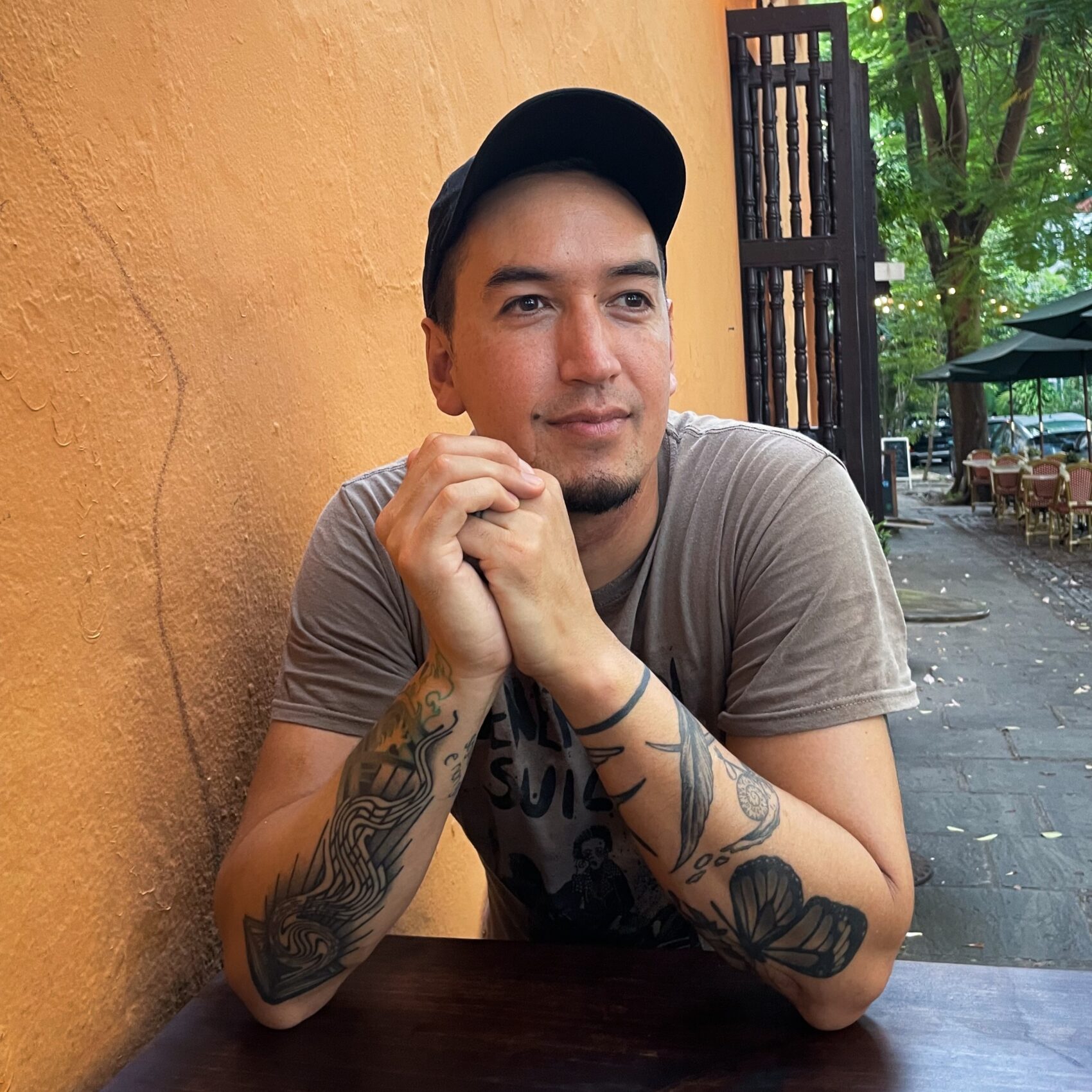
Our inaugural curator for this series is Jon Cho-Polizzi, a literary translator and assistant professor of German at the University of Michigan whose research and translation work focus on the polyphony of the contemporary German literary scene. His translations include Fatma Aydemir’s Djinns, Sharon Dodua Otoo’s Ada’s Room, and the essay collection Your Homeland Is Our Nightmare. In 2024, he won the Helen & Kurt Wolff Translator’s Prize for his translation of Max Czollek’s De-Integrate: A Jewish Survival Guide for the 21st Century.
For his series, Jon has invited four translators whose work speaks directly to the intersections of literature, activism, and identity: Aaron Coleman, Melody Makeda Ledwon, Mona Kareem, and Anton Hur. Their conversations will explore how translation acts as a vital tool for decolonization, cultural exchange, and the reclamation of diverse narratives across borders. Ahead of the launch, we asked Jon about his vision for the series and who he’s excited to bring into conversation.
CAT: What excites you most about taking on the role of guest curator for our translator-curated event series?
Jon Cho-Polizzi: The community of literary translators is so incredibly interesting and innovative, but our work often remains so disparate. We operate behind the scenes. Our projects, our motivations, our creative processes don’t always come to light. Things are changing, but we still have far too few opportunities to come together and exchange thoughts and ideas. And that’s why the Center for the Art of Translation providing platforms for translators working in different languages, on different continents, across different diasporas, to meet up and ask each other questions and exchange experiences is such an important contribution. It sets the stage for new potential intersections and future collaborations, but most of all, it creates an opportunity for us to come together and share the things we love with the wider community. Personally, it also gives me the chance to be in conversation with some of the folks whose work I admire most, and that’s something I’m really looking forward to, as well.
I’ve tried to highlight a range of languages and literatures from around the globe. I want to see how our projects map across languages and geographies and time.
What guiding ideas or questions are shaping your approach to programming these events in collaboration with the Center for the Art of Translation?
Translators are often people who wear many hats. Some of us are also creative writers. Educators. Activists. Artists. Scholars. Some of us work in tech. We live all over the world, and our work is informed by so many different factors and so many different aspects of our varied lives. I’m interested in how our identities and positionalities come to inform our projects. I’m interested in the ruptures, but also in the unexpected continuities. With my programming, I’ve tried to highlight a range of languages and literatures from around the globe. I want to see how our projects map across languages and geographies and time: I’m interested in what unites them, as much so as what makes each of them unique.
What conversations are happening in German-language literature today that readers elsewhere should be paying attention to?
Germany is a country that in living memory has transformed from a brutal ethnonationalist project to a nation whose population today is made up of more than 25% immigrants and the children of immigrants. Among younger generations, these numbers are more like 1 in 3. And the rest of the German-speaking world is not so different. German-language literature today—and really, for the last couple of generations—has really started to reflect this radical demographic shift. It’s being influenced and informed by all the stories these new Germans have brought with them to Central Europe. These memories and experiences are merging with the traumas and traditions of a post-National Socialist Germany, and that’s manifesting in incredibly interesting ways. In Germany, conversations around belonging, around race, around memory and guilt and complicity are happening in ways that simply would not be possible in other places where the intersections of these themes feel more fossilized or follow more familiar cues.
Germany (and by derivation, German literature) is becoming increasingly global, increasingly multilingual and diasporic, but of course this is also tempered by its own cultural and geographic specificities. But because Germany is also this country with a really old and venerable literary tradition in its own right, people on the outside tend to have very specific, preconceived ideas about what German literature should look like, sound like, be. Translation simply has not caught up to the reality of the contemporary German-language literary scene. And so, it’s a really exciting time to be working with this language, with these creative communities. I like to think that the work I’m doing and the projects that inspire me—the work that a lot of other translators are taking on today, as well—are going to be part of a sea change that will reshape how future generations think about the German-speaking world.
Many of the writers you work with explore questions of identity, migration, and community. How do their works challenge or expand ideas of belonging and cultural identity?
Germany is a place that up until very recently determined citizenship solely by means of German heritage, German blood. And so, it’s a country that until well within many of our lifetimes was home to literally millions of people who were the second or even third generation of their families to be born in and live in Germany while still being denied participation in the governments and institutions that determine the course of their lives. When these laws finally started to change around the turn of the twenty-first century, it radically altered the perception of what was possible in Germany. What it meant to be German. And that created a lot of hope and a lot of positive transformations, but it also resulted in a lot of pushback and a lot of regressive posturing. In many cases, these conditions have created conditions that don’t feel at all unfamiliar to a lot of us experiencing the radical polarization in the world today. But literature is poiesis: it’s a process of imagining and reimagining, of making claims to things that have not yet or may not ever come to pass. It’s about making those possibilities legible and daring to project different futures, different presents, and different pasts. And these are stories we all benefit from sharing, regardless of where we’re from.
What was your path to becoming a translator?
One part of this answer would be the course of my education: I studied literature and history at UC Santa Cruz, where I also started learning German. After graduating, I lived in Germany for a long time and eventually also completed an MA in translation studies at the Ruprecht-Carls-Universität Heidelberg, with a focus on technical rather than literary translation. And then I got my PhD in German at UC Berkeley (actually, a concurrent PhD in both German and medieval studies—the latter has a much more indirect connection to the work I translate, but it’s had a fairly profound influence on the way I’ve learned to read).
And of course, all of these things mattered tremendously: they opened doors, they honed skills, they created connections and institutional backing for my work. But at the end of the day, I think the more accurate answer would also have to include personal predilection. I’ve always been something of a scene kid; I grew up in the punk subculture, and I think I bring a lot of that DIY, community-driven energy and ethics to my professional life. I want to feel like I’m a part of something bigger than myself. Since I’m not much of a published creative writer in my own right, when it comes to literature, that’s primarily meant trying to provide support to the writers and writing communities I respect.
From a very young age, I’ve always spent a lot of time at readings, poetry slams, literary events, and literary festivals. When I was living in Germany, and in the subsequent years when I was doing research on German-language topics, I always dedicated time to volunteering at these kinds of spaces. As an English speaker, this often meant that I’d get gigs translating literature-adjacent material. Flyers. Festival advertisements. Blurbs. But sometimes I’d also get to work on small excerpts from featured writers’ works. And in some of those cases, real relationships developed out of these encounters. A few authors in Germany really took me under their wings or were willing to collaborate in very meaningful ways. And I made a point of keeping in touch and showing up. I think I owe a lot of the connections I’ve made, the relationships I have in the German-speaking literary world, to this approach: a kind of boots-on-the-ground way of community building and trying to make a point of figuring out how the skills I bring to the table can best serve the interests of the authors I aspire to work with.
Translation for me has always been an extension of my politics: I want to feel like translating a given author or a given work is going to lead to a net-positive change.
What is your relationship with the author of the original work like? How does that influence your translation process?
Because translation isn’t my primary source of income at this point, I have the luxury of being fairly selective about the works I translate and the authors whom I work with, too. I work almost exclusively with living authors. And this provides its own challenges, because this also means that the legacies and the inheritances of these authors are not yet predetermined. I want to feel like I can stand behind the projects I’m a part of—not just today, but also ten or fifty years down the road. Of course, that doesn’t mean I have to agree with a particular author about everything, but I do have to believe that we share common ground. That translating their work and circulating it among new audiences is going to broaden and not narrow conversations. That it’s going to expand our understanding in novel or constructive ways. Translation for me has always been an extension of my politics: I want to feel like translating a given author or a given work is going to lead to a net-positive change.
As an English-language translator, I also have the privilege of translating into a language that a lot of the authors I work with are already intimately familiar with. This means, in many cases, that authors I translate for are able to provide really targeted feedback on early drafts of these translations. This sometimes feels daunting, but it also means at the end of the day (ideally) that I’m translating their work the way they want it to be translated. At least to the best of my abilities. It also means that we often wind up being in very close communication and friendships form. Over the years, I’ve built really meaningful relationships with some of these authors. I’ve gotten to know their families, their partners, their children. I’ve gotten to know them as human beings and not just as public figures or creatives. And I think, in the end, that personal connection really helps me to be a much better translator of and advocate for their work.
What topic or conversion would you like translators to discuss more?
Something I’d like to see talked about more often—but actually something that I’ve already experienced a great deal in my personal career as a translator—is just how important it is for translators to support one another. We’re a small field. Some might even claim we are a shrinking field because we provide a “service” some people think can be easily replaced by AI. And in that kind of environment, it might be tempting to view our work from a sort of “survival of the fittest” angle—to assume there are not enough slices of pie to go around and that that means we have to view one another only in the context of growing competition. But translation, just like the literature it supports, is also something that’s becoming increasingly diverse, increasingly polyphonic. In order for our work to matter, for our contributions to make a difference vis-à-vis AI-generated translation work, we’re going to need to lean into this diversity: lean into the strengths of our divergent positionalities, the life experiences we all bring to the table. And this means we need, more than ever, to follow each other’s work. To network. To recognize our own limitations and the boundaries of our specific knowledge, to collaborate more, to recommend one another for projects more often, and to support each other wherever we can. That’s how we’re going to remain relevant moving forward; that’s how we’re going to best position ourselves to argue against the automation of our work.
What’s coming up that you’re excited about—new book releases, films, art exhibits, opportunities, festivals, music, an event you’re part of, anything really!
I don’t love to shamelessly self-promote, but the preorder for my forthcoming translation of Ralph Tharayil’s Roll Back the Mountains(opens in a new tab) [Nimm die Alpen weg] just dropped, and I’ve been really excited about seeing the promotional material roll out. The book cover is gorgeous, and Seagull Books has just done a really beautiful job with the whole project.
It’s an amazing book, and I feel really honored to have been a part of its journey. The novel chronicles two young siblings’ development as they enter adolescence. It’s written in this really sparse prose, distributed in interesting ways across the pages in short aphoristic vignettes. It’s subtle, and the story does such interesting things with its language, which shifts and grows alongside the characters as they grow up, working through the ways our identities form and also are informed and mediated by external forces. It’s a book about being different, about growing up marked by this difference, by the violence of it, but it’s also fundamentally a book about what it means to love and trust each other, to belong: the deceptive simplicity of it all.
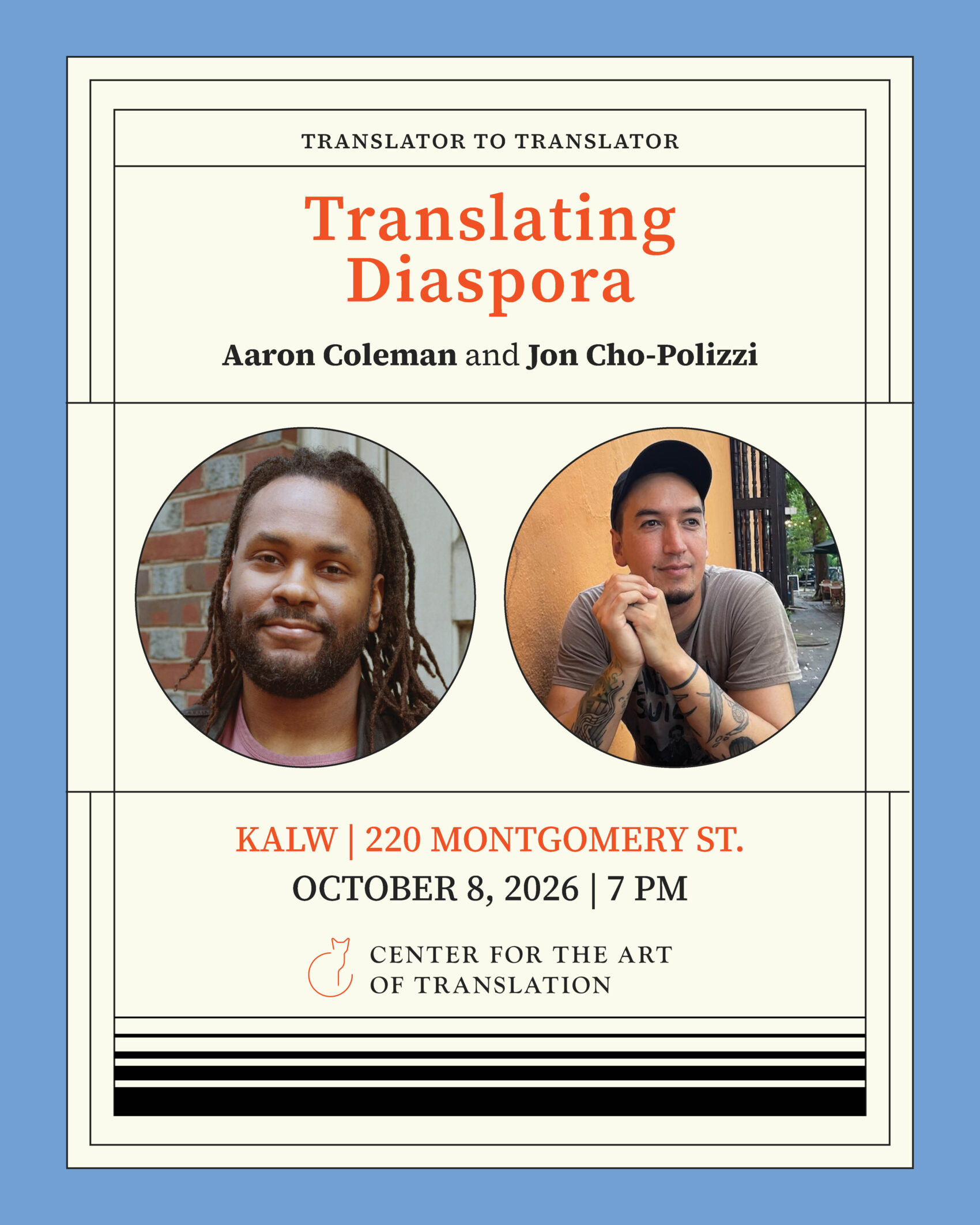
Join us for the first event of the series on October 8, 2026, at KALW Studios in San Francisco! Aaron Coleman and Jon Cho-Polizzi will discuss the challenges and revelations of translating the Black diaspora: examining continuities and ruptures across languages, geographies, and time. Learn more and register here.