A Feminist Reading / Watch List From Iran
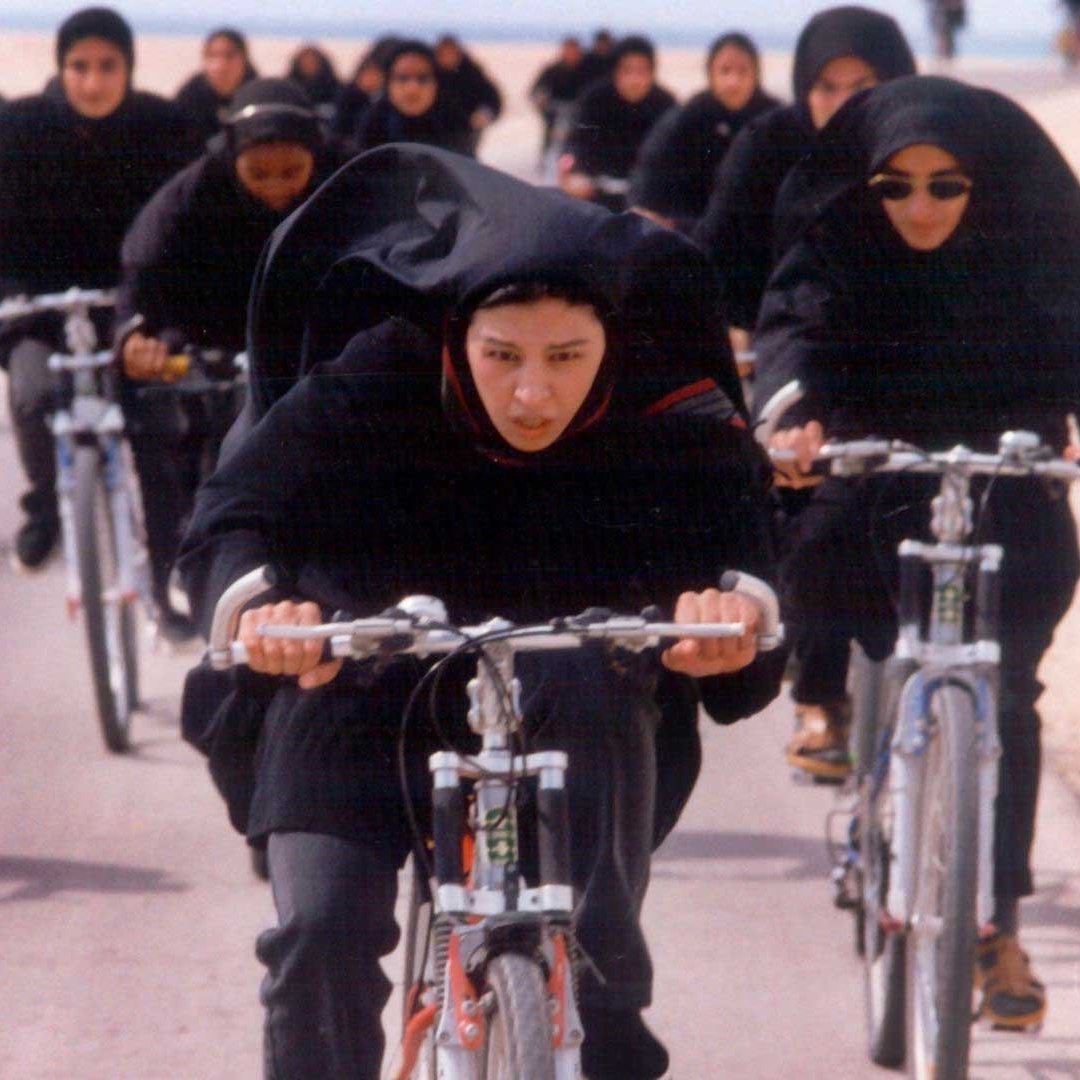
Ten contemporary books, articles, and films that reflect the gravity of Iranian feminism and its resonance on a global scale
The latest round of protests in Iran— catalyzed by the killing of the young Kurdish woman Mahsa Zhina Amini in September— has swelled into a movement of massive scale, encompassing the struggles of women, queer people, ethnic and religious minorities, the working class, public intellectuals, and students alike. Women’s protests against the compulsory hijab triggered global, multilingual conversations about bodily autonomy and feminism as an anti-authoritarian framework.
For Iranians like me, who live in or were born into exile, literature and film serve as essential routes of return and understanding. Iranian feminist authors, journalists, translators, and filmmakers provide sharp and resounding yet deeply humane critiques of the social structures around them. Their tenacity is life-affirming, as is their work itself, be it poetic or empirical, visual or textual. These ten works— which include books, articles, documentaries, experimental videos, and feature films— shed light on a broad range of concerns, but the scope and potential of Iranian feminist literature and cinema stretch farther and wider.

“Dog Rose in the Wind, the Rain, the Earth”
Farkhondeh Aghaei, trans. Michelle Quay
Published in Elemental, excerpted in Words Without Borders
“All along the river, I saw women covered up to their throats in moss, asleep. At first I thought they were dead, but they weren’t. Occasionally they’d open their eyes and look at me. Sometimes their hair was so full of moss, I couldn’t tell what was moss and what was hair. I told one of the women lying in moss and weeds that I could help her get out, if she wanted. But she said she was comfortable, pulled the moss over her naked body, and went back to sleep. She didn’t want to talk to me. However far I walked down the river, I continued to see more and more women lying in the debris, either on their own or in small groups. “
trans(re)lating house one
Poupeh Missaghi, Coffee House Press
“In the aftermath of Iran’s 2009 election, a woman undertakes a search for the statues disappearing from Tehran’s public spaces. A chance meeting alters her trajectory, and the space between fiction and reality narrows. As she circles the city’s points of connection—teahouses, buses, galleries, hookah bars—her many questions are distilled into one: How do we translate loss into language?
Melding several worlds, perspectives, and narrative styles, trans(re)lating house one translates the various realities of Tehran and its inhabitants into the realm of art, helping us remember them anew.”

Missaghi, a translator herself, is also the curator of Words Without Borders’ #WomenLifeFreedom series(opens in a new tab), which showcases visual and written work created by Iranians in response to the current uprising every three weeks.

The Mirror of My Heart: A Thousand Years of Persian Poetry by Women
Translated from Farsi by Dick Davis, Penguin Classics
“A unique and captivating collection of eighty-three Persian women poets, many of whom wrote anonymously or were punished for their outspokenness… From Rabe’eh in the tenth century to Fatemeh Ekhtesari in the twenty-first, the women poets found in The Mirror of My Heart write across the millennium on such universal topics as marriage, children, political climate, death, and emancipation, recreating life from hundreds of years ago that is strikingly similar to our own today and giving insight into their experiences as women throughout different points of Persian history. The volume is introduced and translated by Dick Davis, a scholar and translator of Persian literature as well as a gifted poet in his own right.”
“Women Reflected in Their Own History”
L [anonymous], translated anonymously, e-flux
“The text at hand resonates across multiple registers: the history of protest movements; creativity; identity; and the modes of production of historical agency… the author interweaves feminine sexual drives and female sexuality—a feminine identification that stimulates and invites other women into its chain of becoming.”
“Why did we feel the urge to translate, and translate yet again, and proliferate the translations of L’s text? Translation is integral to ‘Jin, Jîyan, Azadî’ (Women, Life, Freedom)… To amplify and extend L’s text, we wish to add multiple voices who responded to two questions: Why do you think this text is so significant? How does your own experience resonate with what is expressed in these lines?”


“The Kurdish Roots of a Global Slogan”
Shukriya Bradost, New Lines Magazine
“[My friends and I] were high school students when we first protested against the cruelty of the Islamic Republic. In 2003, we established the Woman and Life (Jin, Jiyan) Committee in the northwestern city of Urmia to fight for our Kurdish and women’s rights. I was forced into exile from my homeland one year later due to my vocal activism for that cause. Shortly thereafter, our publication Khaton (‘Woman’) was banned. In many ways, then, the very essence of today’s ‘Woman, Life, Liberty’ slogan was the reason I was expelled from the land of my forefathers in 2004.”
The Hidden Half (Nimeh-ye penhan)
Tahmineh Milani, 2001
“A magistrate is supposed to hear a female death row prisoner; to arouse his sympathy, his wife Fereshteh reveals to him her own “hidden” life story from the time of the revolution: As a student she is a member of a communist underground group and meets Rouzbeh, an older left-wing intellectual and newspaper editor. Against the backdrop of increasing persecution and raids, the two begin a romance that ends unhappily. “The Hidden Half” is one of the most important films by filmmaker Tahmineh Milani. Despite official permission, she was imprisoned and only released after two weeks following an international solidarity campaign.” — 1979ir.de(opens in a new tab)


The Day I Became a Woman (Roozi ke zan shodam)
Marzieh Meshkini, 2000
“…A masterwork of symbolic cinema; it depicts, with vast imagination, the ordeals faced by women in modern Iranian society. Meshkini reportedly made it as three separate short films, in order to elude the system of official censorship that governed features but not shorts. The result is a trio of tightly composed and lyrically filmed episodes, titled by the name of their protagonists, that offer images of enormous psychological power—images that ought to haunt both the memory and the subconscious of anyone who sees them.” — Richard Brody, the New Yorker(opens in a new tab)
Irani Bag
Maryam Tafakory, 2021
“A video essay that deconstructs a cinematographic motif in order to propose a powerful textual and political analysis of censorship and intimacy in post-revolution Iran. Irani Bag not only exposes a codified vocabulary, it also invites the spectator to reconsider the relationship to (and between) sight and touch.” — Another Screen(opens in a new tab)


Dream of Silk (Khab-e abrisham)
Nahid Rezaei, 2003
“In Dream of Silk, director Nahid Rezai returns to her all-girls high school twenty-five years later to explore the lives of young girls in contemporary Tehran. In this candid exploration of their dreams and hopes, the girls are at times shockingly open, often sweet, and occasionally sad as they talk about the future.” — Another Screen(opens in a new tab)