National Poetry Month: Saluting poetry in the classroom
How reading, translating, and writing poetry engages and inspires students and transforms learning.
Poetry is the most precise and expressive use of language, and translation is the closest form of reading. This idea inspired the creation of our Poetry Inside Out world poetry and translation school program, which has offered thousands of students a hands-on experience with the literary arts for more than 20 years. So for the 25th annual National Poetry Month we thought it only fitting to share the impact that poetry (and translation!) can have in the classroom.
“This is how it happens…when you read some poems…a rainbow comes out of your head…you climb up to the top of the rainbow and slide down into your imagination.”
—4th grade Poetry Inside Out student
Decades of research shows that arts education increases engagement and inspires learning. And it’s especially powerful for students in underserved schools and those who are new to English. A recent opinion piece in the San Diego Union-Tribune(opens in a new tab) urges us to remember how vital the arts will be to student engagement post-covid. Since literature and language arts are a standard part of academic instruction, it’s easy to add poetry to the lineup.
Poetry can expand students’ reading horizons(opens in a new tab), can be less intimidating for beginning writers or English language learner students, and offers infinite possibilities for theme, topic, or emotion.
The most powerful element of exposing kids to poetry and translation? Philadelphia teacher Sara Prim(opens in a new tab)o writes: “There is no one correct answer. This was one of my biggest learning moments… Translation is murky, and therein lies its power and its art.” The unique format of poetry and the act of translation is incredibly freeing and empowering—students figure out pretty quickly that they can make a poem their own. This gives them an opportunity to see themselves on the page.
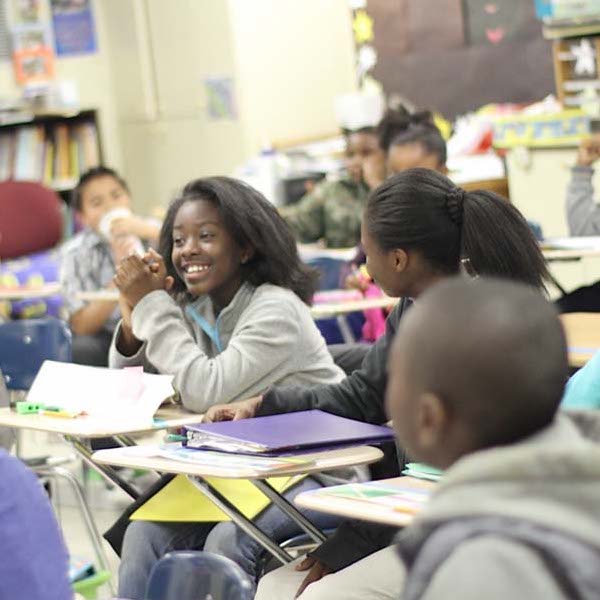
Poetry Inside Out students as young as third grade learn how to translate poems and offer surprising interpretations and insights into work that is sometimes hundreds of years old. They make discoveries about how language works and can claim their place in a long literary tradition. As they hunt through a glossary for an English definition, debate word choice and realize that word order varies from language to language, they get to craft their own original poetry and discover their voice. It’s uniquely empowering: “I started writing, I started expressing my feelings more and that actually helped.”


And poetry can help students understand history. Poetry Inside Out includes a set of poems written by hopeful immigrants from China who were held at the Angel Island Immigration Station in the middle of San Francisco Bay, some of them for years. The poems were discovered carved into the walls of buildings that were slated for demolition. Many Bay Area students visit the island on field trips as part of their history curriculum.
Students get the chance to read and translate several of the poems, which touch on issues of identity and belonging that resonate even today. This process brings the history alive and connects them with the writers across time. Read about one class’s field trip experience.

Want a hands-on way to celebrate National Poetry Month? We’ve created sample poems from the Poetry Inside Out library to translate from French(opens in a new tab), Italian(opens in a new tab), and Chinese(opens in a new tab).
If you’d like more information about how you can bring poetry and translation to your classroom or school, you can email Poetry Inside Out Program Director Mark Hauber (mhauber@catranslation.org). And check out this video from The Philadelphia Writing Project(opens in a new tab), our partner in Philadelphia, to see the program in action.
Here’s a final student poem to make your day:
A Boy
I stand alone at the forests of the Earth
A boy started to grow!
From the tree’s roots
I started glowing like fireflies.
The Sun was shining through me.
The trees began to crowd the boy
and suddenly it was nightfall
—By Maleah M.