PIO Teaching Fellow Spotlight: Brandon Barr
Meet one of the 2022-2023 Poetry Inside Out Teaching Fellows and learn more about his work in curriculum building this year!
This school year marked the launch of the inaugural Poetry Inside Out Teaching Fellowship, a year-long program designed to support teachers as they pursue curricular research, build skills in creative language instruction, and learn how to foster collaborative discussions of poetry in translation in the classroom. Teaching Fellows join a vibrant network of students, teachers, poets, translators, and academics committed to open-ended dialogue about language and literature, working together to develop culturally responsive, integrated curricula based on PIO’s key practices.
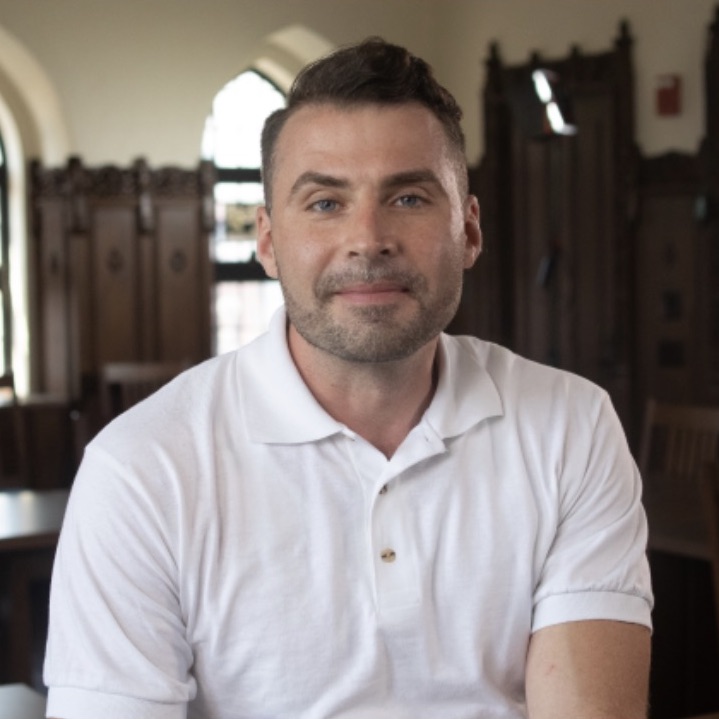
Having introduced the fellows as a group earlier this year, we’re excited to spotlight them individually and learn more about their work as the program progresses. Brandon Barr has taught Language Arts at public middle schools in Chicago for 17 years. Barr studied Spanish as a young adult and gained an interest in translation while working with bilingual students and families as a teacher. He was first introduced to Poetry Inside Out during the pandemic and embraced the fellowship as an opportunity to further students’ engagement with poetry in translation as classrooms readjust to in-person learning.
What have you gained from the Teaching Fellowship so far?
I have appreciated being able to reflect on my teaching practice with other teachers on a regular basis. The way the Fellowship is framed, we engage in inquiry collaboratively. This positions us to be curious about our profession, stepping back and observing our work with a freshness that is hard to achieve for veteran teachers. I like thinking about the effectiveness of the activities that we are using, finding new ways to assess student growth, and building stronger classroom discourse between students.
Tell us more about your research / curriculum-building project. How is it going? Anything you’re particularly excited about?
Now that our accordion books [made during a workshop at the Teaching Fellowship retreat] are constructed, I am excited to use them as a tool for further reflection and thinking. In March, my classroom will have a residency with the Chicago Poetry Center(opens in a new tab) for a poetry residency, where accordion books will be put to use as a place for students to write their own poetry after interacting with the translated work of a poet. I was inspired by my participation as a Teaching Fellow to write a grant proposal and organize this residency for my class, and now, all of these pieces feel like they are falling into place for a powerful learning experience.

What do you hope to make of the rest of your time as a fellow?
I look forward to diving into new PIO poem pages that I have not used with students yet, building my accordion book practice and developing models that I can use with future classes, and seeing my students’ engagement grow. A couple of my students have already latched on to PIO practices in promising ways; it is exciting to think what they will accomplish with more time.
How do you see the skills you’ve gained during the fellowship benefitting your students in the future?
I found the Day of Translation really interesting. I had never thought before about how students consume and process information at the intersection of image and text. That is where student engagement in literacy lives, and my instruction needs to be responsive to their needs. The way that I have approached my instruction is very dependent on words only. The accordion book practice provides my students with a way to reflect across media and refine their thinking through new connections that cannot be as easily achieved with words alone.
We will begin accepting applications for 2023-2024 class or PIO Teaching Fellows in early spring! For more information please contact Poetry Inside Out Program Director Mark Hauber: mark@catranslation.org