CAT Book Club: Introducing Empty Set
First of all, thank you to everyone who came out to Green Apple Books on the Park last week to see Madame Nielsen in conversation with Veronica Scott Esposito! More on our takeaways from that event soon.
In the meantime let’s take a look at our next book in the CAT Book Club:
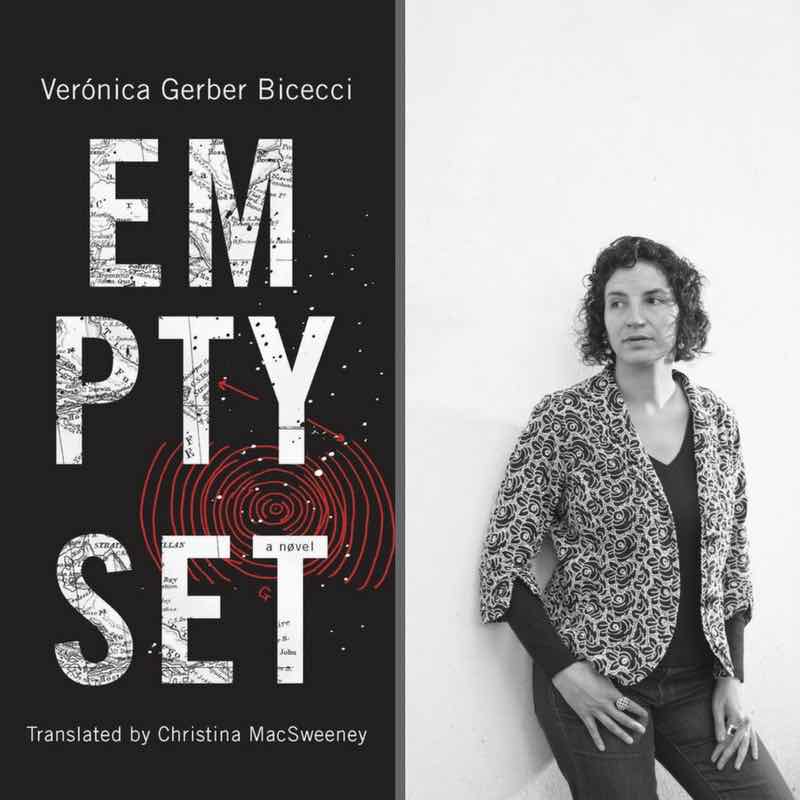
Empty Set(opens in a new tab) by Verónica Gerber Bicecci, translated from Spanish by Christina MacSweeney.
What is this book?
This book has been called a lot of things: an “experimental novel(opens in a new tab),” a “Venn diagram for love(opens in a new tab),” an “artfully constructed meditation on loss(opens in a new tab),” a “lucid story and also an art object(opens in a new tab),” a “Rubik’s Cube in the best possible way(opens in a new tab),” even “an antidote to the current climate of despair(opens in a new tab).” There seems to be a plethora of words used to describe this book, which blends real life and fiction, text and image.
There are diagrams, illustrations, letters written in coded messages that the reader has to disentangle. One reviewer(opens in a new tab) responded to the text with an illustration of his own. And another(opens in a new tab) wrote, “I can’t say I’ve ever read anything like it—a novel, sure, but with the spirit (and sometimes the form) of poetry, or linked short stories, along with drawings and a fascinating epilogue on how it was translated.”
In a recent interview(opens in a new tab), Verónica Gerber Bicecci said:
I’m not even sure if Empty Set is a novel. From my way of seeing things, it is an art project, like any other I’ve done before. The thing with this piece is that it comes in a book and you have to read it instead of going to an exhibition space. So, to me, it’s an artifact in the medium of a book.
Empty Set is also about trying to combine writing and drawing—to understand how to tell a story using drawings, to tell things that words say differently. Or to use the drawings to see something you can’t see in another way—to have another perspective of the story through diagrams. So: I like to think of Empty Set as an in situ installation in the field of literature, and this is not my idea—a fantastic curator, Roselin Rodríguez, described it this way.
What is the role of the translator?
Earlier this week I was reading Eric M. B. Becker’s essay “What Is a Translator?”(opens in a new tab) In it, he manages to articulate very clearly thoughts I am constantly juggling. His questions appear simple but reveal wide chasms within the field of translation: namely, what a translator is and what it is a translator does. He articulates it this way: “Are translators, to borrow a phrase from Paulo Rónai, ‘modest intermediaries in the relay of someone else’s messages,’ or are they, as is increasingly averred, co-authors?”
Enter Empty Set. This book highlights how collaborative the translation process can be and, in the paradigm set up by Becker, definitely veers toward co-authorship between author and translator. In the translator’s note, “Email Set,” which acts as a kind of epilogue, we witness the often-unacknowledged collaborative process that goes into every translation. Translator, author, and editor (Lizzie Davis of Coffee House Press) work to find a solution to a specific translation problem. This addendum is unique in that it appears within the style of the novel itself, complete with new drawings Verónica Gerber Bicecci made specifically for this English edition. Rather than a kind of afterthought to the whole book, like most translator’s notes, this one folds into the text naturally, becomes a part of it.
In a moderated conversation on The Rumpus(opens in a new tab), Verónica Gerber Bicecci and Christina MacSweeney had some very illuminating things to say about the translation process.
Verónica Gerber Bicecci:
It was a beautiful process. To me translation it is a process of creation, I wanted very much that Christina appropriate the text as much as possible and tried to comment to help in that appropriation process.
And Christina MacSweeney:
I think that translation is less of a tightrope than a reaction to the original text, a means of finding a way through it. Working with text and drawings was something new for me, but it was great: sometimes I felt I was reading the text and looking at the drawings, and sometimes it was like reading the drawings and viewing the text.
We interviewed Christina MacSweeney last year about her translation of Elvira Navarro’s A Working Woman, what sparked her love for Spanish-language literature, and her thoughts on the gender disparity in translated literature.
Verónica Gerber Bicecci and Christina MacSweeney will make a special joint appearance in San Francisco on March 29 to discuss Empty Set. Join us!
Sarah Coolidge (they/she) is a queer editor and musician based in Oakland. They have worked at the Center for over a decade, serving as editor of the Two Lines journal before launching the Calico Series in 2020. They’ve had the honor of working with countless translators they admire and have edited work by Mariana Enriquez, Iman Mersal, Pirkko Saisio, Dorothy Tse, Wilson Bueno, and Elena Garro, among others.