Jazmina Barrera’s Linea Nigra in Conversation
Highlights from the vibrant dialogue surrounding the book, on motherhood, birth-as-translation, and more.
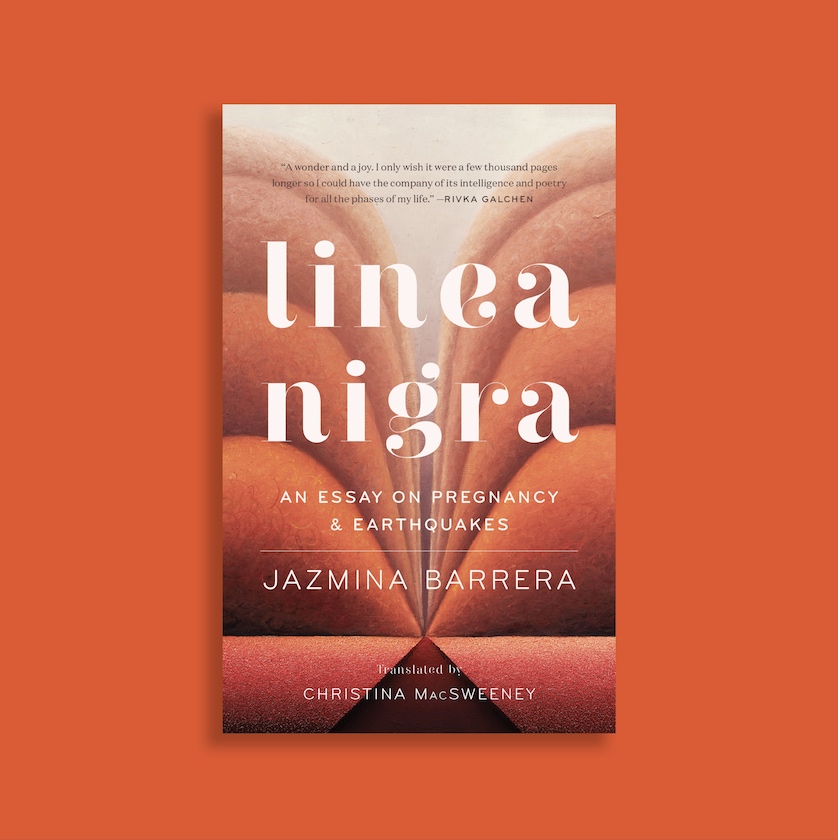
Since its release last month, Jazmina Barrera’s book Linea Nigra, translated by Christina MacSweeney, has become a node in a vibrant, multifaceted public conversation about motherhood, childbearing in literature, and Spanish-language feminist writing.
Between a book tour, a literary festival, and a wave of stellar, thoughtful reviews, the dialogue around Linea Nigra has been full of dynamic insights in writing and at spoken events, helping to expand the scope of conversations about “writing the body,” literary criticism, and more.
In the lead-up to Of Moons and Lines, Barrera’s conversation with Gabriela Wiener and Rivka Galchen as part of Brookline Booksmith’s Transnational Literature Series this Saturday, June 18 at 12 p.m. EST, let’s take a look at some of the highlights in the public and literary engagement Linea Nigra has enjoyed so far.
On May 12, as part of her book tour, Jazmina appeared at Books Are Magic in Brooklyn to discuss Linea Nigra with Kate Zambreno, the author of To Write As If Already Dead. You can watch their conversation here:
This event wasn’t the only time that Jazmina’s work was put in dialogue with Kate Zambreno’s; in her article for Astra Magazine entitled “Art Criticism That Pauses to Breastfeed,” Nikki Shaner-Bradford reflects beautifully on the two writers’ most recent books, both written in fragments as they simultaneously reckoned with pregnancy, illness, and other experiences that reshaped their notion of what the work of the critic really is:
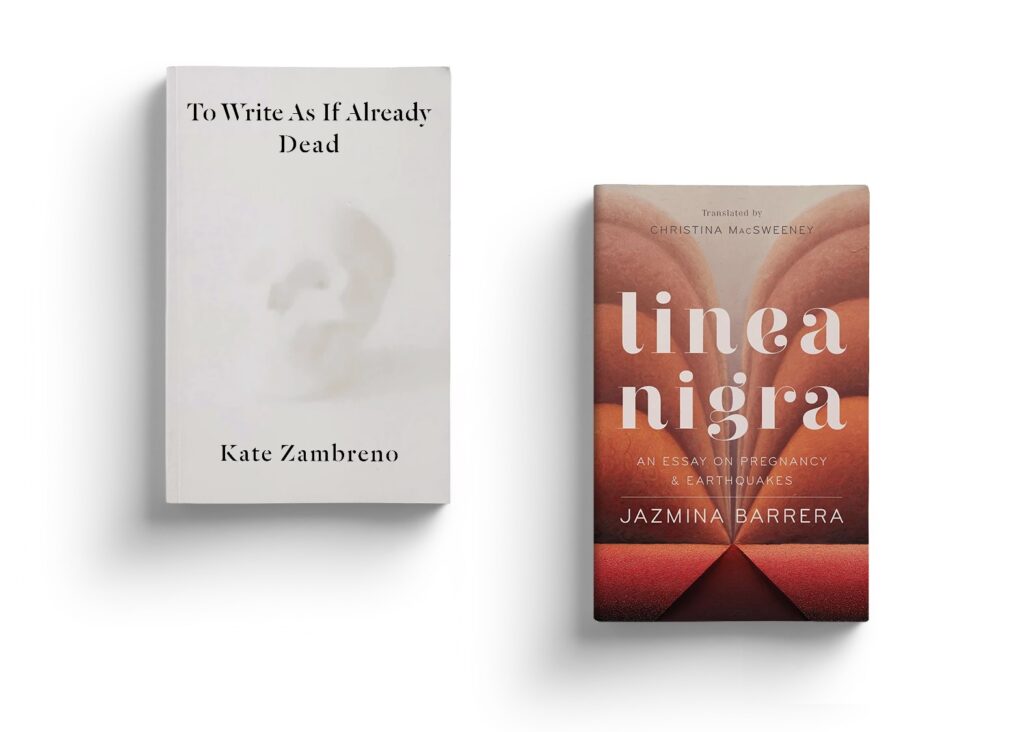
“Jazmina Barrera and Kate Zambreno put forth a form of writing inspired and shaped by the body… Each offers a kind of literary doppelgänger for the other, unintentional companion pieces that paint two portraits of the writer as a mother. Together they assert a model of writing that is constantly aware of the body. Art criticism that pauses to breastfeed.
…These are books of interruptions. Barrera and Zambreno document their processes — Barrera typing notes into her phone while she breastfeeds, Zambreno recovering from illness in the space of her notebook — but then a baby cries, the seismic alarm sounds, a contraction comes, Barrera’s mother is diagnosed with ovarian cancer, Zambreno develops shingles, paid projects take precedence, the body is weary. Both writers are meant to be writing other books than the ones we are reading.
…Perhaps the “question” of writing the body will cease when more writers, like Barrera and Zambreno, remind us of its omnipresence. It went into the page somewhere, even if you can’t see it right now. It’s embedded.
Should the critic have a body? Would it be a distraction or an aid? For Barrera and Zambreno, it’s both.
I am typing this now with both hands. I wonder, how are you reading it? How many breaths have you taken? How long until we forget ourselves again?”
Read Shaner-Bradford’s brilliant piece in full here(opens in a new tab).
Malwina Gudowska eloquently approaches Linea Nigra as a starting point for a larger discussion about translation-as-birth, and birth-as-translation in a review for Lit Hub(opens in a new tab):

“Barrera’s nods to translation throughout the book, originally published in Spanish, and ones I read in English, translated by Christina MacSweeney, illustrate how using multiple languages to explain and to interpret pregnancy and motherhood offers a point of contact. Mothers are all speakers of a similar vernacular of pre- and post-motherhood, even though the language is often too arduous to articulate, while at the same time, the uniqueness of each motherhood experience robs them of a common language.
…Both translation and motherhood change the rhythm of a story where languages must coexist and the original text, just like the pre-motherhood being, is somewhere between them, between selves. Translation is constant choice and endless sacrifice, a search for meaning in chaos and a call for interpretation at the most profound level, as is motherhood.
…It is a practice that appears often in motherhood memoirs, a search for the origin story of a term or idea to help find purpose and clarity in one’s own narrative.
Translation also occurs in fragments: word-level equivalence, grammatical equivalence, textual and pragmatic equivalence. In each case, the collection of fragments creates a continuity and a whole, both lived experiences redefining notions of what is unique yet ordinary. Like motherhood, translation is the beginning of a story, a new version of an old self.”
Read more from Gudowska’s piece, “On Jazmina Barrera’s Linea Nigra and the Untranslatable Experiences of Motherhood,” here(opens in a new tab).
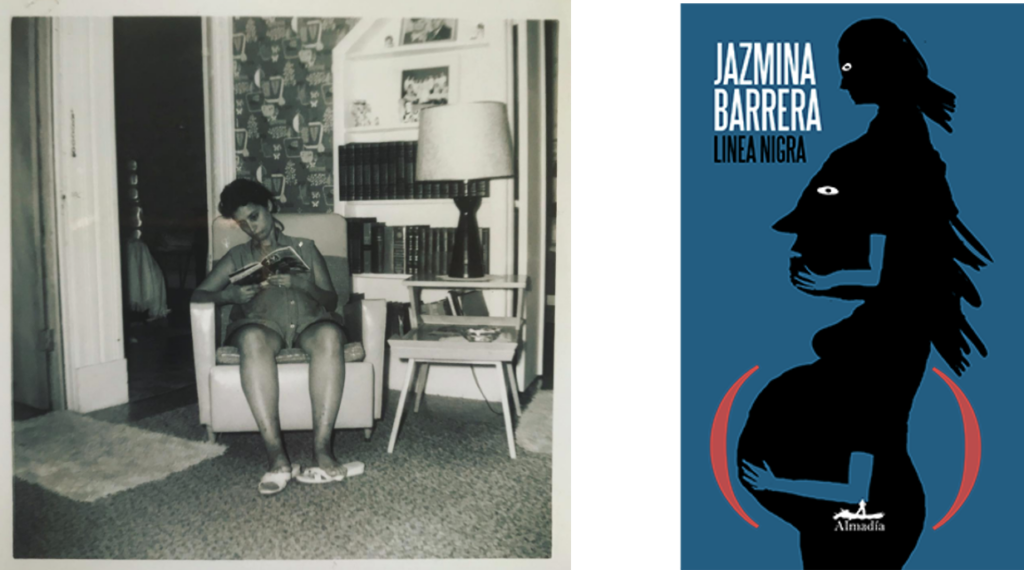
Finally, take a look at Nichole LeFebvre’s piece in the Los Angeles Review of Books(opens in a new tab), where she ponders Linea Nigra as an exemplary meditation on how life can spring forth from darkness and catastrophe:
“…A few years ago, I met a botanist and forester named Rose… [who] told me that forests know how to manage themselves, citing the Monterey pine, a tree indigenous to California and Baja California, Mexico, as an example. The Monterey pine procreates under duress. Their serotinous pinecones, glued shut with strong resin, only open in response to extreme heat.
The Bay Area, where I live, has often felt like it’s shouting at me to leave — wildfires that turn the sky orange, the ever-present threat of the Big One — and as my partner and I plan to start a family, I question how we can create and celebrate life throughout, and in spite of, this time of widespread environmental destruction. In Linea Nigra, Barrera veers toward optimism in the face of crushing darkness — a stance that I find refreshing and admirable. And, toward the book’s conclusion, she arrives at her true task as a parent: ‘He didn’t ask to be born: we asked him. It’s up to us, at least in the beginning, to make living worth the effort. To make it better than nothingness.’ I keep coming back to the Monterey pine, offering hopeful solace, akin to Barrera’s earthquake, that life on earth is cyclical, regenerative. We walk the steps of those who came before us, be they artists, writers, mothers, or Monterey pines. Wildfires make way for the next generation.”
You can find LeFebvre’s full review here(opens in a new tab).
Don’t miss more reviews of Linea Nigra in Litro Magazine(opens in a new tab), the Chicago Review of Books(opens in a new tab), Kirkus Reviews(opens in a new tab), Foreword Reviews(opens in a new tab), and Publisher’s Weekly(opens in a new tab)— and catch Jazmina, Gabriela Wiener, and Rivka Galchen at their virtual event tomorrow.
Thank you for all your thoughtful readership and engagement with the book. To many more fruitful conversations in the future!