Literary Translation Between Academia and Public Humanities: Radhika Prasad and Kelsey McFaul
A conversation about the shifting roles of translators and texts between the university and the press
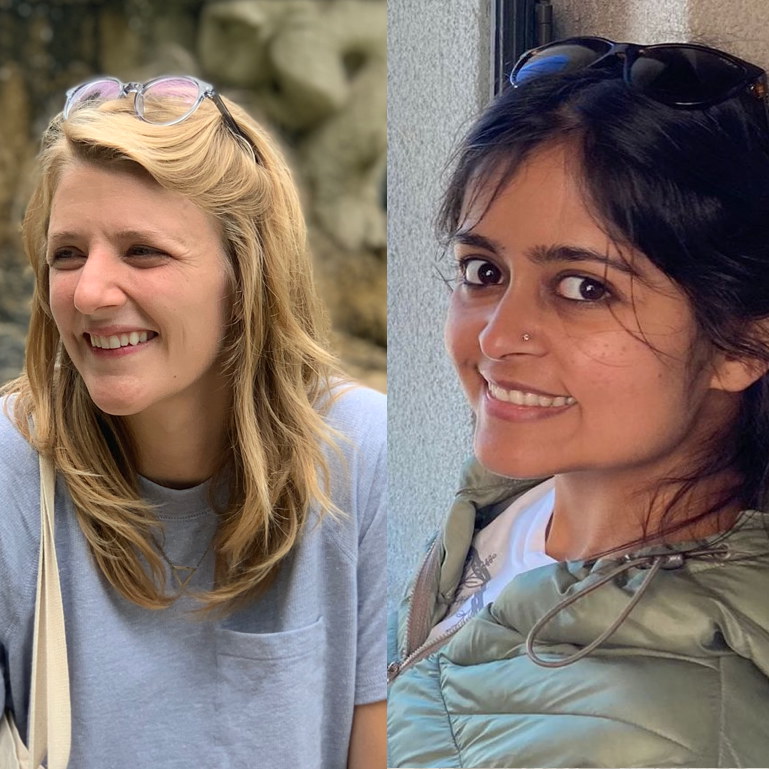
In 2020, the Center for the Art of Translation welcomed Kelsey McFaul as its inaugural Public Fellow(opens in a new tab) sponsored by The Humanities Institute at the University of California, Santa Cruz. Kelsey’s work as a PhD candidate focuses on literary traditions in the Horn of Africa in the twentieth and early twenty-first centuries. Kelsey’s work as a PhD candidate at UCSC focuses on literary traditions in the Horn of Africa in the twentieth and early twenty-first centuries. She explores how African language novels reframe “the work of African novel,” especially relating to Afrocentric relationships to nature, language, and form. Kelsey began working with the Center to find ways to support the translation of African language literatures, and since transitioning to her current role as Research and Special Projects Coordinator, has been instrumental in making Two Lines Press’s publication of No Edges: Swahili Stories a reality.
Radhika Prasad, who is also a PhD scholar at UCSC, works on Hindi literature of the post-independence period in India, i.e. the 1950s-1970s. She is interested in how language and literature played a role in overlapping processes of decolonization that swept the globe in the mid-twentieth century. As the 2022-23 THI Public Fellow for CAT, she has been seeking out connections with translators working from Indian languages, which has involved (in her words) “a lot of careful listening to, and watching, the intricate workings of a press.”
Working between the often siloed fields of academia, public humanities, and publishing, Kelsey and Radhika stand at a unique intersection in the world of literary translation. Here, they reflect together on the varying cultural and material positions of translated texts—and of translators themselves—across different literary landscapes. Their conversation has been edited for length and clarity.
Kelsey McFaul: Hi Radhika, it’s been so wonderful to have you join the Center for the Art of Translation as a Public Fellow this year!
When I was a public fellow, I was surprised how much my work with the Center and my academic project worked hand in hand and informed each other. The Humanities Institute’s Public Fellowship program(opens in a new tab) seems to really facilitate such an engagement between academic research and public organizations, allowing graduate students to explore their skills outside of the academy. I’ve loved discovering this synergy between different parts of my life. But I’m curious how you relate to the idea of “public humanities” and what it means to you.
Radhika Prasad: Having inhabited university spaces for a long time, it took me a while to understand what the public humanities were all about, but experiencing the American academy as well as the crisis of academia up close has changed my perspective. Academia is a very paradoxical space. On the one hand, scholars put a lot of work into studying issues that they find deeply meaningful and consider important to society; on the other, they often fail to “translate” those beliefs to the world outside of academia and often remain trapped within circles that both understand their jargon—and might even hold the same beliefs. The idea of “public humanities” forms an integral bridge between the potential insularity of academia, and a lively intellectual world outside of it, that is keen to engage with the arts and humanities in, perhaps, more lived terms.
It’s been wonderful to have the opportunity to work with CAT as a THI public fellow. In the past few months, I’ve found it fascinating to move between academic spaces and CAT meetings, and to see how conversations around publishing literature in translation are equally informed by literary history, the politics of writing, the pleasure of reading, and the demands of the market. This approach makes it in some ways similar to academia, and in others, radically different from it. But I like your use of the word “synergy” to describe your simultaneous experience of academia and public humanities. What does that look like for you? I’m especially curious to hear how it shaped your recent work on No Edges!
KM: My academic work focuses on how literary texts exist in relation to one another across the boundaries we typically use to organize literary study, like language or nationality. Rather than maintaining those boundaries, I’m trying to sense the ways texts build networks of connection through shared literary language, thematics, and formal choices.
When I began the project of seeking out Swahili literature in translation for what would eventually become No Edges: Swahili Stories, I found myself thinking about it in a similar networked way: it was important to me to try to understand the Swahili literary landscape before considering the potential role of translation or Two Lines Press in this space. I reached out to folks in many parts of the Swahili literary ecosystem: professors in East Africa, the US, and Europe, Swahili language teachers, established and emerging Swahili translators, and English language writers who also spoke Swahili. This network of interlocutors and conversations deeply informed the project, and I’m so grateful to all of them.
Working with the Center has also helped me learn and grow new ways of reading beyond academic analysis, including attention to how a text relates to those around it, to the list and ethos of a given publishing house, and to the wider English literary ecosystem. And it’s also taught me that thoughtful conversations about literary language, history, and nuanced interpretation are not exclusive to academia but possible in publishing as well.
How have you experienced the movement/relationship between academia and public literary spaces as part of this fellowship?
RP: Recently, my work for CAT has involved contacting translators to inquire about their current projects, and it’s been a pleasant surprise to see how many of those translators have become important interlocutors for the guiding questions of my academic research. The small talk that our conversations begin with quickly turns into a much more generative conversation about the stakes of translation. The knowledge that I have gained from hearing translators talk about the writers they work on, their relationship with the languages they translate from and into, and the publishing market for translations from Indian languages in India and in the US has been invaluable.
I should add that moving from the academy to public literary spaces has also been somewhat overwhelming: it has made me sharply aware of the insularity of the academy from spaces where literature is actually being produced, not just in the sense of writing, but also in the sense of the printing, marketing, reading, and sale of books.
While having an experienced eye with regard to reading literature for its politics and ethics has been useful in these literary spaces, I am also learning how to temper the impulse for analysis with a curiosity about the readerly experience. Being a student of literature means that your enjoyment of it relies deeply on an understanding of its nuts and bolts–historical context, narrative form and style, characterization, etc. Working with publishing has encouraged me to take a step back and resituate the pleasure of reading from that framework of academic reading, back to the text.
KM: Entering a new literary space outside academia was overwhelming for me too. At first, I was intimidated by the amount of terminology and systems that are part of the book industry but that I’d never encountered before: typesetting, trim size, cover treatments, printing, distribution, software for tracking book sales. Considering how much time we spend thinking about and even historicizing books in an academic context, I was surprised to learn I had hardly any knowledge about their materiality and production!
Of course, it’s especially fun to learn about those aspects in a place like the Center, where there’s real attention both to translation as an art and to books as objects that can be beautifully crafted. Working in publishing has certainly made me think more about the material conditions of the texts I study, as well as how academia often enacts disembodied, dematerialized relations to texts. I’m curious what you think about this—about what a text stands for in academia versus in publishing. Has working in these spaces changed or developed your views of what a text is and how we relate to it, especially when it comes to a translated text?
RP: I’ve been thinking about the ways in which the Covid-disrupted supply chain affected the production of books, something I heard about early on in my fellowship. Then there’s the fact of the inaccessibility of academic texts as books, and their availability being limited—especially but not only during the pandemic—to e-books, words on a screen. It’s interesting to see how academia both tries to theorize these forms of materiality and is trapped within it.
I agree with what you say about the “disembodied, dematerialized” way in which academia engages with texts. What really stands out to me, however, is the way in which academia treats the text as an object of analysis, and publishing treats it as an object of pleasure. Of course, analysis and pleasure are not mutually exclusive; ask any literature undergrad and they would profess to take great pleasure in analysis, and no intelligent reader would read without at least a modicum of analysis.
But at the same time, what is pleasurable to analyze may not always be pleasurable to read, and vice versa. The text in publishing contexts— especially at independent presses like Two Lines— is able to stand its ground within dense circles of questions, incoherencies, inconsistencies, and oddities that an academic approach often feels compelled to parse out. There is so much space for leaving questions unanswered, which in itself is a singular approach to engaging with literature and translation—to encounter what is strange without explaining it (away).
KM: I agree with you that analysis and pleasure are not mutually exclusive, and this seems especially true for many of the literary translators I’ve gotten to know. Literary translators engage in deep literary analysis and research of their texts and also delight in the difficult, cloudy, lingering questions that translation raises. The pleasure of translation seems to come as much (or more) from the ruminations and debates about literary language as from the satisfaction of settling on one of many creative, artful solutions. This posture, which creatively communicates indeterminacy and unanswered questions, differs from my experience of translation as an instructor and as a student researcher in academia, which, as you say, often at least attempts to resolve those questions more swiftly.
For me, the value I most associate with academic translation is accuracy. Students translating short stories in a class like Translation Theory, for example, are often focused on whether their translation is accurate and attempt to find the “right” way to transmit a word or phrase from one language to another. Sometimes I see myself and other academic colleagues falling into the same patterns in how we treat translation within our research projects. My impulse to “accurately” translate a text might manifest as staunchly maintaining sentence structure (rather than reordering according to English syntax), providing a literal translation of idioms, or using footnotes to provide cultural or historical context. None of these methods are bad in and of themselves. But they do eliminate some of the mystery, or the untranslatability, of a text. And they can envision the academic translator as a transmitter rather than a creative practitioner who is to address the incommensurability of languages in incomplete, messy, inventive ways.
How do you think the practice of translation, and the role of the translator, are regarded in literary studies and in independent publishing?
RP: My own engagement with translation in academia has, like you, entailed teaching translation theory to undergraduate students. In that regard, it’s been interesting to take a step back from the process of translation in an academic context and think about the product of translation in a publishing context. I’ve enjoyed zooming out from questions about what a word or phrase is translated into and why, to observing the full effect of the finished translated piece. And while I’ve had such generative conversations with translators about their languages and processes of translation, their ability to balance an analytical approach with a distant reverence, even unquestioning love, for the texts they translate is fascinating.
When thinking about translation in academia, it’s hard to overlook the minimization of the labor of translation. While many academics and graduate students undertake translation for purposes of their work, there’s little to no professional value attributed to it. Correspondingly, in literary studies, too, the translator often ends up remaining a “transparent” entity who makes the text available to a mostly Euro-American readership. I think there’s a lot of work to be done to incorporate the figure of the translator into the processes of reading, analysis, as well as recognition in the academy.
KM: That’s true of mainstream book publishing too, as recent conversations about translators’ names on book covers and the #NameTheTranslator campaign have shown.
RP: Exactly. And for this reason, the work done by CAT and Two Lines Press, and other presses like Tilted Axis and Europa Editions, which are deeply invested in publishing translations, is so significant—not only in their publication of translated literature but also in the machinery of publicity and marketing around it. These presses have taken upon themselves the rather difficult task of making translators visible, making them part of the discourse around writing and publishing, and most importantly, fostering an audience for literary translation that is able to actively appreciate the mediations involved in it. In my time at CAT, it’s been fascinating to observe how much thought goes into considering both how a translation reads or sounds, and the subject position of the translator themselves.
Perhaps it is because of the devaluation of the labor of translation that even though I have to undertake many forms of translation for my own academic work, I have never thought of myself as a “translator.”
KM: I’ve also avoided thinking of myself as a translator, but I think this is because I very much feel like a student of the literature I work with and, relatedly, a student of translation as well. While acknowledging that my academic training might lead me to be perceived as a specialist, I feel most at home acting as a bridge: on the one hand, insisting on the important and exciting contributions of African language literature to the American academy and literary world, and on the other, working to make the structurally unequal systems of global academia and publishing more accessible and equitable, to lift back the curtain on those systems and also to unsettle them.
Another inflection point within this tension is the text as a commodity object. My sense is that translated literature that circulates widely has constructed its cultural capital on a very delicate balance of its perceived difference and perceived universality. But I’m fascinated by how translation makes it possible for texts to circulate differently in different contexts and the insights those circulations might have for us.
RP: I completely agree with what you’re saying about acting like a bridge–on the one hand, making a rich archive of writing in non-metropolitan languages available to a metropolitan American readership, and then making certain opportunities for wider readership and exposure available to translators and writers in other parts of the world. I think that our different positions as individuals familiar with particular non-American cultures, as well as with American expectations (to some degree), is what equips us to act as bridges.
While my correspondences with translators begin with my connections to Two Lines Press, they often end up drawing me back from the space of American publishing and forward into the South Asian intellectual landscape. I think that many of the translators I speak to are quite surprised to find that I am perhaps more like them than they expected me to be as someone affiliated with an American publishing house. However, I find myself worrying that these translators see me as a representative of a somewhat ‘provincial’ Western readership that will ultimately not know how to appreciate their work.
This is part and parcel of the structural inequality you mentioned. While most of the world has some familiarity with Western culture, history, and politics, the reverse is not true. This is what makes the work of presses that publish translations doubly significant. Not only are they making visible the work of translation, but also pushing back against a historical tide of Western cultural dominance and insularity.
Radhika Prasad is a PhD candidate at the University of California Santa Cruz and was the 2022-23 Public Fellow at the Center for the Art of Translation.
Kelsey McFaul is part of the editorial staff at Two Lines Press. She has a PhD in literature from UC Santa Cruz with a focus in African language literatures. She first joined Two Lines as a Public Fellow in 2020–21, supporting the creation of No Edges: Swahili Stories.