On a Woman’s Madness: A Conversation with Astrid Roemer
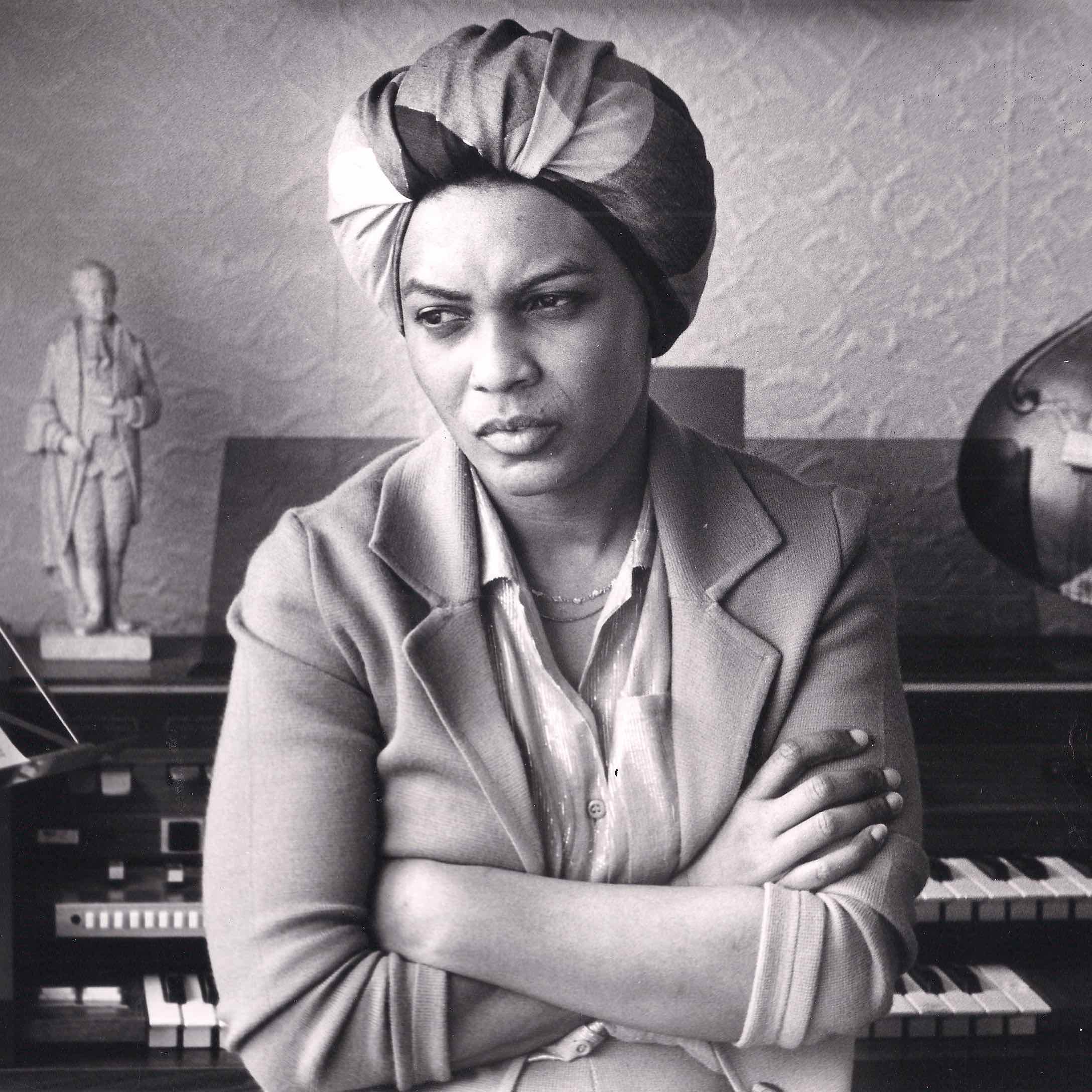
Roemer speaks to Two Lines Press about the genesis of her daring novel of queer love in Suriname, out from Two Lines Press on February 21.
A classic of queer literature that’s as electrifying today as it was when it originally appeared in 1982, On a Woman’s Madness tells the story of Noenka, a courageous Black woman trying to live a life of her choosing. Translated into sensuous English for the first time by Lucy Scott, Astrid Roemer’s intimate novel—with its tales of plantation-dwelling snakes, rare orchids, and star-crossed lovers—is a blistering meditation on the cruelties we inflict on those who disobey. Roemer, the first Surinamese winner of the prestigious Dutch Literature Prize, carves out postcolonial Suriname in barbed, resonant fragments.
To celebrate the novel’s release— coming in just five days, on February 21— we’re sharing this conversation with Astrid Roemer, where she speaks about the influences and memories that helped her the vibrant, elemental world of On a Woman’s Madness. Enjoy, and be sure to keep an eye out for the book at your favorite independent bookstore next week.
Two Lines Press: On a Woman’s Madness is set in Suriname and follows the life of Noenka, a young Afro-Surinamese woman. Can you tell us more about the time period and cultural context Noenka is living through? What are some of the expectations placed on Noenka, and what possibilities are available to her?
Astrid Roemer: Although I wrote the book in the 1970s and projected the characters into 1960s Paramaribo, it’s becoming clear to me now that I’ve lived in Suriname again for some years that women’s personal lives have not changed significantly. The fact that women are migrating to the Netherlands in large numbers is new. But the struggle with vestigial colonial structures and prejudices has made way, to a great extent, for something different: religion and traditional cultural assumptions. And those provide structure and stability in the lifestyles of women young and old. Noenka is expected to behave herself, and that means she has no choice but to work as a teacher, find a husband, marry, and start a family. Noenka is willing to choose that path at first, but it gradually makes her feel deeply miserable. She longs for other possibilities, without knowing what they might be or being able to articulate them. She wants a life that makes her happy.
TLP: Noenka describes her name as meaning “never again.” Can you tell us about the significance of Noenka’s name and how she sees herself? What were the origins of this character, and what inspired you to write her story? How would you describe Noenka’s story both in the novel and in your writing process?
AR: “Noenka” has a Brazilian connotation and means something like “never again.” And this position relates to her mother’s marriage, which she felt was not gratifying for her parents. Too many colonial conflicts that could not be resolved. She was determined not to repeat this pattern in her own life. I was spurred to write this novel by the audacious feminist books of Erica Jong and Anja Meulenbelt. My own unstable life with the man I loved with all my heart and soul, as well as the difficult existence of many of my contemporaries, drove me to write about an Afro-Surinamese woman’s life in Suriname. In brief: For a woman in post-colonial Suriname, is it possible to be happy? That was the kind of question in my mind as I started writing. On a Woman’s Madness tells the story of a young Creole woman unwilling to settle for ways of life that serve, rather than her interests as a woman in love, the economic demands of patriarchy: to bear children, to care for your husband, to preserve the nuclear family as the cornerstone of society.
TLP: When you were writing On a Woman’s Madness, who were some of the writers that you were reading and were inspired by? What books did you want this novel to be in conversation with?
AR: The whole time, I listened to jazz vocalists and to soul and pop music. J.S. Bach and Mozart in the evenings. I read essays about homosexuality. Until I was twenty, I’d had no idea that such a thing existed. I enjoyed Dutch cabaret and was passionate about that variety of Dutch. And I kept my cosmology library up to date. While writing this novel, I just kept thinking, What will my dear lover think of this?!
TLP: You’ve described On a Woman’s Madness as a “fragmentary biography.” Can you tell us why you chose the fragmentary form for this novel and how it relates to Noenka’s narrative? Can you also expand on how this novel engages with biography?
AR: I have an inborn urge to look at everything from multiple perspectives. Among the family in my maternal grandparents’ house, there were always so many different points of view—as well as differences of opinion that led to conflicts. I always had the feeling everyone was “right.” I made a writing plan: to compose a fictional biography in a form that would symbolize the ruins of Noenka’s existence. Only when I write short stories am I purely chronological, anchoring myself in the here and now. A fictional biography, like my own autobiographical work, is layered like sediment, and I, as the author, break up that sediment like a kind of treasure hunter so that I can write a cohesive narrative about a hidden history. At the same time, I also wanted to make it abundantly clear that Noenka is not Astrid Roemer, the writer herself!
TLP: Orchids infuse the novel with their color and perfume. What is their thematic significance? Can you speak to the importance of the sensory and sensual in On a Woman’s Madness?
AR: I know it is through the senses that everything reaches us, reaches me. I also use the senses as perspectives that bring me information. I am aroused by aromas that bring me information I cannot understand. And flowers play a role in this. I’m crazy about perfume. As a baby, I found myself in my grandparents’ house, where delicious food was boiled and baked and concocted daily, and my uncles and aunts put a lot of energy into their looks and their fantasies. I’m sure I picked up some kind of addiction to wonderful fragrances there. The orchid came to me during the writing process, as did the snake. These symbols are inherent to the novel, the way a birthmark can be inherent to a child’s skin. Some things just happen, emerging spontaneously as I write.
TLP: Your first book was a collection of poems, and you’ve also written plays. Can you talk about how your work as a poet and playwright has informed your novels?
AR: I started out by writing poems and lyrics. Don’t know why. Maybe because they’re short forms. I also wrote for musical theater. And writing a large-scale opera is a good fit for me. Yet there’s something intimate about the novel that I cherish. I love intimacy, face-to-face contact with a person—and face-to-face contact with the pages of a book in which the author lies concealed.
TLP: What are your thoughts about the fact that this novel is now being translated into English and can be shared with English-speaking readers for the first time?
AR: I am truly overjoyed that this will become an English-language novel, because some of my ancestors from colonial times spoke English. As a matter of fact, the conflict in my grandparents’ house between descendants of colonists and descendants of enslaved Africans—a conflict that is hard to articulate and has a linguistic dimension—may be represented in literary form in On a Woman’s Madness. This novel has English at its heart!