On Dry Land: Fifth Graders Explore Angel Island
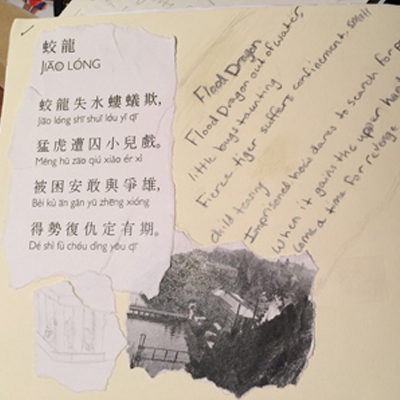
One of the poems carved into the wooden barracks on Angel Island begins with the image of a water dragon on dry land. Removed from their homeland, nearly one million immigrants from China, Japan, and other Asian countries entered this island in the middle of the San Francisco Bay between 1910 and 1940, spending months—sometimes years—living in the drafty barracks, awaiting news about whether they would be allowed to enter the United States.
This past April, seventy-five years after the station’s closure, a class of fifth graders from San Francisco’s Presidio Hill School hiked up one of the island’s steep hills to their campsite, pulling along two wagons full of camping gear and carrying anything else they might need during their overnight stay on their backs. The trip marked the culmination of their unit on the Angel Island Immigration Station.
Michelle Fix, the classroom teacher, explained that the entire unit was based on simulating the immigrant experience. The classroom was transformed, as it became first a steamship, then the station itself. The students held mock interrogations, in which they were given actual case files of family members who would have had to explain the incongruences in their paperwork. The class read several books and looked at photographs from the Immigration Station, asking: What’s going on? How are the people in these photos feeling?
According to Ms. Fix, besides the dedication and enthusiasm of the students, the most amazing part of the experience was the way in which several Bay Area organizations partnered to extend the lesson beyond the classroom. The students ventured to San Francisco Center for the Book, where they made journals so that they could write down their thoughts, impressions, and experiences throughout the unit.
Poetry Inside Out brought poetry into mixture, guiding the students through a translation of one of the anonymous poems that was carved on the barrack walls. Here the students delved into the actual language that immigrants had used to express their experiences. Translating the poem was not easy.
The students struggled with the characters and syntax of Chinese and had to work to guess meaning of the poem’s startling imagery. In particular, they debated the meaning of one troublesome line: was a tiger taunting a caged child or a child taunting a caged tiger? Ms. Fix remembers this moment well: “I remember when I translated the poem before our lesson, I assumed that the speaker as feeling like a child, powerless. It hadn’t occurred to me to think of the scene literally. It was another instance in which I learned from my students.”
The final touch came in the form of a 65-foot sailboat. The group had the chance to enter the Bay from the Golden Gate Bridge and sail toward Angel Island, just as so many immigrants had. Aboard the Baylis, armed with their journals and poem pages, they listened to a man tell his grandfather’s story of arriving at the very station they were now approaching. Along the way, they also learned a bit about the ecology of the bay, testing the water quality and identifying plankton. When they landed, they took their possessions and set off up the hill toward their campsite for the night.
The next day, they walked to the Immigration Station. The pamphlets they were given outlined the different rooms of the barracks and listed the poems found in each room. One particular room on the first floor had been a bathhouse, then a storage room.
There they found a poem more distinct than the others. It had been covered for decades by shelves, and was therefore well preserved. Some of the other poems were extremely faded, though you could still make out the etched lines of the characters on the dusty brown walls.
The students’ desire to touch the poems was palpable, though that was not allowed. Tired and hungry, they wandered through the rooms with their journals opened to their poem pages and translations. At last, they came to the room where the poem they had translated was supposedly located.
It was not easy to identify the characters among the faded scratches on the wall, but when someone finally found it, the entire class gathered around to see the real poem they had discussed in their classroom. Ms. Fix described the moment as the perfect end to the lesson. As she said, “It brought the poem alive.”