To My Dead | Third Day Unceasingly
I should have been taking care / of their voices, the warmth of their hands, / making sure the door was closed as they left…
Halottaimhoz
Májat sütöttem, és citromlevélből, finom fűszerekből
készítettem ágyat neki, hogy illata idecsaljon
Halottaimhoz
Májat sütöttem, és citromlevélből, finom fűszerekből
készítettem ágyat neki, hogy illata idecsaljon
benneteket, menekülő halottaim. Megismertétek
a szív halálát, a szomjúságot, ami kínzóbb és
reménytelenebb, mint ahogy a szárazföld
belsejében lakók vágyakoznak a tenger után?
És megismertétek a sárga romlást, ami a tüdőt
összegyűri, mint egy papírlampiont, és a mellbe
sebes gödröt váj? Kimerültebbek lehettek a vízhordó
szamárnál, a viselős tevekancánál. Jöjjetek, üljetek
asztalhoz, és miközben esztek, úgy nézzétek
a dombon szétszórt házakat, az eget, a káposzta
levelét, úgy nézzétek a zuhanó sólymot, az asszonyok
csípőjét, az ablakba kitett korsót, mintha élő húsból
vágnátok, és sosem érne véget a csók, mintha eggyé
ölelhetnétek mindezt a fénnyel, és a világ nem lenne más,
mint isten öléből kiszakadni készülő pollúció.
Harmadnapja egyfolytában
Azoknak a szedett-vedett,
semmire sem való tárgyaknak,
a két rozsdás metszőollónak,
a szakadt jutazsáknak,
az ásónyélnek, a falétrának
és a kiömlött homoknak is,
ami mostanra megkövesedett,
a szögeknek és a fűrésznek,
a műanyagcső zöld kígyójának,
a gyerekmedence lyukas oldalának,
még annak is, pedig az aztán
tényleg semmire sem volt jó,
és azoknak a hiábavaló képeknek,
ahogy hülyén kapkodtunk esernyő után,
mikor a téli vihar elkapott bennünket
a tenger felé vezető úton,
az umbriai búzamezőnek,
és a villamosnak, amint csörömpölve megállt
a cukrászda előtt, és úgy indult el újra,
mint egy nehézsúlyú bokszoló
ahogy föltápászkodik leütés után,
és annak a roskadozó fahídnak,
amely alatt gumicsizmában trappoltunk,
a cseppek szétszakadó gyöngysorának,
ezeknek mind gondját kellett volna viselnem,
és nekik is, halottaimnak,
Magda, Péter, Szilárd, az apám,
nem értem, miért nem ülnek itt
most is a konyhában,
miért nem kérnek vizet,
gondját kellett volna viselnem
a hangjuknak, a kezük melegének,
és az ajtó csukódásának, miután elmentek,
építenem kellett volna nekik egy házat,
azoknak a szedett-vedett,
semmire sem való tárgyaknak,
azoknak a képeknek,
amit nem tépáz meg a szél,
nem szakít be a hó,
nem szárít ki a napsütés,
nem temet be a felejtés,
hogy ne ilyen magányosan
álldogáljanak odakint, toporogva,
harmadnapja, hogy egyfolytában esik.
To My Dead
I cooked liver, placing it on a bed of lemon leaves
and fine spices, so its fragrance would entice you here,
my fleeing dead. Did you ever know the death
of the heart, did you know thirst more torturous
and helpless than the desire of the landlocked for the sea?
Did you know that yellow decay kneading the lungs
together like a paper lantern, hollowing out a wounded ditch
in the chest? You could be more exhausted than the water-bearing
donkey, the camel with calf. Come, sit down
by the table, and while eating, look at
the houses scattered on the hillside, the sky, the cabbage
leaf, look at the plunging falcon, the women’s
hips, the jug set out on the windowsill, as if you were all
cut from living flesh, as if the kiss would never end, as if you could
embrace this, make in one with the light, as if the world were nothing
but pollution preparing to break free of God’s embrace.
Third Day Unceasingly
All of those worn-out
good-for-nothing objects,
the two rusty pruning shears,
the torn jute bag,
spade handle, wooden ladder,
the spilled-out sands
now turned to stone,
the nails and the saw,
snake of green plastic,
the wading pool’s hole-punctured siding,
yes, that too, and by then
it was really good for nothing,
and all those useless pictures,
as we idiotically scrambled for an umbrella,
caught by the winter storm
on the road that led to the sea,
the wheatfields of Umbria,
and the tram, clattering, that stopped
in front of the candy store, and started off again
like a heavyweight boxer
struggling to his feet after being knocked down,
and that decaying wooden bridge
—we trotted beneath it in rubber boots—
the raindrops like strings of pearls, scattering everywhere.
All the things I should have taken care of,
for them too—for my dead:
Magda, Péter, Szilárd, my father.
I don’t understand why they’re not sitting
with me now here in the kitchen,
why they’re not asking me for a glass of water.
I should have been taking care
of their voices, the warmth of their hands,
making sure the door was closed as they left;
I should have built a house for them,
a house for all those worn-out
good-for-nothing items,
all those pictures
so they won’t get battered by the wind,
nor torn by snow,
the sun will not scorch
nor oblivion bury them,
and they won’t stand around
solitary, just there, outside, stamping their feet,
for the third day while it unceasingly rains.
“Halottaimhoz” from Éjszaka, utazás. Bratislava: Kalligram, 2011.
“Harmadnapja egyfolytában” from Jelenkor: Irodalmi és művészeti folyóirat. Pécs: Vol. LXV, No. 1, Jan. 2022, pp. 9-10.
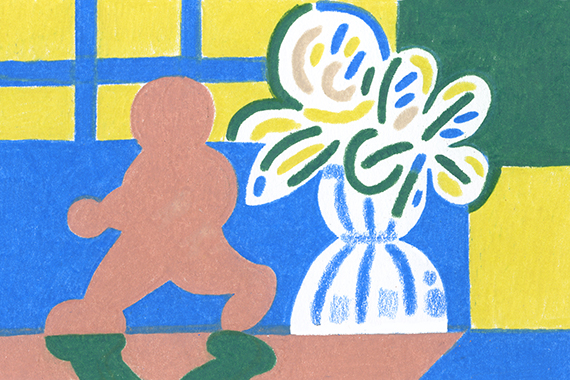
Image by Thomas Colligan.
Gábor Schein, born in Budapest in 1969, teaches modern Hungarian literature at ELTE in Budapest. He is the author of ten books of poetry, five novels, and four children’s books. His work in English includes the novellas The Book of Mordechai and Lazarus, translated by Ottilie Mulzet and Adam Z. Levy (Seagull Books, 2017) and Autobiographies of an Angel, translated by Ottilie Mulzet (Yale University Press, 2022).
Ottilie Mulzet has translated the work of László Krasznahorkai, Szilárd Borbély, Gábor Schein, György Dragomán, László Földényi, and Edina Szvoren. She was awarded the National Book Award in Translated Literature in 2019 for her translation of Krasznahorkai’s Baron Wenckheim’s Homecoming. She lives in Prague.