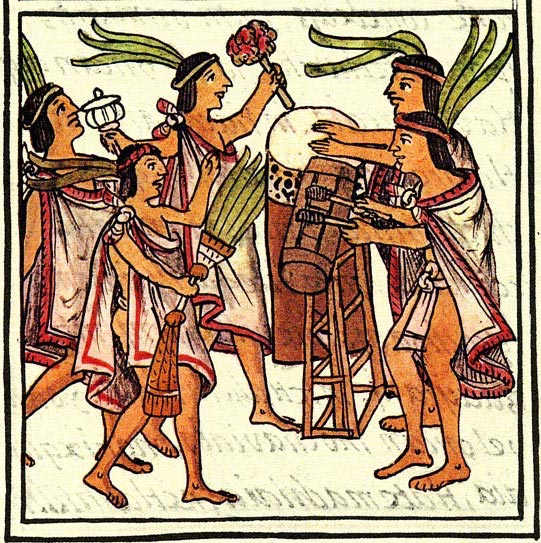
Zan Tontemiquico
Zan tocochitlehuaco,
zan tontemiquico,
ah nelli, ah nelli
tinemico in tlalticpac.
Xoxopan xihuitl ipan
tochihuaca,
hual cecilia,
hual itzmolini in toyollo
xochitl in tonacayo.
Cequi cueponi,
on cuetlahuia.
Glossary
|
WORD
|
DEFINITION
|
POSSIBLE SYNONYMS
|
|---|---|---|
| ah (adv.) | implies negative | not, it is not, that’s not |
| cecilia (v.) | an alternative spelling of the verb cehceliya—to grow and put forth roots | sprout, grow, germinate, develop, spring up, burgeon |
| cequi (art.) | a portion of the whole | some, a few |
| cueponi (v.) | unfold and spread out (like flowers) | blossom, open, burst open, unfold, bloom, flower, emerge, are brought to life |
| cuetlahuia (v.) | become dry and shriveled | wither, shrivel up, dry up, perish |
| hual (adv.) | refers to direction or location of something or some action | here, hither, this way, in this place, thus |
| in (prep.) | indicating a connection between people or things, usually in terms of one’s location in respect to another | on, upon, in, with regards to, with respect to |
| ipan (v.) | to be similar to | is like, is similar to, such is, so is |
| itzmolini (v.) | to come into being and progress to maturity | sprout, put out shoots, turn green, ripen, develop, mature, burst forth |
| nelli (adj.) | in accordance with fact or reality | true, correct, accurate, right, undeniable |
| on (adv.) | after that; next; afterward | then, after that, next, subsequently, later |
| tinemico (v.) | from the verb nemi—to exist or reside | we come to live, we come to dwell, we come to be |
| tlalticpac (n.) | the planet on which we live and the third planet from the sun in the solar system | earth, world, planet, globe |
| tochihuaca (n.) | the spiritual or immaterial part of a human being or animal regarded as immortal | our soul, our spirit, our being, our nature, our anima, our psyche |
| tocochitlehuaco (v.) | from the verb cochi—to enter the condition of the body and mind during which we lie down, close our eyes, and rest | we come to sleep, we approach sleep, we come to slumber |
| tonacayo (n.) | from the word nacayotl—the physical structure of a person or an animal | our body, our flesh, our incarnation, our progeny |
| tontemiquico (v.) | from the verb temiqui—to have a series of thoughts, images, and sensations occurring in one’s mind during sleep | we come to dream, we approach dreams, we come to envision |
| toyollo (n.) | from the word yollotl—part of the body regarded as the center of a person’s thoughts and emotions, especially love or compassion | our heart, our emotions, our feelings, our passion |
| xihuitl (n.) | plants with narrow green leaves that grow in fields and gardens | grass |
| xochitl (n.) | the seed-bearing parts of a plant that are typically surrounded by brightly colored petals | flowers, blossoms, florets, roses |
| xoxopan (n.) | the season in which vegetation begins to appear | (in) spring, springtime |
| zan (adv.) | nothing more; for only one purpose | only, just, merely, but, exclusively |
Background
About Free Verse
Free verse is a literary device that can be defined as poetry that is free from
limitations of regular meter or rhythm and does not rhyme with fixed forms. Such
poems are without rhythms and rhyme schemes; do not follow regular rhyme
scheme rules and still provide artistic expression. In this way, the poet can give his
own shape to a poem how he/she desires. However, it still allows poets to use
alliteration, rhyme, cadences or rhythms to get the effects that they consider are
suitable for the piece.
Bio
Tochihuitzin Coyolchiuhqui was an Aztec lord from Teotlatzinco and a Nahuatl poet. Poetry was an important part of the Aztec culture. Tochihuitzin was one of the many sons of the Aztec emperor Itzcóatl. We know when Tochihuitzin lived only because. he is mentioned in the Crónica Mexicayotl, a history of central Mexico written in Nahuatl around 1598. The manuscript recounts the siege of the city of Texcoco in 1419. The invaders murdered the city’s ruler, Ixtlilxochitl, and attempted to assassinate the twenty-five- year-old prince, Nezahualcoyotl. Along with his brothers, Tochihuitzin helped the young prince flee and find refuge in Tenochtitlan, modern-day Mexico City. Besides this account and the poetry he left behind, little is known of Tochihuitzin.