Getting Through To Kids: A Teacher’s Story
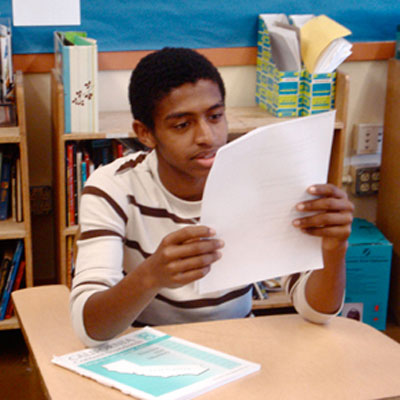
We recently received a letter from a teacher in San Diego who taught Poetry Inside Out in her 7th grade classroom. Her class was typical of most Poetry Inside Out classrooms: diverse in every way, with English-language learners and a range of learning and developmental issues. She felt especially challenged and told us what Poetry Inside Out meant to her and her kids:
In seventeen years of teaching, I’d prided myself on never being one of those teachers. None of us knew what to do. I was running out of tricks.
Until one day I had an email about “Poetry in Translation,” translating poems from world languages into English. “Impossible,” I thought. I nearly deleted the invitation, but a few days later I got the email again.
I went. When I left after the first day of training, I thought, “If it’s as amazing as I think it may be, let’s try it in this classroom.”
On Monday I told my class what I’d signed them up for. I thought they’d laugh, but there was stunned silence. Then I asked who’d ever had to translate or interpret for someone. And nearly all the hands went up. We shared our stories, eagerly, and suddenly they were listening to one another.
That was when the magic began. When I asked for a Spanish speaker to read a poem, quite a few hands went up, but the one I noticed immediately was one I’d not expected. Rodrigo hadn’t raised his hand, used his voice, all year. From that day on he read every Spanish poem.
Only two days in and already kids who ordinarily didn’t participate were, spontaneously. Willingly. There was a palpable shift in dynamics, almost a reversal of roles. Daniel said that translation “made me feel smart.”
As a teacher I needed feedback, so at the close of the first week I gave a self-assessment. On the optimism scale, ten students were looking forward to more, eight were “confident and curious,” and five were “totally excited.”
The tide had turned. We weren’t going to drown. We’d been at it for four days.
In May, the Vice Principal said there was no way around it: they had to take the state assessment tests. So we trudged over to the computer lab. I tried to get them pumped up and excited. It didn’t feel like Stand and Deliver. It was hot and they were exhausted.
All year we’d struggled with being on task and having a positive sense of ability, now we were doing it daily. All year I’d seen careless, sloppy work; now I was seeing attention to detail, increased reliance on one another for suggestions and peer editing. I hadn’t had to counsel or reprimand a student since the project began.
Two days before school ended I could finally see their scores. The full impact of their accomplishment didn’t hit me until a week later: almost all the kids’ scores went up in both Reading and Language, but they also exceeded their goals by 200 and 300 percent.
Poetry Inside Out made them gifted. The content was real and engaging and fresh. They were there for each other when they needed it, like training wheels on a bike. Tina said, “where else do you get to feel brilliant on a daily basis?”
What we’d all thought was impossible wasn’t at all, it just demanded effort, concentration, the joyful humility and community of working together. At one point Bruce said he loved the way “we were all pushing together.”
Someone else might look at the test scores and notice what incredible “bang for the buck” there seemed to be, and I don’t deny that measure. But I might reread the kids’ comments instead and come to rest on the one that says “Poetry Inside Out was the best part of 7th grade.”
We’re winding up a fundraising campaign to make sure Poetry Inside Out stays in classrooms this fall! Please consider donating: your gift makes it possible for kids like Julio, Tina, and Rodrigo—who have little chance to experience arts or enrichment activities—to know the world of poetry, build vital reading and writing skills, and most important, begin to think of themselves as smart and capable. Any amount makes a difference!