Why Language Matters
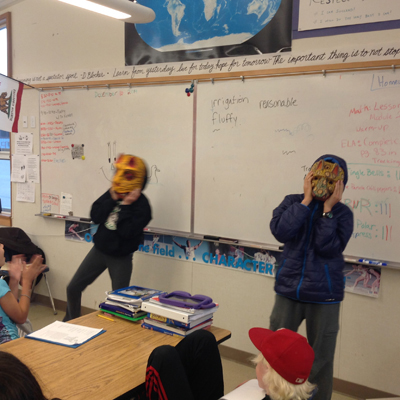
When Poetry Inside Out instructor Brian Kirven asked his class of 6th graders at West Marin School why in the world they would even attempt to read and translate a poem from the Mayan language Tzotzil, a student responded, “so it doesn’t disappear.”
It’s true: languages are disappearing quickly, and, alongside them, culture: songs, stories, dances, rituals, and histories. As the Wall Street Journal estimated in its article published in January, the number of languages spoken on earth will likely drop from 6,000 to 600 in the next hundred years. That means losing an average of 54 languages every year!
Earlier this year, when the Center hosted the launch of documentary filmmaker David Grubin’s latest film Language Matters, organizations from around the Bay Area met at San Francisco’s Exploratorium in order to discuss the pervasive threat to endangered languages. Now streaming on pbs.org, Grubin’s latest film examines how three languages in particular are struggling to survive, with varying degrees of success. The documentary’s host, poet Bob Holman, who was at the Exploratorium event, traveled to Aboriginal Australia, Hawaii, and Wales in an effort to demonstrate why language matters.
Among the speakers at the event was Vince Medina, who spoke passionately about a language rarely talked about but particularly relevant to all of us here in the Bay Area: Chochenyo. Chochenyo is the native language of the East Bay, one of many Ohlone languages that were suppressed through force as immigrants expanded westward into California. The language was thought to be lost until Medina revived it. His story is truly inspirational: he listened to audio recordings, talked to community members, and began using his ancestral language in his daily life, despite the fact that nobody spoke it fluently anymore. Thanks to him, the language is no longer considered extinct, and Medina teaches Chochenyo to children and other community members throughout the region.
Back at West Marin School, Kirven’s students are grappling with the unfamiliar words of “Bolom Chon.” Not only do Kirven’s students realize the potential cultural loss, they understand that they can play an active role in its revival.
Like Medina, the students bring movement and life to the words, chanting them, discussing them, and deciding on their meaning. One group of 6th graders translates the title as “Jaguar Jig,” while another decides on the title “Tiger Talk”. Earlier on in the process, the students acquainted themselves with not only the poem but Maya culture. Kirven tells me, “A community member of Tzeltal Maya descent lent us a couple of jaguar masks, and gave me a rundown of the ‘Bolom Chon’ dance.”
With these visual representations the students are able to contextualize the poem, recognizing the cultural importance of jaguars and the ritual of the dance. Through true engagement, they make personal connections to the poem. “One student felt a kinship with this chant,” Kirven remembers, “and chose a black jaguar for the subject of her own poem, associating its hide with the night and its yellow eyes with the sun.”
We know that language matters. So let’s do something about it.
Sarah Coolidge (they/she) is a queer editor and musician based in Oakland. They have worked at the Center for over a decade, serving as editor of the Two Lines journal before launching the Calico Series in 2020. They’ve had the honor of working with countless translators they admire and have edited work by Mariana Enriquez, Iman Mersal, Pirkko Saisio, Dorothy Tse, Wilson Bueno, and Elena Garro, among others.