Splendor: An interview with translators Olivia Lasky, Kit Maude, & Eunice Lee
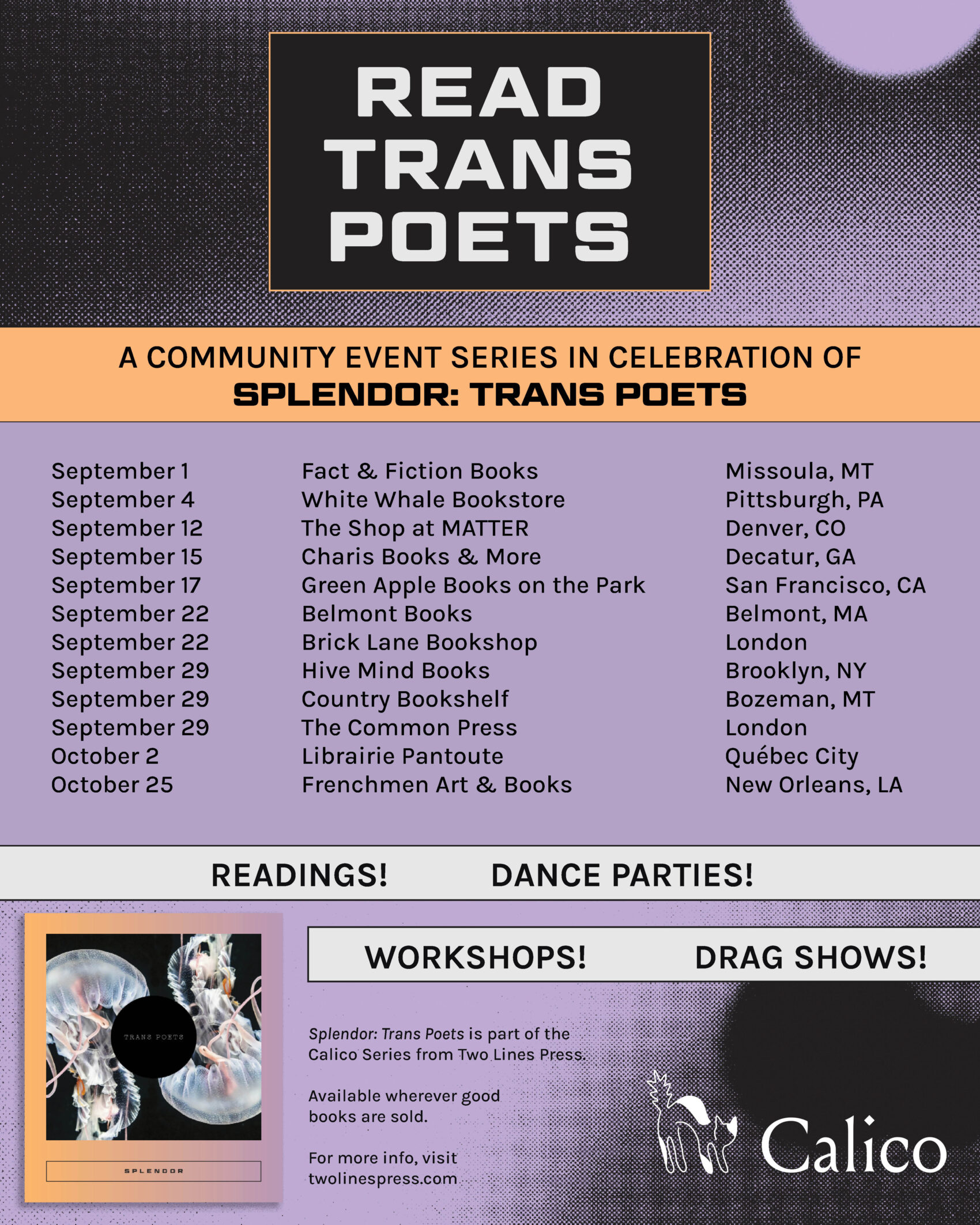
September is a special month here at CAT, as we celebrate the launch of Splendor: Trans Poets(opens in a new tab) with a community event series across the US and internationally. Featuring trans and nonbinary poets, the event series extends until October, including readings, workshops, drag shows, open mics, and more. In advance of these exciting events, we’ve invited Olivia Lasky, Kit Maude, and Eunice Lee to talk about their experiences working on their pieces and their perspectives on the anthology. With a luminous introduction by Rickey Laurentiis, the new Calico title presents five poets with previously unpublished translations from Argentina, Denmark, Korea, Norway, and Quebec.
CAT: Could you tell us about your experience working on your pieces for the Splendor collection? What compelled you to translate these poems?
Olivia Lasky: I first met Ida [Hove Solberg] when we worked together at Tidsskriftet Mellom(opens in a new tab), a Norwegian journal focused on literature in translation. While I was already familiar with Ida’s poetry translations (which are also fantastic, by the way!), I’d never read any of their own poems. Still, it was no surprise that I was drawn to The Last Hare from the very first page, and immediately started thinking about how I would translate certain words and phrases. Sometimes I find this habit annoying—a bit of an occupational hazard, if you will—but when I saw Two Lines’s call for poetry by trans writers, I jumped at the opportunity to be able to work with Ida and their poems.
Kit Maude: Well, in time I hope that all of Camila [Sosa Villada]’s work will be translated; she and her work deserve to be read as widely as possible for as long as people are reading, so when Sarah [Coolidge]—the editor of Splendor—asked whether I’d be interested in doing a selection from La novía de Sandro(opens in a new tab) I jumped at the chance. These texts, some poems, some more hybrid, are raw, heartfelt, but also deceptively well crafted—like Camila’s work in general. I emphasize the craft because I think it’s the aspect that often gets overlooked but that makes her such a great writer; she has a superb sense of timing, rhythm (she’s not also an actor and musician for nothing), and the arresting image that elevates even a brief piece into something memorable. The experience of working on them was thus a lot of fun—Camila takes the lead and you just try your best to keep up.

Eunice Lee: The poems I’ve translated for Splendor are from the collection Word Dream Body (2026) by Berlin-based nonbinary South Korean poet Kim Sono. Word Dream Body reimagines a Korean tradition of dream interpretation called “taemong” from a trans and nonbinary perspective. A taemong is a dream that foretells the conception of a child. Dreamed by a parent, relative, or close friend, a taemong is believed to predict a child’s future, including its binary gender: feminine symbols (e.g., flowers, fruits) predict a girl, while masculine symbols (e.g., tigers, dragons) predict a boy.
Unlike most Koreans, the poet was born without a taemong. In Word Dream Body, they write their own “nonbinary taemong” into (and against) a longstanding, communal tradition of gendered mythmaking. Some of the poems narrate taemong stories introducing animals outside of the tradition—for instance, a jellyfish studying the way human beings sleep and dream.
I was especially captivated by three animal poems: “Taming Flesh,” “One,” and “Two.” These poems each imagine the jellyfish, the koi, and the stork in ways that not only challenge binary gender, but also playfully trouble the boundaries between the human and the nonhuman, the individual and the collective. In “One,” the speaker becomes one with a gorgeous talking koi, as their faces align in a reflection upon the glass pane. This delicate but ecstatic image asks what it means to be together, to become “us” even briefly in collective dreaming. The stork in “Two” doesn’t bring a baby but “a wide bone,” a signifier of death that turns into a token of intimacy collected among other “brittle knickknacks” of a very domestic and very queer cohabitation. In “Taming Flesh,” the jellyfish extends a surprising sense of empathy toward its sleeping human, “Speaking and touching as little as possible,” approaching with curiosity and care rather than trying to define or control. The queer futurities foretold in these taemong dreams felt extremely liberating to me, and compelled me to translate these poems.
CAT: In the collection, the poems explore change, the body, and being. In your view as a translator, how does language interact with physicality in these works?
Olivia Lasky: The actual spacing of the poems is probably the first thing that strikes me; Ida has chosen a distinctive way of placing each word and line that draws the eye to certain phrases and essentially forces the reader to pause in intentional places. When reading aloud, there’s also an intriguing interplay between sibilance, which creates a quiet, breathy effect that mirrors the poems’ understated language, and plosives, which evoke the violence and brutality that run throughout the collection. The spacing was simple, and I tried to keep these specific sounds in mind while translating.
Like language, love is slippery, malleable, and surprising, as are these texts.
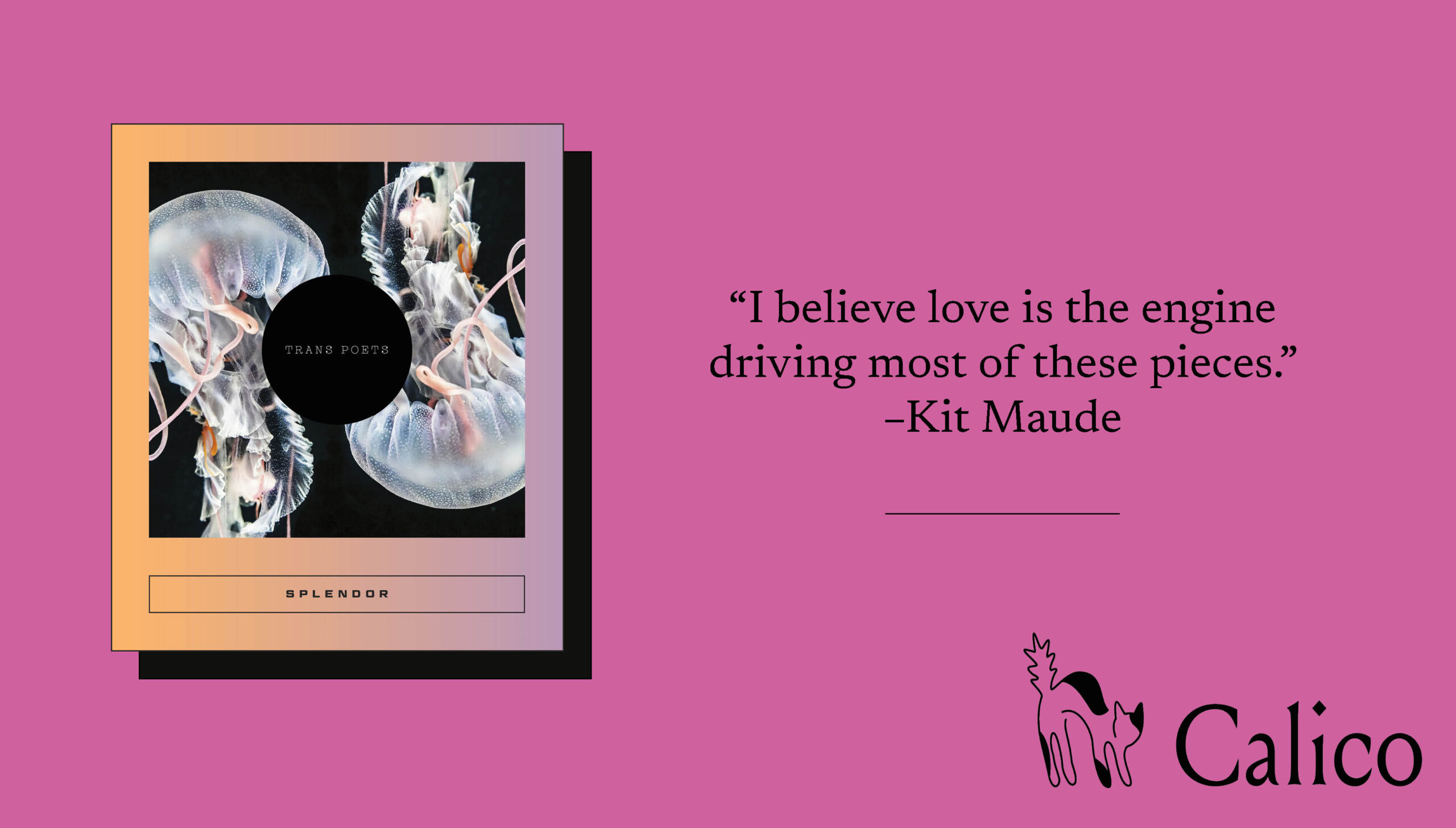
Kit Maude: I’m not sure that physicality is the word I’d use; sensuality seems more apt when talking about how language interacts with the body. And I think the key word missing here is love—I believe love is the engine driving most of these pieces; love for oneself, physical and romantic love, love for one’s friends and comrades, and also of course love in the face of adversity, oppression, and often vicious hatred, a love of defiance. Like language, love is slippery, malleable, and surprising, as are these texts.
Eunice Lee: “How deep must one carve into a body for it to become a different body?” asks the speaker of “Two,” turning a dead tree into a home. Physicality is transformed and questioned in these poems—and Kim Sono explores how language, like the body, is similarly vulnerable to change. When a wide bone is introduced to the tree-turned-home, the speaker of “Two” can’t quite decide where to put it. (“What should we do now, and how,” the couple ask.) In their quest for storage space, the two burst into a gamelike chant, listing different objects against which to measure the bone: the bone can “cover” anything from a “leafling” to a “tombstone” to a “nightmare” to a “planet.” The bone’s size and physicality, as well as the meanings surrounding it, keep transforming as the list continues. Mid-list, someone interjects,“(Not quite covered. Let’s try this again.)” and I’m reminded here that language, especially when it comes to poetry and translation, involves the challenge of “trying again” and again to find the right words amid uncertainty and endless possibility. I’m also thinking here of transness as an ability to “try again,” to imagine and explore beyond the assigned and the biological.
In Kim Sono’s poems, poetic form also takes on a trans physicality. The stanza shapes constantly shift, from incantatory verses like the above, to prose paragraphs, to slender and tentacular lines, to the italicized “transcript” of a jellyfish’s interview, to the one-liners that conclude each of these three poems (“What seems to be a leg is, in truth, a tentacle”; “It’s the water’s laughter at my surprise”; “Stark white stitches on the dream cloth”).
Then, there’s also intimacy and tension between these poems, which, like bodies, sit (or sleep, or dream?) alongside one another in Splendor. A closeness is implied between “One” and “Two,” but their relationship is more complex than that of a linear sequence. Between the titles “Two” and “Taming Flesh” is an alliteration and a sonic kinship I’ve carried over from the Korean titles, which are respectively pronounced, with repeated “l” sounds, dul [둘] and gildeurineun sal [길들이는 살]. I wanted to capture the mouthed and heard physicality of these titles.
I enjoyed playing around with repositioning some of the rhythmic and alliterative experiences when preserving meaning.
CAT: What draws your attention first when translating poetry? Is there a phrase, a word, or a brief passage that was particularly meaningful for you to translate?
Olivia Lasky: Definitely the rhythm and sounds! And as I know Ida, I actually had their voice in my head as I was both reading and translating, and I hope I was able to recreate the cadence and alliteration of the original. All translators know how difficult it is to “sacrifice” anything in a translation, and I enjoyed playing around with repositioning some of the rhythmic and alliterative experiences when preserving meaning. In the first poem featured in Splendor, for example, I ultimately had to forgo an incredible collection of sounds: “skyer / som speglar seg i fjorden / eit skiftande skin over åsen / sjå det” became “clouds / doubled in the fjord / a shifting shimmer over the hill / see it.” However, I later found an opportunity to come up with some alliterations of my own; “sjå nasjonens slam / ei opphoping avvik / resurssugande naturperversjon” became “look at the dregs of the nation / an aggregate of aberration / parasitic perversion of nature.”
Many of the poems are also quite raw, with striking, yet understated, imagery. For example, “me and you / in flares against the wall.” Ida has a gift for writing about painful or violent experiences with a gentle hand, making the reader pause to really consider the image being painted.
Kit Maude: I actually don’t translate much poetry—I think generally to translate a poem requires a poet with the skill and knowledge to wrestle with all the formal issues that make poetry such a wonderful and confounding art form. I’m not qualified to do that. In this case, however, because I’m so familiar with Camila’s work, and because many of the texts have prose elements I thought I’d give it a shot; hopefully I’ve done OK. As you may have noted, I’m a superfan of Camila so if I started listing lines from this selection I might end up just quoting the pieces entirely—I’ll limit myself to the titles and first lines: “I never knew whether to love or hate men.” “This is an ode to my ugliness.” “Travestí Witchcraft,” “Ode to my Breasts”…they can’t help but grab you, can they?
A memorable exchange regarding the Splendor poems was when we decided on the pronoun “it” for the human being observed from a jellyfish’s perspective. We were excited to introduce this small twist, bringing attention to anthropocentric assumptions that might be underlying anglophone pronouns.
Eunice Lee: When translating poems, I try to keep my ears open to their musicality. Sometimes, I prioritize the rhythm or cadence over literal meaning, especially where a poem seems to lean heavily into its music, like in the stanza from “Two” that I’ve described as incantatory:
One leafling covered with the wide bone.
One tombstone covered with the wide bone.
One nightmare covered with the wide bone.
(Not quite covered. Let’s try this again.)
One clinic covered with the wide bone.
One temple covered with the wide bone.
One fog patch covered with the wide bone.
One border covered with the wide bone.
One planet covered with the wide bone.
I’m sticking to a syllabic rule in the Korean original. The name of the object being covered—“leafling,” “tombstone,” “nightmare,” and so on—must consist of two syllables. (Because of the repetition, every line consists of the same number of syllables.) The structure of this song seemed important to retain, and I wanted a reader to be able to sing each line to the same melody.
What was challenging, however, was translating the word angae [안개], meaning “fog” or “mist.” These two strong options I had in the English were monosyllabic. I considered a two-syllable word like “smother,” as a noun referring to a cloud of mist or smoke, which felt technically correct but not emotionally. (Editor Sarah Coolidge gave me extremely helpful feedback that allowed me to see this.) Then I came across the phrase “fog patch.” A fog patch is meteorologically different from a fog, because it has clearer boundaries and is grammatically countable—but my ear told me this two-syllable word would be a better fit for the music of this stanza. I also realized that the phrase “fog patch” might create, for readers of the translation, extra friction between the countable and the uncountable, and that this might highlight the poems’ interest in individuality and community, in the cultural norms that make us count something as “One” or “Two.”
I also try to make the process of translation as collaborative as possible. The poet and I always keep a shared document where we come to collaborative decisions, a great many of which concern gendered personal pronouns, because Korean pronouns are less gender-specific than those in the English. (“Is this a ‘he/him’ tiger?” I asked about one poem in the book.) A memorable exchange regarding the Splendor poems was when we decided on the pronoun “it” for the human being observed from a jellyfish’s perspective. We were excited to introduce this small twist, bringing attention to anthropocentric assumptions that might be underlying anglophone pronouns.
CAT: Can you tell us more about your featured author’s work? Are there any other pieces by them that you’re currently translating or particularly excited about?
Olivia Lasky: Ida is a prolific translator from English, Swedish, and Danish, and I actually edited their translation into the New Norwegian of Terrance Hayes’s American Sonnets for My Past and Future Assassin(opens in a new tab). I hope there will be opportunities like this! Otherwise, Ida recently shared a few poems with me that will likely be part of their next book and touch on some of the same themes as The Last Hare. I can’t wait to read—and hopefully translate—the next collection!
Kit Maude: Forthcoming from Riverhead is A Domestication(opens in a new tab), a translation of Tesis sobre una domesticación, a wonderful, moving, and funny novel, so look out for that! And I hear that Camila’s currently working on an extremely exciting project—but in the meantime, if you enjoyed these texts then be sure to check out the novel Bad Girls(opens in a new tab) and the story collection I’m a Fool to Want You(opens in a new tab), both available from Other Press.
Eunice Lee: Kim Sono’s poems explore language, sound, embodiment, dreams, spirituality, and queerness. But this list fails to capture all the vibrant work I’ve encountered across my translation projects with this poet.
My first project with Kim Sono was a translation of their third poetry collection, Syncopation (2024). Inspired by a Korean word game and also evocative of the sonnet crown, Syncopation takes each poem’s ending (which could be a line, a word, or even an idea) to create the beginning of the next. Playful, jazzy, psychedelic, while also spiked with grief, the collection asks how trans and nonbinary identities may help us grapple with other binarisms, like that between life and death. One prose poem features a nonbinary human speaker and their friend, Bird, who is neither human nor bird, neither dead nor alive. The former asks, “I could claim my existence by using the word ‘nonbinary’ (despite its being a mere negation of the word ‘binary’), or by asking to be referred to by ‘they’ pronouns, but what do you even call that state of being alive and dead at once?” You can read my translation of this piece, titled “The boundary as an aesthetic choice,(opens in a new tab)” in the online edition of Harvard Review.
The poet’s fourth collection, Word Dream Body—which I’m currently translating—not only spotlights the taemong tradition, but also incorporates a diverse array of archival, collaborative, and multimedia methods into the poems. (The poet mentions Theresa Hak Kyung Cha’s Dictee as an inspiration for this structure.) Alongside the animal taemong poems, there are curated excerpts of oral histories and newspaper articles on transness, gender-bending performances, and gendered dream interpretations in various Asian cultures; visual pieces honoring and mourning Korean trans voices like Byun Hee-soo; a collaborative poem by four queer poets; lyrical, prose, and hybrid form poems on time, physicality, and spirituality; and so much more.
You can find more poems from Word Dream Body in a recent translation featured on The Offing (“Unclean nothingness” and other poems)(opens in a new tab). If you enjoyed the poems in Splendor, you might also enjoy these four, in which an ungendered body of water describes the feeling of swans drifting on its surface; villagers chase after a vehicle hauling away a violently stolen thousand-year-old tree; a mysterious giant tongue licks the back of a turtle; and “[t]he future alone is not a dream, and the future alone does not pity us.”
Olivia Lasky is an Oslo-based translator specializing in Norwegian-to-English literary translations. Originally from the San Francisco Bay Area, she has degrees in English literature and Scandinavian studies, with a focus on Sámi language and culture. She also translates from North Sámi, Swedish, and Danish. Her work has been published in Harper’s Magazine, The Dial, Words Without Borders, The Southern Review, Two Lines, and The Georgia Review, and by publishing houses including Harper Collins, Seagull Books, and Greystone Books.
Kit Maude is a translator based in Buenos Aires. He has translated dozens of Latin American writers for a wide array of publications and writes reviews for Ñ, Otra Parte, and The Times Literary Supplement.
Eunice Lee is a poet, researcher, and translator of Korean literature. She is the translator of Syncopation by Kim Sono (ASIA, 2024) and Fruit of Life: Poems by Kim Myeong-sun (Rutgers University Press, forthcoming 2026). Her poems and translations can be found in Asymptote, Circumference, The Margins (Asian American Writers’ Workshop), Harvard Review, and more. She is pursuing a PhD in English at Harvard University.
Splendor also features co-translations by Sophia Hersi Smith and Jennifer Russell, and by Jana Vourgourakis and Andrew Wilson. Wilson and Vourgourakis will read from the anthology alongside original poems from Alexis N. Garcia and Mukethe Kawinzi at Green Apple Books on the Park in San Francisco.
Part book launch, part community event, we envision these readings as an opportunity to build international trans solidarity through poetry. See the tour schedule below and check out our events page for the complete info. Come celebrate with us!