A Closer Look: Translating Tone in Angel Island Poetry
Jeffrey Leong is the translator of Wild Geese Sorrow, a collection of translations of poetry from the Angel Island Immigration Station. We interviewed him last month about the book. In this post, he discusses translating tone and takes us through the translation process of one of the poems. Jeffrey will be at the Book Passage in San Francisco’s Ferry Building tomorrow to read from his translations.(opens in a new tab)
Much has been written about the hurdles of translating from the character-based, visual semiotics of Chinese to the text-based, alphabet-driven symbols of English. Many key T’ang poetry characteristics, such as tonal parallelism and end-rhyme, are either impossible to bring over or would result in an English equivalent both incomprehensible and wooden. My goal was to produce a text readable as an English language poem, yet remain as true as possible to its original Chinese in both form and content.
For me, content was not as problematic as form. For form, I tried to maintain at least the imagistic minimalism and parataxis that exists in the original but add some filler words such as prepositions, verbs, verb tenses, etc. to produce a clear poem in English. I also used plain diction and avoided American idioms wherever possible. But of greater importance is what I would call the issue of “tone.”
What is “tone,” in poetry? It is every craft element that can provide shades of meaning in a poem, and thus includes:
- Diction – whether high, low or medium
- Syntax – word order (regular grammar, elided, fragmented)
- Sound – use of rhymes (alliteration, assonance, repetition, end-rhyme)
- Imagery – whether popular or classical, everyday or historical allusion
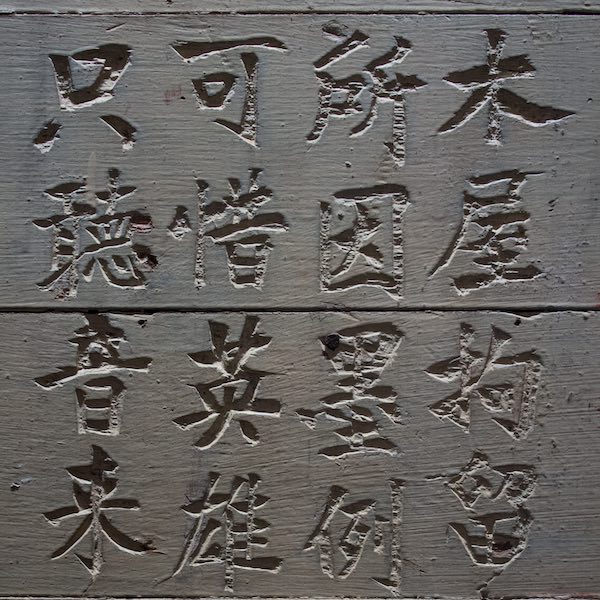
To me, the overall tone of the Angel Island poems was undeniably one of anger, frustration, and outrage. This angry tone uses the above elements and was expressed within classical T’ang poetics and its technical requirements. The following step-by-step illustration shows my process for translating this angry tone for a twenty-first-century reader. This example is from Poem 4 of Wild Geese Sorrow:
Poem 4
- 黃 家 子 弟 本 香 珹,
- 挺 身 投 筆 赴 美 京.
- 買 槕 到 了 金 山 地,
- 誰 知 撥 我 過 埃 菕.
- 我 國 圖 强 無 此 樣,
- 船 泊 岸 邊 直 可 登.
- 民 國 十 三 廿 肆 晨
- 逍 逵 子 鐵 城 閒 筆
Here is the original eight-line Chinese text in the modern layout, read from left to right, and top down. (It should be noted that Lines 7 and 8 are the signature of the poet, and not part of the poem’s meaning per se.)
Next I made the following transliteration (romanization) into Yale Cantonese using Internet resources:
- Wòhng gà jái daih bún Hèung Sèhng
- Ting sàn tauh bāt fuh Méih jīng
- Máaih zaauh dou liuh Gām Sàan deih
- Séuih jì buht ngóh gwo āi lún
- Ngóh gwok tòuh kéuhng mòuh chí yéung
- Syùhn bohk ngohn bīn jihk hak dang
- Mahn gwok sahp sahm yah sei sahn
- Sui waih jái tit sèhng hàahn bāt
This eight line T’ang style poem uses slant end-rhymes. Within its traditional seven character line, it groups characters into images and juxtaposes these, to create leaps of meaning. Further juxtaposition is used between couplet lines to pair contrasting ideas.
Next, a word-for-word translation is made from Internet resources:
- Huang family son younger brother this Fragrant City
- Straighten body cast writing brush go America capitol
- Buy oar to the Gold Mountain ground
- Who knew assign I cross Island –
- My country map chart strength no this kind of way
- Boat anchor shore edge straight away ascend
- Nationalist China 13th year – twenty four morning
- Leisurely thoroughfare child Iron City idle writing brush, pen
This “raw” translation gives a sense of the poem’s meaning in very general terms.
I then made my English literary translation based upon the word-for-word with the following result:
I, young son of the Wong clan from Hèung Sèhng,
straightened up, tossed my writing brush,
to quest for America’s capitol.
I bought an oar, came to the place of Gold Mountain.
Who knew I would be sent to this Island?
If my country were strong, it would not be like this.
When the ship docks, up a gangway straight to shore.
Written at dawn, 24th day in the 13th Year of the Republic,
the idle pen of a lazy boy from the City of Iron.
In this translation, I’ve tried to maintain the line length, syntax, juxtaposition, and imagery within the original. This translation does foreground the implicit “I,” typical first person speaker of T’ang poetry, but uses plainspoken medium-level diction without slang. It tries to balance the form and content (i.e. structure and meaning) of the original. As can be seen, formatting of the English translation is more of an art than a science.