Ambiguous Departure | Moses | Aubrac
Halfway up the hill, the day breathes.
L’APPAREILLAGE AMBIGU
À minuit, par un clair de lune coupant comme un rasoir, je détachais l’amarre de la galère funèbre,—et voguais. De longues étendues de terre plaine, des vols de ramiers blancs fantomatiques contre les berges, c’était le premier éveil de cette marine féerique que j’improvisais dans le creux du paysage nocturne. Solennels et funèbres, des chevaliers aux armures de sable me saluaient sur les berges du flamboiement fleurdelisé de leurs bannières—une haie d’oriflammes dessinait sur l’eau bleue comme du pétrole la carrière ouverte au triomphateur. A l’horizon, les vagues se perdaient dans de grands points d’orgue—parfois une trombe ardente, un gantelet de cristal, un doigt pointé comme l’index d’un cadran solaire figuraient le zodiaque familier de ces périples mal définis. A des fanaux soudain plus clairs, au branle-bas humide d’un appareillage nocturne, à mille feux Saint-Elme brillant sur les agrès, je pouvais déceler l’approche des brises du large comme le souffle d’une cave humide, puis c’était le coudoiement amical des pétroliers, d’immenses estacades de brumes, les balustrades géantes où s’accoudaient pour l’à-Dieu-vat les figurants majestueux avec leurs barbes de neige, leurs fracs et leurs éventails de théâtre, les éclaboussures salines et noires de suie où frissonnaient des épaules de marbre et, porté déjà sur l’encolure de la première houle et tout à coup en selle, le coup de clairon du lâchez-tout saluait le débordement de la jetée.
L’APPAREILLAGE AMBIGU
À minuit, par un clair de lune coupant comme un rasoir, je détachais l’amarre de la galère funèbre,—et voguais. De longues étendues de terre plaine, des vols de ramiers blancs fantomatiques contre les berges, c’était le premier éveil de cette marine féerique que j’improvisais dans le creux du paysage nocturne. Solennels et funèbres, des chevaliers aux armures de sable me saluaient sur les berges du flamboiement fleurdelisé de leurs bannières—une haie d’oriflammes dessinait sur l’eau bleue comme du pétrole la carrière ouverte au triomphateur. A l’horizon, les vagues se perdaient dans de grands points d’orgue—parfois une trombe ardente, un gantelet de cristal, un doigt pointé comme l’index d’un cadran solaire figuraient le zodiaque familier de ces périples mal définis. A des fanaux soudain plus clairs, au branle-bas humide d’un appareillage nocturne, à mille feux Saint-Elme brillant sur les agrès, je pouvais déceler l’approche des brises du large comme le souffle d’une cave humide, puis c’était le coudoiement amical des pétroliers, d’immenses estacades de brumes, les balustrades géantes où s’accoudaient pour l’à-Dieu-vat les figurants majestueux avec leurs barbes de neige, leurs fracs et leurs éventails de théâtre, les éclaboussures salines et noires de suie où frissonnaient des épaules de marbre et, porté déjà sur l’encolure de la première houle et tout à coup en selle, le coup de clairon du lâchez-tout saluait le débordement de la jetée.
MOÏSE
Les yeux fermés sous les feuilles fraîches de ses troènes, le chemin d’eau m’emportait chaque après-midi à reculons comme une Ophélie passée dans sa bouée de fleurs, dissolvant lentement du front les clôtures molles. Couché plus bas qu’aucune autre créature vivante sur l’oreiller fondamental, tombait sur moi la face des arbres comme la rosée d’un visage penché sur un lit de malade, et mettant le monde doucement à flot sur ma route comme un liège, j’étais fiancé aux anneaux sonores des ponts comme une gaze, de plain pied avec le mufle bénin des vaches. L’ombre de la forêt sur la rivière mêlait à l’eau noire une douce tisane de feuilles mortes et d’oubli. Midi me trouvait dérivant au large ensoleillé de vastes grèves scintillantes, les mains closes sur le cœur, les paupières éclatantes de langueur, puis le somptueux froissement des roseaux dévorait les rives d’une palissade théâtrale de murmures, et mollement entravé comme d’une robe par les tiges aux longues traînes, engourdi au fond d’une impasse verte, les doux maillons de soleil de l’eau qui me portait comme un ventre, comme un qui regarde au fond d’un puits redescendaient jusqu’à moi en se dénouant sur le visage d’une femme.
AUBRAC
Il faut si peu pour vivre ici. De ce balcon où penche la montagne à l’heure où le soleil est plus jaune, il ne reste plus à choisir qu’à droite la banquette où l’herbe noircit sous les châtaigniers, à gauche la Viadène au loin déjà toute bleue. À mi-pente, la journée respire. De cette galerie ample et couverte où glisse la route de gravier rose au-dessus du Causse gris-perdrix, on voit mûrir très bas les ombres longues dans la lumière couleur de prune. Tout commande de faire halte à ce reposoir encore tempéré où la terre penche, pour respirer l’air luxueux de parc arrosé, la journée qui s’engrange dans les rais du miel et la chaleur de l’ambre, jusqu’à ce que l’œil gorgé revienne à la route rose qui monte sous le soleil avant de tourner dans l’ombre d’un bois de sapins, et que ta main déjà fraîchisse avec le soir—ta main qui laisse filtrer le bruit plus clair du torrent, ta main qui me tend les colchiques de l’automne.
Nous monterons plus haut. Là où plus haut que tous les arbres, la terre nappée de basalte hausse et déplisse dans l’air bleu une paume immensément vide, à l’heure plus froide où tes pieds nus s’enfonceront dans la fourrure respirante, où tes cheveux secoueront dans le vent criblé d’étoiles l’odeur du foin sauvage, pendant que nous marcherons ainsi que sur la mer vers le phare de lave noire par la terre nue comme une jument.
AMBIGUOUS DEPARTURE
At midnight, under a moonbeam sharp as a razor, I untied the ropes of the mournful galley—and set sail. Long stretches of flat land and white, ghostly wood pigeons flying above the banks were the first awakenings of the magic seascape I improvised in the nocturnal scene. Solemn and mournful, knights in sable armor saluted me from the banks with the blaze of their banners’ fleur-de-lis patterns—on the water blue as petrol, a row of oriflammes outlined the open course for the victor. Waves drew out in grand fermatas toward the horizon—at times a raging whirlwind, a crystal gauntlet, a finger pointing up like a sundial’s gnomon served as the familiar zodiac for those ill-defined voyages. The beacons suddenly brighter, in the watery commotion of a nighttime departure, by the light of a thousand St. Elmo’s fires shining on the rigging, I could discern the approach of the open sea breeze like the breath of a humid cellar, then there were oil tankers merrily rubbing shoulders, huge jetties of fog, giant balustrades where the majestic spectators with their snowy beards, tailcoats, and theatrical fans propped up their elbows and waited for the unmooring, the salty black soot splattering on shivering marble shoulders, and, the ship already carried by the first swell and suddenly mounted on its saddle, the bugle call to cast off greeted the flooding of the pier.
MOSES
Eyes closed under fresh privet leaves, the water path carried me backwards every afternoon like a pale Ophelia in her buoy of flowers, the waves slowly dissolving the soft enclosures. I lay on the elemental pillow, lower than any other living creature, the aspect of trees falling on me like the dew of a face leaning over a sickbed, and setting the world sweetly afloat on my path like a cork, I was betrothed to the bridges’ resounding rings like gauze, level with the harmless muzzles of cows. The forest’s shadow on the river mixed the black water with a sweet tisane of dead leaves and forgetfulness. Noon found me drifting on the sunlit sea of vast scintillating shores, hands closed over my heart, eyelids bursting with languor, as the reeds’ sumptuous rustling ate away at the banks of a theatrical hedge of murmurs, and, gently entangled in the stalks like a dress with long trains, numbed in the depths of a green dead end, I was carried by the water like a belly, the sweet nets of sunlight descending over me like a man gazing into the depths of a well, unraveling over a woman’s face.
AUBRAC
One needs so little to live here. From this balcony where the mountain leans at the hour of the yellowing sun, one has only to choose the bench to the right where the grass darkens under the chestnut trees, Viadène to the left already blue in the distance. Halfway up the hill, the day breathes. From this wide and covered gallery where the rosy gravel road glides above the partridge-gray Causses, long shadows can be seen below, maturing in the plum-colored light. Everything asks that you pause, at this still-temperate resting place where the earth tilts, to breathe the luscious air of the dewy park, the day that takes refuge in honey rays and amber warmth, until the saturated eye returns to the rosy road that rises under the sun before turning into a pine forest’s shade, and until your hand has already cooled with the evening—your hand that filters the torrent’s sharp sound, your hand that offers me autumn crocuses.
We’ll go higher still. Higher than all the trees, where the earth glazed with basalt raises and unfolds an immensely empty palm in the blue air, at a colder hour when your bare feet will sink into the breathing carpet, when your hair will shake off the smell of wild hay in the wind riddled with stars, and all the while we’ll walk as though on water toward the lighthouse of black lava, like a mare across the naked earth.
“L’Appareillage ambigu,” “Moïse,” and “Aubrac” from Liberté grande. Paris: Editions Corti, 1969.
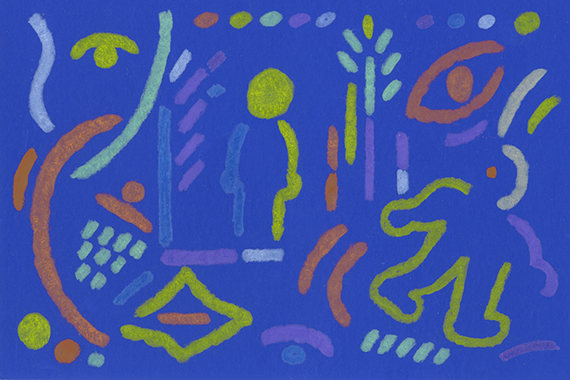
Image by Thomas Colligan.
Julien Gracq (1910–2007), born Louis Poirier, was a French writer best known for his novels. He wrote under a pen name—a combination of Julien Sorel from Stendhal’s The Red and the Black and the Gracchus brothers of the Roman republic. His lyrical and dense prose earned him recognition as a master stylist. In 1951, he won the Prix Goncourt for The Opposing Shore but refused it out of disdain for the literary establishment.
Alice H. Yang is a teacher and translator based in Lyon, France. She graduated from Yale in 2019 with a degree in literature. Her translation of Gracq’s collection of prose poetry Liberté grande (Abounding Freedom) was awarded Yale’s Theron Rockwell Field Prize, a university-wide honor for a “poetic, literary, or religious work of scholarship.”