Exclusive Interviews with the NEA Translation Fellows: Kevin Gerry Dunn
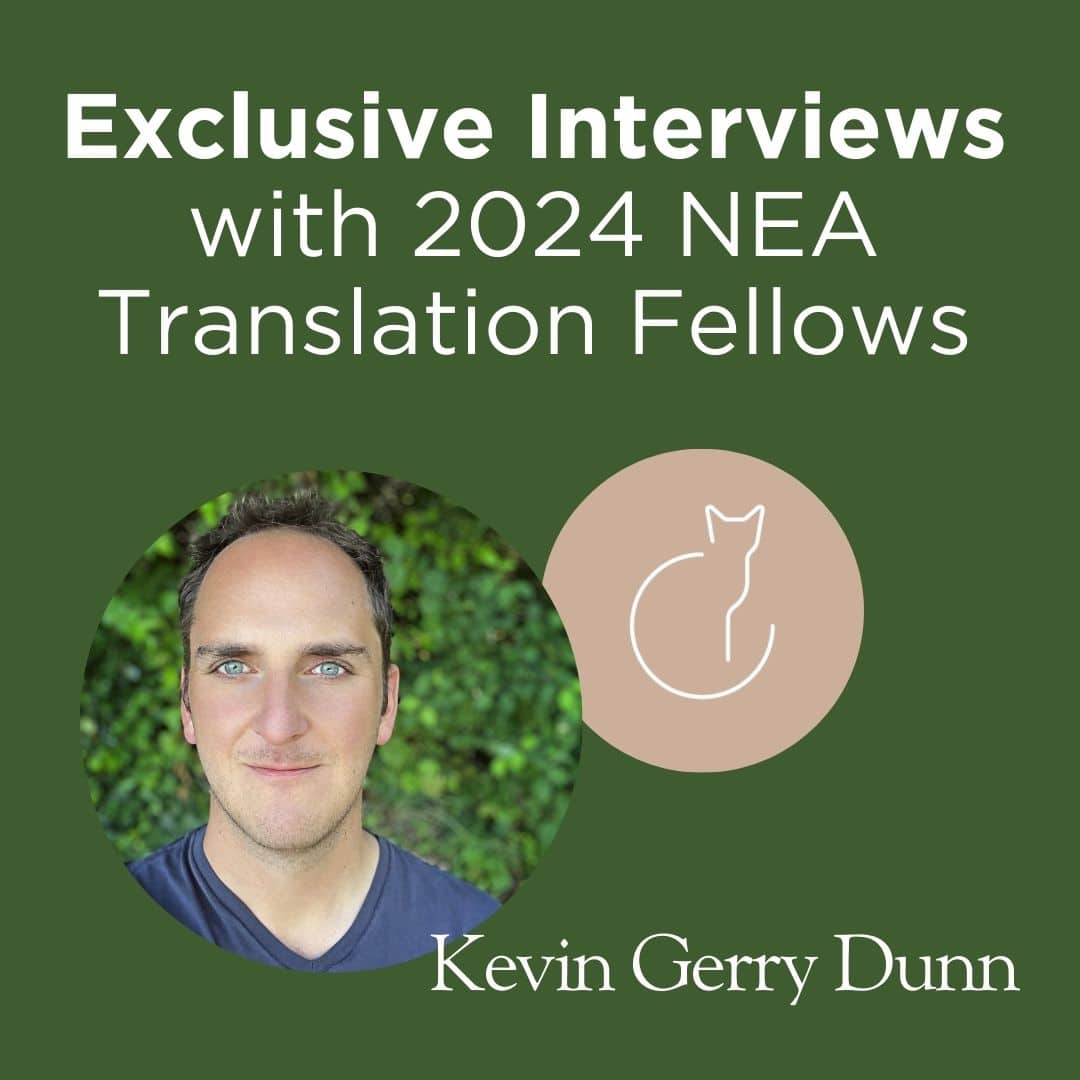
Tell us a little about your project. What drew you to the work you’re currently translating—themes, style, the author’s insight?
The Tyranny of Flies is a novel about authoritarianism by one of Cuba’s most prominent and prolific young writers, Elaine Vilar Madruga. As a child of the nineties who grew up watching reruns of Seinfeld, I’m tickled that the translator and author of the book are Gerry and Elaine.
When I was pitching the book, I told editors it was like a Buñuel film or a Greek tragedy narrated in the voice of Holden Caulfield. I’ve shown early drafts to a few people now, and they say they get more Lemony Snicket vibes. But to be honest, I don’t think there are any good comps; it’s a book unlike any I’ve read before. It’s enigmatic, playful, political, and occasionally kind of disgusting. It leaves a lot open to interpretation, but in my interpretation, it’s about how the same violence you see in political institutions like the military are equally present in the domestic institution of the family. It insists that the family actually is a political and public institution, that the term “domestic institution” is an oxymoron.
Because Flies is a Cuban book about dictatorship, I’m a little worried that a certain sort of star-spangled reader will assume it’s a one-dimensional allegory about Communism, an elaborate metaphor for the circumference and depth of Fidel Castro’s asshole. And maybe it is! But I have a different interpretation, which the publisher is kindly allowing me to share with readers in an inflammatory and offensive translator’s note at the end of the book.
How did you begin your foray into the translation community? What authors and translators (or personal relations!) inspired your early interests in global literature?
In college, I did a BA/MA program in Spanish-language literature, and I was horrified to discover, when it was too late to get my money back, that the MA component involved very little reading of Spanish-language literature. Every course was way over my head. My classmates (it seemed to me at the time) were post-structuralist geniuses who could discuss pre-Colombian epistemologies not only in Spanish and English, but French, German, ancient Greek, probably Nahuatl and Quechua too…. I, on the other hand, was a hungover, hickey-and-pimple-riddled twenty-year-old who had no idea what he wanted to do with his life, who had never set foot in a Spanish-speaking country, who had learned the language from gringo teachers in high school. I would desperately try to keep up while my professors lectured on media theory in Spanish, then log on to a computer in the library and google things like “what is Jack Foocoe simple english summary yahoo answers.”
In one particularly brutal seminar, the professor took pity on me and said that instead of writing a lengthy paper on narcotremendismo (“what is narcotremendismo simple english summary yahoo answers”), I could translate the first chapter of a Fernando Vallejo novel into English.
I sat down at one of those same library computers, and before I’d finished a draft of the first paragraph, I knew what I’d do with my life.
What excites you about translation—as a concept, a community, and an ever-evolving practice?
I think it’s a great sign when a translated book gets one-star reviews on Goodreads, because half the time, the reviewer is just pissed the book isn’t American. They find more roundabout ways of saying it, but really, they’re just complaining that the book doesn’t cleave to the narrow, Anglocentric formula they’re comfortable with. A few months ago, I saw graffiti in Spain that said EL FEMENISMO QUE NO INCOMODA ES MARKETING (“Feminism that doesn’t make you uncomfortable is marketing”). You could say the same of literature. Books that don’t make you uncomfortable are merchandise.
At the risk of sounding self-important, I think translation is an act of mutiny in miniature: as long as the translator or editor doesn’t defang the book in English, it can be a backdoor for sneaking something with actual bite into an otherwise toothless literary scene. If they hadn’t first succeeded in their source languages, would Virginie Despentes or Adania Shibli have sold in the U.S.? Would they even have made it past the editorial gatekeepers? I doubt it. Thankfully, the translators of Despentes and Shibli—Emma Ramadan, Frank Wynne, Elisabeth Jaquette—have translated those authors in all their toothy glory.
The Tyranny of Flies is a perfect example of a book that certain readers will love to hate: the dialogue isn’t brimming with Austen- or Wilde-esque witticisms. The character arcs don’t have much arc to them. There are enough needless words to make E.B. White blush. It insists on telling instead of showing, or maybe it rejects the show/tell dichotomy altogether. I hope that in English, our book receives exclusively one- and five-star reviews. I’ll be disappointed if it gets tons of limpdick three- or four-star reviews. Spare me the “it wasn’t for me, but it sure is interesting to read a book by a Cuban lady” bullshit.
Are there any books or authors in translation that you would like to share?
Too many! I’m about to be excessively effusive about a bunch of translators, some of whom I’ve never or only briefly met, I hope that’s not too weird.
One of my favorite things is when you can tell that an author and a translator have chemistry, and you can practically see the sparks flying on the page. One duo that immediately comes to mind is Lisa Dillman with Andrés Barba: every book they do together is better than the last, and following the trajectory of their collaboration over the course of four books is like watching Jim and Pam fall in love over the course of four seasons. Or another great example: Lizzie Davis with Juan Cárdenas, who broke the goddamn mold with Ornamental, superglued the mold back together, then shattered it all over again with The Devil of the Provinces. Read the short text they published in Lithub, “A Small Parenthesis(opens in a new tab),” and tell me that isn’t an author-translator match made in a hallucinogenic heaven.
I love books (like Flies) featuring mothers who speak at length about how shitty motherhood can be, and I just read two great ones back-to-back: The Dear Ones by Berta Dávila, translated by Jacob Rogers, and Love Me Tender by Contance Debré, translated by Holly James. Both are pitch-perfect translations, and both are short enough to finish in three or four sittings.
I’ve also been reading a lot of grisly books from Brazil lately. By the time I finished Of Cattle and Men by Ana Paula Maia and translated by Zoë Perry, I could practically smell the viscera on the slaughterhouse floor. And The Whore by Márcia Barbieri, translated by Adrian Minckley, is a masterpiece of smut so vile that I’m sure it’s only a matter of time before it’s banned in Florida libraries.
Giovanna Lomanto is a poet and essayist with a tendency to play the same song on repeat until she has memorized every last note. She received her BA in English at U.C. Berkeley and finished her MFA at NYU, during which time she published two poetry collections and two mixed media chapbooks.