Introduction to IXELLES
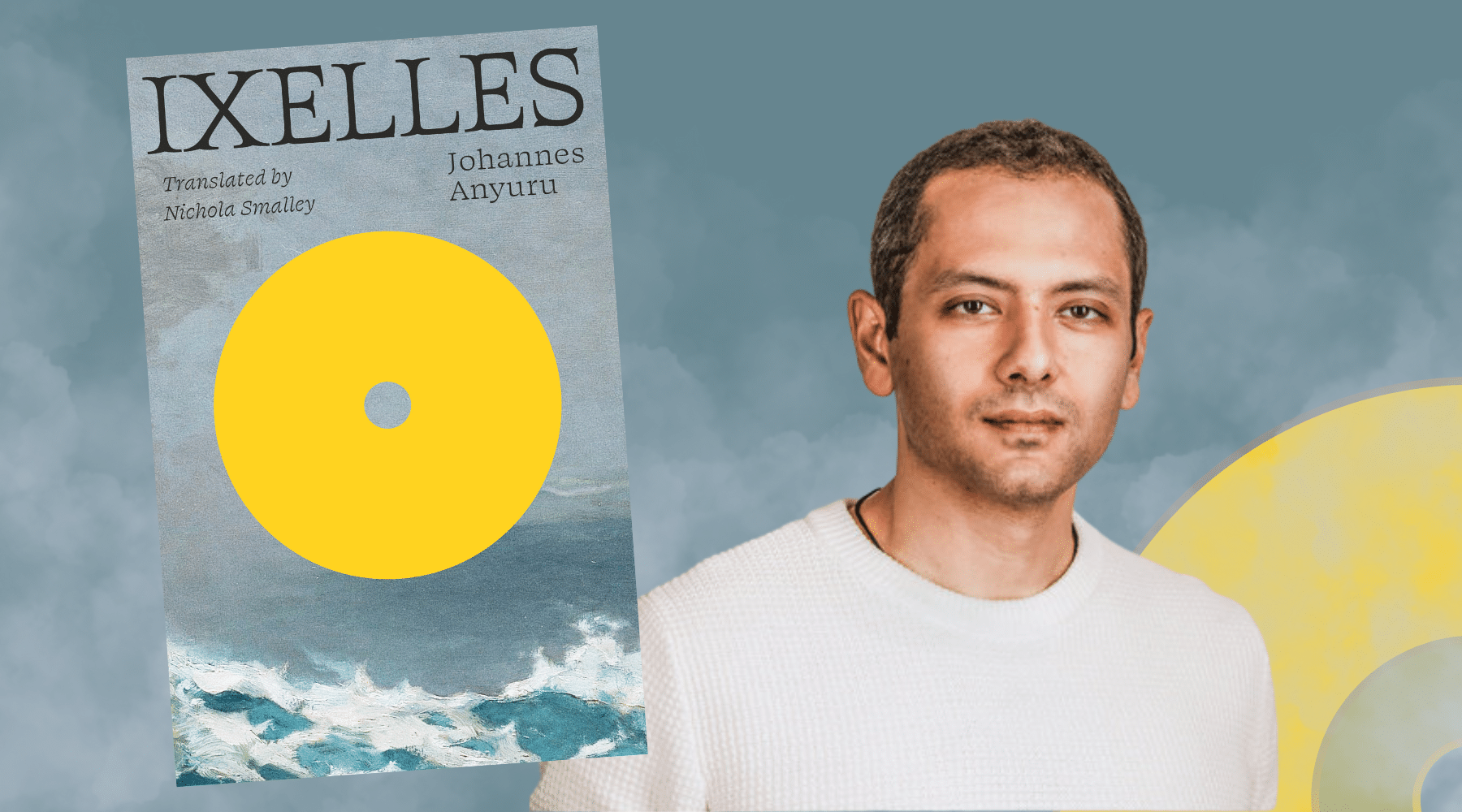
Read Omar El Akkad’s introduction to IXELLES, the latest publication from Two Lines Press.
On the eastern banks of the Willamette River in Portland, Oregon, about 20 minutes north of where I live, there’s a highway that cuts through what used to be one of this state’s most vibrant Black neighborhoods.
Around the middle of the twentieth century, thanks in part to an abundance of well-paying shipyard jobs, a Black middle class began to thrive in Portland, and many who worked on the docks settled into the Albina neighborhood. But beginning in the 1950s, the Oregon Department of Transportation chose to pass the state’s biggest highway through Albina, severing it from the river, severing it from itself. In the decades that followed, Albina’s population plummeted. A community of people who in Oregon’s founding charter were expressly prohibited from living in the state had managed to create something of a root system—and in the span of a few years, they watched the state pull it right out of the ground. Even today, all these years later, the ghosts of what Albina used to be hang over what it has become. Perhaps Faulkner was right about how the past is never past, but in places where this kind of damage is done, neither is the present fully present. Instead, there is strange uncertainty that takes hold, like the soft, raw skin that forms after the wound but before the scar. A middle place.
It is likely a function of my upbringing—having been made to leave the country of my birth at the age of five—that I’ve always gravitated to writers whose work interrogates the unsettled middle place of belonging. And while it’s never wise to wield superlatives, I’m not sure there’s a writer alive today who has done so in more original, more quietly subversive ways than Johannes Anyuru. I consider his 2017 novel, They Will Drown in their Mothers’ Tears, to be one of the finest of the century so far. And in almost every way, Ixelles represents an even more incisive achievement.
Anyuru has a talent for showing the seams in society’s sewing. Often, Ixelles reads like faint transmissions from uneasy, adjacent universes.
Ixelles is a ghost story. We are introduced to Ruth, who in a past life was a resident of Twenty-Seventy. It’s the sort of neighborhood on which it has always been possible for the more prosperous parts of town to safely project all their fiercest notions of economic and cultural otherness: It is unsafe there; the people unpredictable, unacclimated to prevailing norms; it would be better to turn it into something else, something more, well, refined.
In her present life, Ruth facilitates such transformations. She is a professional fabulist. Her job is to create people out of thin air—people whose opinions happen to support the positions of her firm’s clients. One of those clients wants to demolish Twenty-Seventy. The job of making this politically palatable takes Ruth back to the world against which her new life and high-paying job were supposed to provide insulation.
In Twenty-Seventy, Ruth is confronted with the possibility that her old boyfriend Mio—the father of her child and a man she believes was violently murdered—might still be alive. Mio is a martyr to the people of the neighborhood, a Robin Hood who once handed out PlayStations to the kids. He surfaces like a flickering specter, in snippets of conversation and recorded audio, in stories fully believed and impossible to verify. He hovers over Ruth, infects the middle place between a past she can never fully shed and a present that will always be ill fitting.
Anyuru has a talent for showing the seams in society’s sewing. Often, Ixelles reads like faint transmissions from uneasy, adjacent universes. There is something of Borges that runs through the novel—a child’s compendium of monsters from a role-playing game; past lives that refuse to die; the gravity of a library, that desperate wanting to be consumed by a story, by many stories at once; belonging as a matter of narrative ownership. It occurs to me that, just as so many of Borges’ characters might be said to share his fear of dying in a language they can’t understand, Anyuru’s characters often navigate the world as though gripped by a fear of dying in a culture that doesn’t understand them.
For years now, I have taught Anyuru’s work in my class on style and structure in contemporary fiction. Sometimes I’ll ask students to read the first few pages of They Will Drown in their Mothers’ Tears and tell me how the novel begins. Is it with a fleeting image of girls swinging in a playground? Or the section told from the perspective of a woman whose very name might be a lie? Or, earlier still, with the Muslim invocation that sits on its own page before any of the story is told? (I must admit that, knowing nothing about Anyuru at the time and having only a brief, oversimplified synopsis of the story to go on before picking up the novel, I couldn’t discount the possibility that the invocation was not a statement of faith, but cheap scenery, no different than the ubiquitous call to prayer or vaguely oriental music that accompanies the beginning of so many Western movies set in the Muslim world.) Inevitably, my students and I end up talking not only about the uncertainty of disputed belonging, but also the consequences.
If the default mode of modern Western identity can be described as feudalistic—one class that owns the parcels, has always owned the parcels, and another that toils for a pittance—then it’s tempting to describe Anyuru’s writing as an indictment of this mode. But that’s not quite accurate, and certainly not sufficient. Ixelles is less an indictment than an extrapolation—of repercussions, both moral and social, of bounds and boundaries. If one is told, time and again, that they will always inhabit a near-fantastical space in which they are only as American, as Swedish, as Anything as some unreachable class deems them to be, then is the entire geography not equally fantastical? When she invents fictional Muslims to bolster whatever position or scheme her clients support, is Ruth engaged in anything more or less fraudulent than her society at large?
“How does a lie begin?” Ruth wonders.
With a game two girls come up with so they can be someone else for a night, when they go down Meltmarkt, pretending to have French accents, pretending to have money. The lie begins with a boy who dies in an underpass, or when that boy’s son is old enough to ask about his dad, and his mother works for the agency and lies on a daily basis. The lie begins with nothing.
Anyuru’s ghost story haunts this nothing. In so asymmetrically ordered a world, it is the only parcel of belonging that might be called even ground.
OMAR EL AKKAD is an author and journalist. He was born in Egypt, grew up in Qatar, moved to Canada as a teenager and now lives in the United States. He is a two-time winner of both the Pacific Northwest Booksellers’ Award and the Oregon Book Award. His books have been translated into 13 languages. His debut novel, American War, was named by the BBC as one of 100 novels that shaped our world.