World Map
They made the announcement at a quarter after three: Grandfather was dead.
世界图景
三点一刻,他们宣布了祖父的死亡。此时,克鲁克依鸟在疯狂鸣叫,他们说每个地图测量员死后都会变成这种鸟。现在是三月上旬,捉摸不透的春风有时狂躁,大多时候是悲悯的,虽然最糟糕时风也把一整棵树连根吹起。
世界图景
三点一刻,他们宣布了祖父的死亡。此时,克鲁克依鸟在疯狂鸣叫,他们说每个地图测量员死后都会变成这种鸟。现在是三月上旬,捉摸不透的春风有时狂躁,大多时候是悲悯的,虽然最糟糕时风也把一整棵树连根吹起。
祖父曾教会我如何辨认这种鸟的声音。他让我不要理会它们说的话和唱的歌,也不要试图去理解它们词语里的意思,只需要注意它们的沉默——克鲁克依鸟沉默的时候,就是危险来临的时候。我的父母就是因为没有分辨出这种沉默,而永远消失在了白色的海里。那是我第一次知道,危险是致命的,我们可能会随时消失在地图的任意一个坐标点上。祖父还教会了我如何辨认海的颜色。他在地图上给海填上蓝色、红色、黑色和白色,虽然我那时只看得到灰色的大海,海的咸味还蛰得我眼睛发酸。祖父说,我们其实并不知道大海是什么颜色的,就像所有无边无际的东西一样;大海的颜色来自于海下面藏着的不同颜色的镜子,地图测量员游到海底是为了寻找镜子的颜色,比如我的父母。
在世代流传的故事里,白色的大海是最危险的。据说第一个测量员找到的镜子就是白色的。在那之前,人们以为海下面住着迷人的女妖和精力旺盛的人鱼,它们的歌声造出五光十色的幻影,造出狂风骤雨和彩虹下的世界尽头。那个测量员再也没能回来,他的身体被埋葬在最深的海底,骨头和镜子一样白。一只克鲁克依鸟衔回了测量员的小指头骨,大家马上就焚烧了那根骨头。在我们看来,人人最终都要化作灰尘,变得无限小,又无穷大。这自然是很久之前的事了,就连祖父的曾祖父当时也只是一颗微尘。
World Map
They made the announcement at a quarter after three: Grandfather was dead. The kehloogqey birds were shrieking madly. They said all surveyors turned into birds like these when they died. It was early March, and from time to time, unfathomable spring winds stirred. More often than not, the wind just wailed pitifully, but at the worst of times it lifted entire trees and carried them away, roots and all.
Grandfather had taught me to recognize the birds’ cries. He had said to ignore the things they said and the songs they sang, and not to read any meaning into their words, focusing only on their silence—it was a sign of danger when the kehloogqey birds went silent. Because they had been unable to recognize this silence, my parents had vanished forever into the white sea. I had learned from this that danger was fatal, and any of us could vanish into any coordinates on the map at any time. Grandfather also taught me to recognize the colors of the ocean. On the map, he shaded the ocean blue, red, black, and white, though back then I could see only the great gray open sea, which smelled so strongly of salt it made my eyes sting. Grandfather said that, like all things beyond the horizon, it was impossible to know the color of the sea; the color came from multicolored mirrors secreted beneath the surface of the water, and surveyors like my parents dove to the seafloor to see which color the mirrors were.
Tales passed down through the generations claimed that the white sea was the most dangerous, and it was said that the first mirror ever found by a surveyor had been white. Before that, the people had imagined that seductive enchantresses and lively mermaids lived beneath the sea, that their songs wove colorful illusions of light and stirred apocalyptic winds and rain at the ends of rainbows. The first surveyor had never returned. His bones, which were as white as the mirror, rested on the bed of the sea. A kehloogqey bird had retrieved the surveyor’s skeletal pinkie finger, which the people had promptly burned. The way we saw it, everyone eventually turned to dust, becoming infinitely large, and at the same time too tiny to detect. Needless to say, this happened long ago, back when Grandfather’s great-grandfather was just a speck of dust.
(You can ignore this story if you wish. After all, this story itself is like the names that appear in it—it may well have never even existed.)
We built our houses from many different kinds of plant fibers—this explains the mystery of how we could live anywhere we wanted in the world. I was born in a house shaped like a clamshell woven from Manila hemp, a glistening pale-yellow fiber that sheltered us from the rain in the rainy season and the scorching sunlight in summer. And the oldest surveyor among us lived in a vast transparent house built in the expansive interior of an empty fish maw. Looking into the fish maw from the outside, you could just make out the outlines of the Elder, half-real, half-unreal, extending endlessly into the distance like the undulating arteries of the northern hills. The Elder would live out an empty, endless existence, waiting like a frail shadow to be overtaken by disease, old age, and finally death. Each day, in the early morning, the Elder’s abstract silhouette waved to everyone from within the transparent fish maw. The Elder, who had only half a breath of life left, was the immortal totem of the surveyors. According to our legends, the Elder’s house could not be left empty, or else the fish maw would swallow everything and the world would stop turning. When one Elder died, the next Elder entered the house—it was an eternal cycle of degeneration and regeneration as old as that fish maw of unknown origin, so the people had long since forgotten to calculate the Elders’ ages.
The current Elder wore a skullcap which the people imagined must be the most mysterious shade of black, the same shade our ancestors had used to mark the eastern forest on the map. A lost traveler (there were few of these) would no doubt have taken the distorted image of the skullcap-clad Elder that appeared each morning in the fish maw to be Jewish, but we would never make such an ignorant mistake. On our surveying trips, we had encountered mermaids, harpies, gnomes, elves, giants, and spirits of the ether that had no names, but because the shapes and appearances of these creatures were constantly changing, we could never know for sure what we had seen. The world was bigger and more fantastical than anyone had imagined, and the first rule of surveying was to simply record things, not identify them. Fortunately, fewer and fewer lost travelers found their way to us these days. Even when, through miracle or coincidence, they did emerge from the mists, on their way back home, they would convince themselves they had been dreaming.
From the moment we were born, we were destined to search endlessly, but no one had ever told us what the full map of the world was like. Although our limited ability to search and the limitlessness of the world made for the most ridiculous paradox, a surveyor had to have unshakable faith in surveying. In some sense, we grew and developed at an excruciatingly slow pace. At first, my calves and shinbones were racked by severe cramps, a sure sign that a surveyor had matured. For some, it happened at around fifteen; for others, it took only until the age of ten. When the pain had passed, some went through growth spurts, while others went silent overnight, never to speak a word again. I got these cramps at the same time I got my first period: as a rivulet of crimson blood trickled from my inner thigh to my calf, I reflected that this stickiness would cling to me forever, and it felt more terrifying than ever to grow up. That evening, Mom wiped my body down with a clean cotton cloth, and the next day, Dad and I took a boat far out into the open sea.
I have never had another period since that day. For a surveyor, this is nothing unusual. Grandfather said this was a sign of my maturity, and it was important to accept every kind of message without question. When they laid Grandfather in the ground, the kehloogqey birds went silent for just one second, and the shining dust devils that swirled in the sky suddenly vanished. The people said that I had gone out of my mind with grief, that I was hallucinating, because at that very moment the kehloogqey birds were shrieking insistently. The others arranged Grandfather’s head to face eastward, then lit the torch. His body burned for seven days and seven nights, until only ashes remained. The morning after the ashes went cold, an enormous shadow concealed the sun, and a squat but nimble surveyor was invited into the Elder’s fish maw. He returned with word from the Elder: I was to set out for the eastern forest.
I walked a long, long way in the direction Grandfather’s head was pointing, toward the source of the sun. I passed through snowy and sunbaked lands, the brightest places and the darkest, and just when I imagined I was in the middle of a dream Grandfather had yet to finish, an imposing forest emerged suddenly before me. The forest seemed to roil up instantly from the depths of the Earth. The trees grew dense, their branches enmeshed in enigmatic patterns, yet at the same time each tree clutched unhesitatingly at the sky with devilish, steely claws. I weaved between the gaps in the trees, an ineffable warmth surging ceaselessly toward me. It was then that I glimpsed a startling spectacle: the forest was burning and at the same time frozen solid; it refracted the dazzling sunlight and at the same time sucked in the darkness of night. I walked faster and faster, not yet aware that my effort was in vain. As I walked, countless invisible shadows swirled up from my footprints. The shadows sobbed and laughed, telling tales of people losing their way in the woods. As I made my way deeper into the forest, more and more of the irksome shadows arose. Bit by bit, the shadows intertwined with one another until they were as tangled as the forest. I had imagined there would be no way to get lost if I just kept walking east, but now, before anything else, I had to determine which of the shadows were upside-down.
I had to stop. I couldn’t keep walking deeper into the woods, or the upside-down shadows would never stop growing.
As I came to a halt, sticky menstrual blood started streaming down my thigh, and the subtle ache in my shinbones revived, like a nagging intimation of the truth of these woods. I had to wonder whether the shadows were playing a game with me. For so long now, they had been subjugating the real world with their tricks, going by many names, taking many shapes: fear, delusion, anticipation, suffering, joy, anger, duplicity, arrogance…these were the nightmares of the surveyors, and the real world’s enemies.
Like the Elders, I had to use silence to dispel the shadows’ treachery. I thought of the silence of the kehloogqey birds when Grandfather was buried. There was an enormous flash of piercing light, and the trees around me suddenly withered. Their searching branches drooped low and burrowed deeply into the ground. The pain in my shins flared dramatically, and the sticky blood and the tangle of shadows vanished. The eastern forest was just as it had been before—stripped of concealing shadows, it lay bare, naked as a baby. With this, the visions winked out of existence. There was no warmth, there were no seasons, there was no light, and there was no darkness. The forest was made up only of unadorned tree trunks. There was no wind, and there were no voices. There was no sign of life at all, but mysteriously, out of this sterility, a vital, eternal image arose. Our ancestors had marked this location, in a curious shade of black, as the highest point in the world.
As surveyors, we can never remember what our faces look like. We only glimpse ourselves at the moment of death. We are only recorders—for instance, we know we have matured when our shinbones start to ache. It is said to be thanks to this that, no matter where we are in the world, we can always remember the way home.
Unless I search for the way home, I will be consumed by the present moment and vanish into the coordinates of the map. Soon after, my kehloogqey bird will cross the entire east in search of me, fetching my bones and my soul and carrying them away. They will light the torch once more, and I will burn, just like Grandfather and Mom and Dad did. The black forest, the white sea, the golden hills—all of creation is unified through the crisscrossing coordinates of the diagram of the world we have drawn. For generations we have struggled against the shadows, never stopping to question whether this work of surveying may be no more than an absurd lie. Through lies, we cross paths with countless different versions of ourselves, each one a set of coordinates on a world map.
At last, at a quarter after three, I got a clear look at the kehloogqey birds. All their faces were the same.
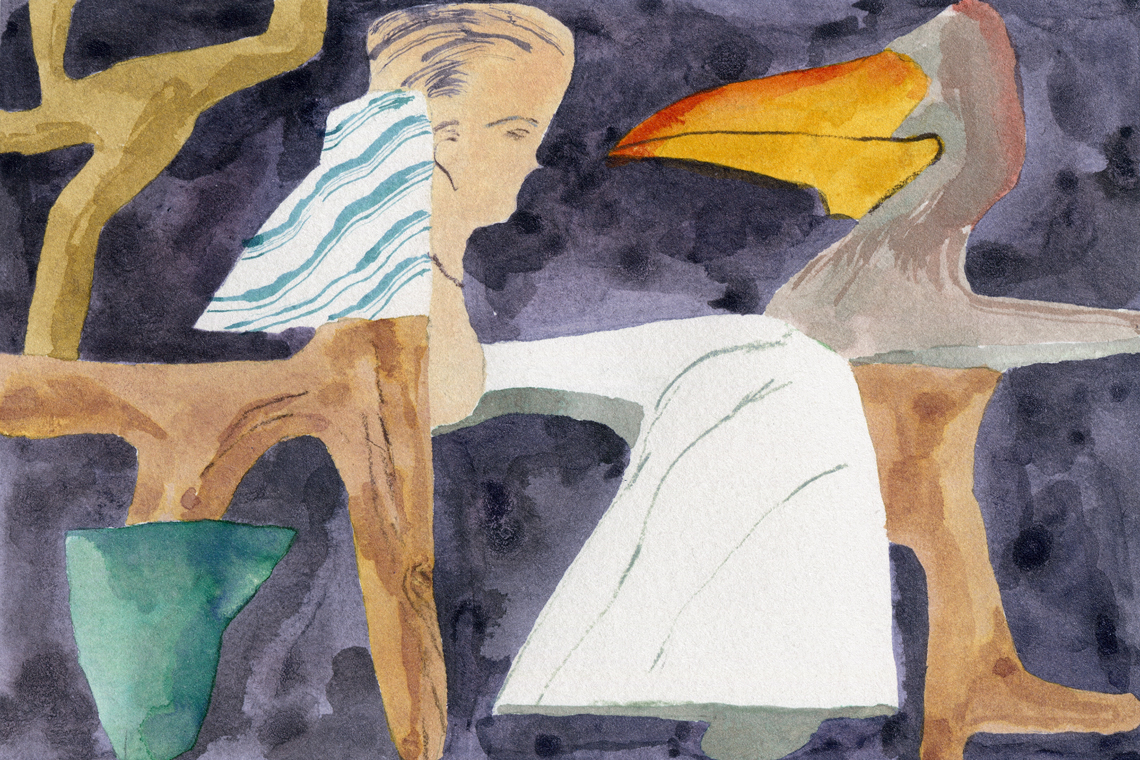
Image by Yusuke Nagaoka.
Yang Hao was born in 1987 and studied script writing and art history at Beijing Film Academy and the University of St Andrews. She has published an essay collection, Into Renaissance, and two novels, Novel Noir and Diablo’s Boys (the English version of Diablo’s Boys, translated by Nicky Harman and Michael Day, is pending publication from Balestier Press). Her debut novel Novel Noir was shortlisted for the Blancpain-Imaginist Literary Award in 2019. She currently lives in Dublin.
Michael Day is a traveler, writer, and translator who lives in Los Angeles and Mexico City. His work has appeared in Los Angeles Review of Books: China Channel, Georgia Review, Words Without Borders, Pathlight, and Massachusetts Review. His awards include the 2015 Bai Meigui Translation Prize (joint winner with Natascha Bruce) and the 2020 Jules Chametzky Translation Prize. His co-translation, with Nicky Harman, of Yang Hao’s Diablo’s Boys is pending publication from Balestier Press.