An Introduction to Hispanic Canadian Literature
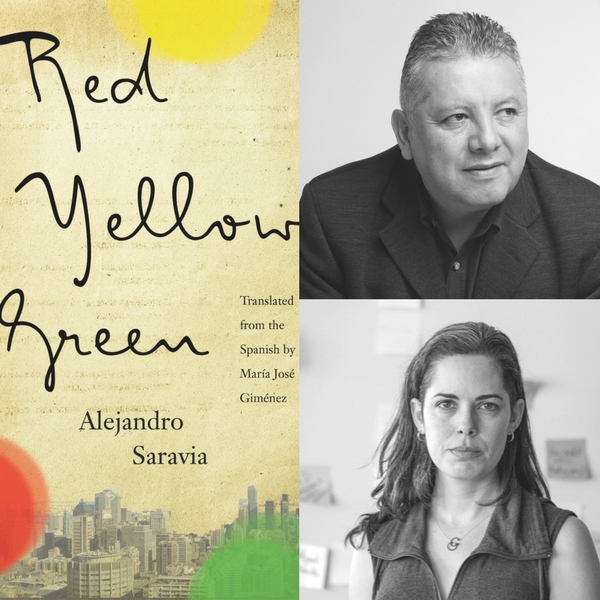
This Thursday we’ll be at San Francisco’s Green Apple Books on the Park to celebrate the publication of Bolivian-Canadian writer Alejandro Saravia’s Red, Yellow, Green(opens in a new tab). The novel—from which we published an excerpt as part of our Online Exclusives—was translated by María José Giménez, a talented translator and poet, as well as a passionate advocate for translated literature and, specifically, Hispanic Canadian literature.
Last year, she guest edited a feature on Hispanic Canadian literature(opens in a new tab) for Words Without Borders. Here’s an excerpt from her introduction(opens in a new tab):
There is a substantial gap in the current discourse on Latino Lit in North America.
First, some context: The landscape of Canadian literature is vast and varied: It comprises works written in the original languages and in the official English and French, Quebec literature, and a small percentage of works published in nonofficial languages and in translation. The country itself is far from being a cultural or linguistic monolith, although it may often be perceived as such from the outside. Canada is an amalgam of various national, regional, cultural, and linguistic identities old and new, and so is its literature, despite unifying aspects such as common themes and the predominance of the official languages. The same could be said about Latin America as a whole. There is a large community of Hispanic Canadians, a heterogeneous group with perhaps as many different voices and identities as its members, and a rich, vibrant, and prolific literary creation…
For some more background, check out this recent interview(opens in a new tab) with María José Giménez on the NEA Arts blog. There, Giménez discusses the importance of reading outside of our own experiences, explains how she first became acquainted with Alejandro Saravia’s work, and offers a glimpse into her translation process. Giménez, who is also a poet, talks about how translation relates to her own creative process:
Anytime I am working with somebody else’s work I feel like I need to retreat to my own voice, to take breaks, and just go back to myself. But something else happens in the process of translation that’s a result of that. I will encounter a word that really captures me and it can be a new word or a word that I already know. I feel compelled to investigate further and how I write poetry is basically an investigation of the world. I am trying to understand my world and the world around me. Looking into words very deeply, doing etymological research about a word that I encountered that just pulls me for no reason at all or any reasons that I can explain almost always leads to a new poem.
Join us Thursday for more conversations about Hispanic Canadian literature, Alejandro Saravia’s novel Red, Yellow, Green, and the translation process. We’ll be joined by both the author and translator!