Exfancy | The Bend | Can We Escape Old Age with Our Lives?
I return to the scene of the crime / to rescue the one who stayed there…
Exfanzia
A mia sorella
I numeri ci aiutano: 64.
Era l’autobus che passava sotto casa,
Exfanzia
A mia sorella
I numeri ci aiutano: 64.
Era l’autobus che passava sotto casa,
la casa degli amori/degli orrori.
L’autobus che portava alla stazione,
da dove sono scappato
per salvarmi/credendo di salvarmi.
Ma adesso, che di anni ne ho 64,
senza volerlo/volendolo con tutte le mie forze
sono tornato sul luogo del delitto
a trarre in salvo chi è rimasto là
per tutto questo tempo
prigioniero/ostaggio.
Come ho potuto lasciarlo così a lungo
nelle mani del nemico?
Come potrò sostenere
il suo/il mio sguardo?
La Curva
Nella curva, la stessa, in montagna,
scendendo dalla macchina,
mia figlia, piccolina,
vomitava, per strada, tutti gli anni.
Ormai la conoscevo:
come al nostro santuario, ci fermavamo
per consolarne i pianti, pulirla e passeggiare
lungo il tornante dell’alba.
Altre vacanze, noi vecchi, lei cresciuta,
ma quella sosta mi rimane in mente,
cruna della nostra famiglia
nella fuga in Egitto.
Ogni famiglia è in fuga,
solo l’Egitto cambia.
È possibile uscire vivi dalla vecchiaia?
Non c’è nulla di più poetico del dialogo con i morti.
—Giovanni Pascoli
Sì, ma se i morti parlano tra di loro, ignorandoti?
È possibile uscire vivi dalla vecchiaia?
Poi mi guardo allo specchio
e vedo papà e mamma
che abitano il mio volto
disputandoselo.
Allora non ve ne siete ancora andati!,
penso, vedendo che fanno capolino
sulla mia faccia, giocando
tra le linee del viso.
A nascondino, quindi…
E forse si divertono
cercandosi tra loro,
io solo, escluso, a fare da teatro
per questi amanti morti che mi usano
come lo spazio, morto, del loro corteggiarsi.
Servo a qualcosa, almeno,
se i miei amati fantasmi
si dànno appuntamento
tra i miei occhi,
naso, fronte, mascella,
per tornare ad amarsi.
Exfancy
To my sister
Numbers help: 64.
That was the bus that passed by my house,
house of loves/horrors.
The bus that stopped at the station
where I made my escape
to save myself/believing I could save myself.
But now that I am 64,
against my will/with all my will
I return to the scene of the crime
to rescue the one who stayed there
all these years,
its prisoner/hostage.
How could I have left him for so long
in enemy hands?
How will I hold
his/my gaze?
The Bend
Every year at the same bend
in the mountains, my little girl
would climb out of the car
and vomit on the road.
I got to know it well:
as if at our sanctuary, we’d stop there
to comfort her, wipe her face, and walk it off
at the sharp turn of sunrise.
Other trips, us old, her grown up,
but that stop is stuck in my head,
eye of the needle
on our family’s flight into Egypt.
Every family is in flight,
only Egypt changes.
Can We Escape Old Age with Our Lives?
There’s nothing more poetic than talking to the dead.
—Giovanni Pascoli
But what if the dead are talking to each other and ignoring you?
Can we escape old age with our lives?
I look in the mirror
and see Mother and Father
inhabiting my face,
competing for it.
You’re still here!
I think, and find them
peering out from my face,
playing in its lines.
Hide-and-seek, I suppose…
Maybe they enjoy
looking for one another
and leaving me out: a theater
occupied by dead lovers,
dead space for their courtship.
At least I serve a purpose
if the ghosts I love
make plans to meet
in my eyes,
nose, forehead, jaw,
and go back to loving one another.
“Exfanzia” and “È possibile uscire vivi dalla vecchiaia?” from Exfanzia. Turin: Giulio Einaudi editore, 2022. “La curva” from Il sangue amaro. Turin: Giulio Einaudi editore, 2014.
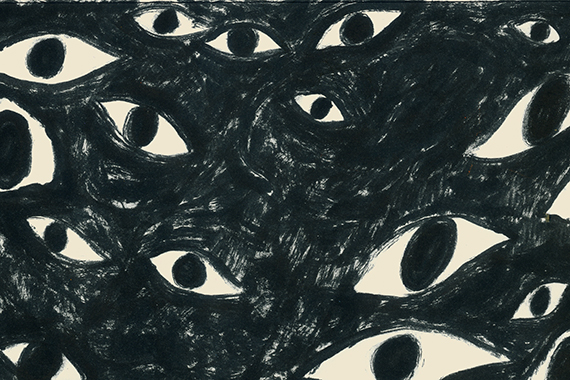
Image by Thomas Colligan.
Valerio Magrelli was born in Rome in 1957. He is the author of several collections of poetry and innovative works of prose. Translations of his work into English include Vanishing Points (FSG, 2010) and In the Condominium of the Flesh (Parlor Press, 2015). He is the recipient of the Mondello, the Viareggio, the Montale, the Premio Antonio Feltrinelli-Accademia dei Lincei, and other major prizes in Italy.
Will Schutt is the award-winning author of Westerly (Yale Younger Poets Prize) and most recently the translator of My Life, I Lapped It Up: Selected Poems of Edoardo Sanguineti (Oberlin College Press) and Fabio Pusterla’s Brief Homage to Pluto and Other Poems (Princeton University Press).