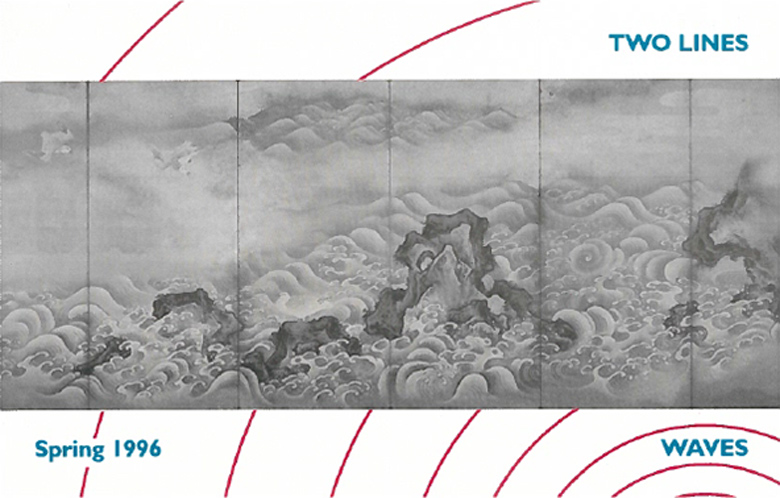
Two Lines 3: Waves
Out of Print
Dirty clothes are not washed at home
when bloodstains are so thorough
they go basin to basin
Waves and quakes. Two Lines itself has endured changes of great magnitude this year as we found independence, for better or worse. Due to budget tightening, our journal is no longer published under the auspices of a university. We decided to make Two Lines autonomous rather than close its pages forever. We are now permanently located atop an old Victorian in San Francisco (speaking of quakes). This change has been and will be a challenge.
Translation is the art that embodies change, movement, and negotiations of distance. Our journal focuses attention on this process and on the practice of translation—vital for a culture’s understanding of the flux of stories, wanderings, and events. Waves are signs of motion. Yet waves are not static traces of a movement that is already in the past, they are the transference of a force, the shape and tendencies of its character, its expression. Which leads us to the origin of the word. The noun wave comes from the Old English verb wafian, to sway to and fro, which first referred to a waving hand. A motion that communicates. — OLIVIA E. SEARS